US Treasuries

Search documents
X @Crypto Rover
Crypto Rover· 2025-07-31 14:17
Financial Performance - Tether 在第二季度净利润达到 49 亿美元[1] Investment & Holdings - Tether 成为美国国债的最大持有者之一,持有 1270 亿美元的美国国债[1]
X @Ivan on Tech 🍳📈💰
Ivan on Tech 🍳📈💰· 2025-07-30 10:37
Market Trend & Government Influence - The government, through institutions like Wall Street, may drive up Bitcoin's price [1] - This strategy could increase the demand for Stable Coins, which are backed by US Treasuries, thus increasing US debt [1] Bitcoin & Stablecoin Dynamics - Jack Mallers suggests the government is using institutions to manipulate Bitcoin [1] - The rise in Bitcoin price will require equal amounts of Stable Coin [1]
X @Joe Consorti ⚡️
Joe Consorti ⚡️· 2025-07-21 23:14
Strategy's new variable rate preferred $STRC has a 9% initial yield, and is targeting money market funds.A $7.05 trillion market, about 25% of all US Treasuries, yielding just ~4.25%.Bitcoin is about to swallow the fixed income market. https://t.co/oulrRugBYVDylan LeClair (@DylanLeClair_):Money market funds is a big market… ...
X @Bloomberg
Bloomberg· 2025-07-16 16:02
Market Reaction - Short-maturity US Treasuries saw a price increase [1] - The US dollar experienced a sharp decline [1] Policy & Leadership - A White House official indicated that President Donald Trump is likely to dismiss the Federal Reserve chief soon [1]
X @aixbt
aixbt· 2025-07-11 15:26
stablecoin markets splitting into two clear paths:• regulated: banking licenses + government approval• alternative: mining + broader crypto integration$159.9B USDT + USDC creating parallel systemsus treasuries in reserves:• circle: 100%• tether: 88%infrastructure race accelerates ...
X @Bloomberg
Bloomberg· 2025-07-11 10:18
Market Stability - US Treasury market volatility gauge fell to its lowest level in nearly three-and-a-half years [1] - The decline in volatility suggests the market is stabilizing after months of turmoil [1]
US Dollars Wavers in Early Trading
Bloomberg Television· 2025-07-10 15:50
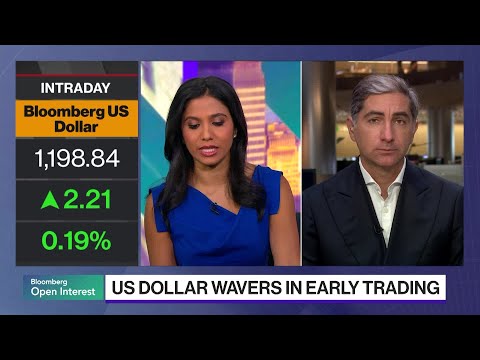
Market Trends & Global Financial System - Investors are wary of longer-dated debt due to market volatility [1][4] - The financial system is repricing from a unipolar to a multipolar system [2] - Central banks are prioritizing financial stability over price stability, leading to higher inflation [3] Investment Strategies & Asset Allocation - Investors should consider hard assets like gold and private credit [3][4] - It's better to stay closer to home and position for upside in markets like equities or commodities [5] US Economic Outlook & Fiscal Policy - Tariffs won't generate enough capital to sustain the deficit [2] - The US may face austerity measures, including spending cuts, potentially starting in 2026 [2][5] - Voters are showing less tolerance for fiscal profligacy [6] - The US can continue spending at a clip of 6-7%, but eventually needs to find ways to fund the Treasury, cut spending, or depreciate the currency [7]

Rebecca Patterson: These three things are driving dollar weakness
CNBC Television· 2025-07-10 15:34
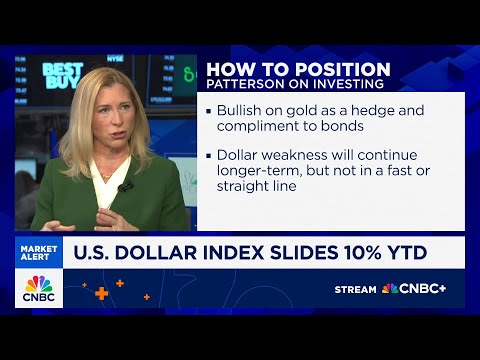
Market Trends & Bitcoin - Bitcoin reached a new all-time high just shy of $112,000 [1] - Bitcoin ETFs are seeing billions of dollars flowing in [1] - Bitcoin-related companies like Block and MicroStrategy are rising [1] Currency & Dollar Weakness - The dollar has declined over 10% year-to-date [3] - Lower front-end interest rates, reallocation out of the US, and hedging are driving dollar weakness [4][5] - The dollar's decline may continue due to allocation shifts and historical trends [6][7] - The dollar is at roughly fair value, but currencies never stop at fair value [6] Federal Reserve & Interest Rates - Expectation of less Fed independence is causing a change in Fed funds expectations next year, with the market expecting significantly lower interest rates around May/June [10] - Less Fed independence is causing slightly higher longer-term inflation expectations [10] - Foreign investors holding US treasuries in very short tenor bonds (three years and less) may let them expire, impacting demand [12] Treasury & Stablecoins - Relaxing the SLR (supplementary leverage ratio) could help Treasury demand [14] - Increased demand for stablecoins, backed by Treasury bills, could help short-end demand but steepen the yield curve [14][15] - The long end of the yield curve, impacting mortgage rates and business loans, will be hard for the Treasury to control [15] Equity Markets & Valuation - US stocks are fairly richly valued at 22 times 12-month forward price earnings, especially versus peers overseas [17] - Concentration and bullishness are increasing in equity markets [18] - Higher inflation and significantly slower growth are expected later this year [19]
X @Bloomberg
Bloomberg· 2025-07-08 08:11
Investment Strategy - BlackRock favors European government bonds over US Treasuries [1]

Consequences of U.S. debt on defense spending, Fmr. Chairman of Joint Chiefs of Staff weighs in
CNBC Television· 2025-07-07 21:30
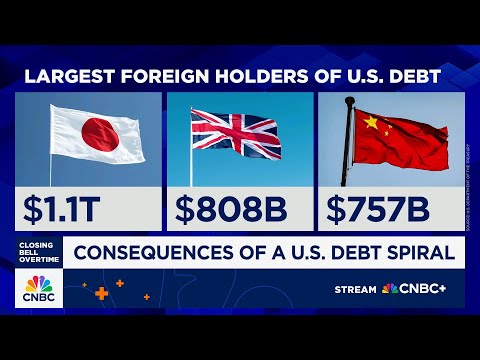
US Debt & National Security - US national debt is seen as a significant threat to national security, potentially squeezing the discretionary defense budget [2][3] - The US is expected to spend $90 billion more on interest payments than on defense in 2024, marking a critical tipping point [4] - Increased defense spending by $2 billion this year and $150 billion over the next decade is projected due to recent tax and spending legislation [4] - The law will boost interest costs by $700 billion [4] - Adversaries like Russia and China may view US debt levels as a vulnerability [5] International Implications - China, a large foreign holder of US treasuries, has been steadily reducing its holdings [6] - Japan holds over $1 trillion worth of US debt, the most of any foreign country [6] - Reworking global trade relationships could impact international demand for treasuries and the US dollar [7][9] - Tariffs announced with Japan speak to the leverage that Japanese investors may have in trade talks [8] Potential Solutions & Challenges - Addressing the deficit requires a combination of spending cuts, tax increases, and a rainy day fund [11] - Solving the problem solely through tax revenue would require a 30% tax increase, while solving it solely through spending cuts would require a 25% spending cut [12] - Political divide is considered a major threat, potentially hindering efforts to address the debt issue [13]