
Interest Rates

Search documents
It's going to be an uphill battle to convince the fed to cut rates: Apollo Global’s Torsten Slok
CNBC Television· 2025-12-19 16:31
Let's continue the conversation right here with Toron Slack. He's chief economist at Apollo Global Management. Um, you have a favorite in that Fed race, by the way.Well, so I don't have a personal favorite, but I think it's clear that the market is trying to chew hard on which of these candidates will have implications for what's happening, especially of course in rates. What the conclusion of course here is that it all becomes about can the new fetcher persuade the other FOMC members about whatever his vie ...

Watch CNBC's full interview with New York Fed President John Williams
CNBC Television· 2025-12-19 14:38
>> WHY DON'T WE GET OVER TO STEVE LIESMAN. HE'S GOT A VERY SPECIAL GUEST THIS MORNING. A SPECIAL INTERVIEW WITH NEW YORK FED PRESIDENT JOHN WILLIAMS.STEVE. >> ANDREW. THANK YOU.YES, I AM HERE AT THE NEW YORK FED WHERE I'VE BEEN. WE DON'T KNOW HOW MANY YEARS IN A ROW NOW, BUT SEVERAL WITH PRESIDENT JOHN WILLIAMS FOR A TRADITIONAL DECEMBER HOLIDAY INTERVIEW. WELL, WELCOME BACK, STEVE.THANKS. AND JOHN, I WAS JUST REMARKING ABOUT HOW GREAT OUR TEAMS ARE WHO SCHEDULED THIS MONTHS IN ADVANCE, KNEW THERE WOULD BE ...
NY Fed Pres. John Williams: Some 'technical factors' distorted November's CPI reading downward
CNBC Television· 2025-12-19 14:21
Inflation Analysis - CPI data shows encouraging signs of disinflation, but some technical factors related to data collection issues in October and early November may have distorted the headline CPI reading, potentially pushing it down by approximately 01% [3][4][5] - The distortion is attributed to data collection occurring primarily in the second half of November when sales are prevalent, and issues with rent data [6] - The industry awaits further data in the next month or two to better assess the impact of these technical factors on inflation readings [7][8] Labor Market Assessment - Employment reports indicate steady job gains, particularly in the private sector, and moderate growth [9] - Technical factors related to data collection in October may have temporarily boosted the unemployment rate in November, potentially by around 01%, suggesting an adjusted unemployment rate of approximately 45% [10] - The labor market is experiencing a gradual cooling, with no signs of a sharp deterioration [11] Monetary Policy Stance - The Federal Reserve's monetary policy is currently well-positioned to gather more information and assess the economic outlook and risks to achieving employment and price stability goals [14] - Current data is broadly consistent with patterns observed, supporting the decision to cut interest rates at the last meeting, but is not yet a "game changer" [13] - The Federal Reserve is aiming to stabilize the labor market and bring inflation down to 2% without causing undue harm to the labor market, indicating a balancing act [16] Neutral Rate Discussion - The real interest rate, adjusted for inflation, is estimated to be around 1% to 125%, which is within the range of neutral rate estimates [19] - The speaker's personal view is that the neutral rate is likely a bit below 1%, suggesting that monetary policy is still mildly restrictive [20]
5 Things To Know: December 19, 2025
CNBC Television· 2025-12-19 12:30
Five things to know ahead of the opening bell this morning. Japan's central bank raising its short-term interest rates to a three decade high of 75% that helped lift the country's 10-year Treasury yield past 2%. And the Bank of Japan also signaling readiness to tighten further.Meanwhile, data center deals hitting a record $61 billion in 2025. That's according to the S&P Global. European Union leaders agreeing to loan Ukraine more than hundred billion dollars to help the country defend itself from Russia for ...
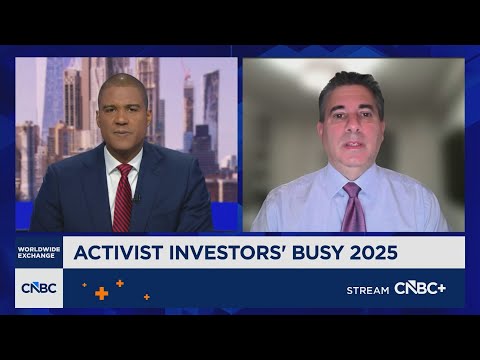
Squire: Activism should be even busier in 2026 as investors rotate back to value
CNBC Television· 2025-12-19 12:14
All right. So, give us a sense. Uh, we have the the data through Q3.What are we seeing in Q4 and what's the outlook for 2026. Are you expecting it to be another busy year for activist investors. >> Yeah, we do.Well, well, it's been it's been busy. Um, we expect there to be even busy in 2026. uh as as investors stop pouring money into Max 7 stocks like they have been which has been slowing down and they start looking for value and and frankly value stocks um we we we see activism a lot of good activist oppor ...
Wall Street Has a Federal Reserve Problem That Could Turn Ugly for Stocks in 2026
Yahoo Finance· 2025-12-19 11:05
Core Viewpoint - The potential appointment of a new Federal Reserve Chair by President Trump could significantly impact the stock market, especially if the new Chair is influenced by political pressures rather than independent economic assessments [3][12][15]. Group 1: Federal Reserve and Interest Rates - Jerome Powell has served as the Federal Reserve Chair since 2018 and has maintained a stance of independence despite political pressures and economic challenges [2][6]. - Powell's term is set to end in May 2026, coinciding with a midterm election year, which historically has seen market volatility due to inflation and interest rate hikes [3][4]. - The S&P 500 Index is currently viewed as expensive, with concerns that the market may face similar conditions to those seen in previous bear markets of 2018 and 2022 [5][7]. Group 2: Political Influence and Market Implications - President Trump has been critical of Powell, particularly regarding interest rate decisions, and has indicated a desire for a new Chair who will align more closely with his economic views [8][12]. - The potential candidates for the new Fed Chair include Kevin Warsh and Kevin Hassett, with concerns that Hassett may lack independence due to his current role in the Administration [12][13]. - Historical precedents show that political pressure on the Federal Reserve can lead to detrimental economic outcomes, particularly during periods of rising inflation [9][10][11]. Group 3: Future Considerations - Investors should closely monitor the actions and statements of the new Fed Chair once appointed, especially in relation to inflation data and interest rate decisions [15]. - If inflation remains above the Fed's target and the new Chair keeps rates low, it could signal future inflationary problems, echoing past economic challenges [15][16].
Stock Market Today: S&P 500, Nasdaq Future Gain Following Cooler-Than-Expected Inflation Print—Oracle, Coty, Nike In Focus - SPDR S&P 500 (ARCA:SPY)
Benzinga· 2025-12-19 10:39
U.S. stock futures rose on Friday after Thursday’s higher close. Futures of major benchmark indices advanced.On Thursday, the November report showed that annual CPI inflation slowed to 2.7% from 3% in September. Because the Bureau of Labor Statistics lacked October survey-based prices, it carried forward September levels, effectively assuming zero inflation for a missing month. Meanwhile, President Donald Trump signed an executive order on Thursday, directing federal agencies to loosen regulations on mariju ...
Stock Market Today: S&P 500, Nasdaq Future Gain Following Cooler-Than-Expected Inflation Print—Oracle, Coty, Nike In Focus
Benzinga· 2025-12-19 10:39
Market Overview - U.S. stock futures rose on Friday following a higher close on Thursday, with major benchmark indices advancing [1] - The November CPI inflation rate decreased to 2.7% from 3% in September, with the Bureau of Labor Statistics carrying forward September levels due to a lack of October data [1] Futures Performance - Dow Jones futures increased by 0.11%, S&P 500 by 0.33%, Nasdaq 100 by 0.48%, and Russell 2000 by 0.32% [3] - The SPDR S&P 500 ETF Trust (SPY) was up 0.012% at $676.55, while Invesco QQQ Trust ETF (QQQ) advanced 0.48% to $612.03 [3] Company Highlights - Oracle Corp. shares jumped 5.65% after ByteDance signed agreements to shift control of TikTok's U.S. operations to a joint venture including Oracle [7] - Coty Inc. shares rose 1.54% as it is set to receive $750 million from the sale of its Wella business to KKR [7] - BlackBerry Ltd. shares declined 5.75% despite reporting third-quarter revenue of $141.8 million, exceeding analyst estimates [7] - Nike Inc. shares fell by 10.06% despite better-than-expected second-quarter results, citing expectations of narrower margins and lower revenue from China [13] - FedEx Corp. shares decreased by 1.04% despite positive financial results and raised guidance for FY2026 [13] Analyst Insights - Scott Wren from Wells Fargo Investment Institute projects a positive trajectory for the U.S. stock market and economy through 2026, driven by an improving economy and moderating inflation [10] - Wren notes the widening spread between 10-year and 2-year Treasury yields, the largest since January 2022, which historically correlates with stronger equity performance [10] Economic Indicators - Upcoming economic data includes speeches from New York Fed President John Williams and releases of existing home sales and consumer sentiment data [11]



Crypto Market Digested Falling Inflation, Rising BOJ Rates
Yahoo Finance· 2025-12-19 08:28
Group 1 - The US Consumer Price Index (CPI) for November showed a year-over-year inflation rate of 2.7%, lower than the expected 3.1%, indicating a cooling inflation trend [1] - Japan's CPI also declined from 3% to 2.9% year-over-year in November, reflecting similar inflation trends [1] - The Bank of Japan raised its interest rates by 25 basis points to 0.75%, marking the highest level in 30 years, which could strengthen the yen and attract capital [2] Group 2 - Despite Japan's rate hike, the cooling inflation in the US and Japan led to inflows into risky assets like cryptocurrencies and stocks, with the S&P 500 gaining 0.79% and the global crypto market cap increasing by 0.7% to $2.93 trillion [3] - Bitcoin rose by 1.2% to nearly $88,000, and Ethereum gained 4% to reach $2,950, indicating positive market reactions to mixed economic signals [4] - The next macro signals to monitor include the US Federal Reserve's communications, movements of the yen, and global liquidity levels [4]
X @Michaël van de Poppe
Michaël van de Poppe· 2025-12-19 08:17
The Bank of Japan has hiked their interest rates.Big news!However, markets knew this beforehand, so the actual impact of this rate hike is:- Firstly, going to have less impact the more those will take places as the marginal impact for the Carry Trade is getting less and less.- Secondly, as everybody knew about it already, the markets have overpriced this to the downside prior to the event expecting a big crash to occur.This is now over, and given the soft read on inflation, it's time to get back to the fair ...