
Drug Pricing

Search documents
Swiss Pharmaceuticals React to Trump's 39% Tariffs
Bloomberg Television· 2025-08-04 13:32
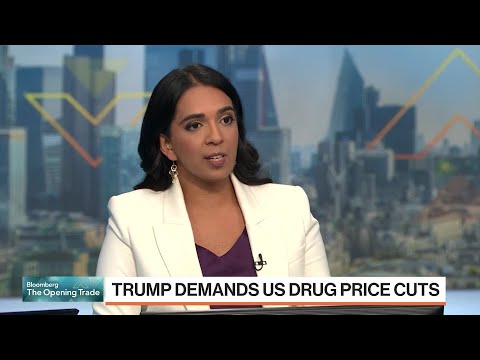
Regulatory & Policy Impacts - Swiss pharmaceuticals face uncertainty due to tariffs sentiment and drug pricing policies [1] - A 39% impact is not immediate, providing a short stay of execution, but manufacturing relocation to the US is anticipated to appease US sentiment [2] - Swiss pharmaceuticals contribute significantly to the trade deficit between Switzerland and the EU, requiring negotiation [2] - The most favored nation drug pricing threat impacts Swiss pharmaceutical companies [3] - Previous attempts at most favored nation drug pricing were stopped by courts due to procedural technicalities [4] - Drug makers are keen to negotiate direct-to-patient drug pricing proposals, potentially benefiting both drugmakers and the US administration [5] Pricing & Market Strategy - The ability to cut drug prices depends on the scope of the cuts, with Medicaid being more manageable than across-the-board cuts [6] - The US administration aims for Europeans to pay more for drugs, seeking to maintain pharmaceutical company profits [7] - Relocating consumer base is a potential strategy, but could negatively impact patients' access to drugs [8] - Pharmaceutical companies may avoid launching drugs in Europe if forced to raise prices unsustainably, limiting patient access to innovative medicines [9]

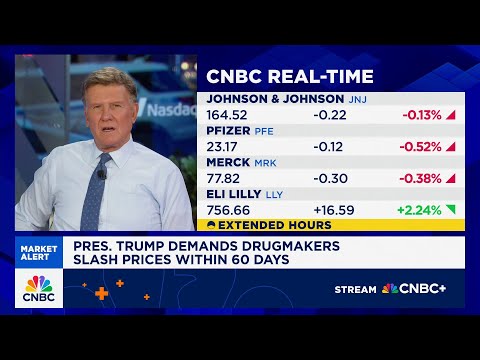
President Trump demands drugmakers slash prices within 60 days
CNBC Television· 2025-08-01 10:54
Government Policy & Regulation - President Trump demanded major drug makers lower prices for Americans within 60 days [1] - President Trump requested drug companies offer their full drug portfolio to Medicaid patients at prices equivalent to those paid abroad, known as the most favored nation rule [1] - Trump urged drug makers to guarantee Medicare, Medicaid, and private insurance patients receive the same lower overseas prices for all newly approved medicines and demanded a direct-to-consumer option for certain drugs [2] - The efforts are expected to face strong opposition from the pharmaceutical industry, and the president's authority to enforce price reductions without Congressional support is uncertain [2] Industry Concerns & Potential Consequences - The implementation of price controls, similar to those in Europe, could stifle pharmaceutical innovation in the US [5] - Concerns exist that price controls may lead to a decline in drug innovation within the country [5] - The fairness argument suggests developed nations should be able to afford drug prices, but the industry should have addressed price control issues earlier [7] Economic Implications - The discussion revolves around importing price controls, raising concerns about the long-term impact on drug development and research [3][5] - The potential unintended consequence of price controls is the reduction of innovation in the pharmaceutical industry [5]
Trump Requests 17 Pharmaceutical Companies to Lower Costs | WSJ
WSJ News· 2025-07-31 20:10
Drug Pricing Discrepancy - Brand-name drug prices in the US are more than three times higher than in other developed nations [1][2] - The administration aims to end this burden on American families [2] Proposed Solutions and Demands - The administration rejects proposals that shift blame and request billions of dollars in handouts to the industry [3] - The administration demands immediate relief from inflated drug prices and an end to the free ride on American innovation [3] - Drug manufacturers are called upon to extend most favored nation pricing to Medicaid [4] - Drug manufacturers are called upon to guarantee most favored nation pricing for newly launched drugs [4] - Drug manufacturers are called upon to return increased revenues abroad to American patients and taxpayers [4] - Drug manufacturers are called upon to provide for direct purchasing at most favored nation pricing [4] Potential Actions - The administration will deploy every tool to protect American families from abusive drug pricing practices if manufacturers refuse to comply [4]

X @GEM HUNTER 💎
GEM HUNTER 💎· 2025-07-31 17:43
RT unusual_whales (@unusual_whales)BREAKING: Trump says he has asked drugmakers to cut US prices of drugs in 60 days, or face consequences. ...
Field: Investors are breathing a sigh of relief at the 15% tariff level
CNBC Television· 2025-07-29 11:19
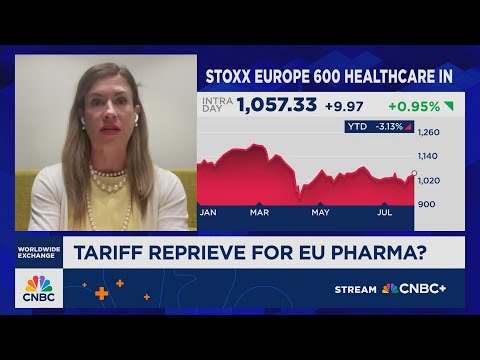
All right, look at some new data uh from RSM. They say about more than 40% of the branded drugs we use here in the US, they come from Europe, about 18% of gener. So really, how big of an impact will these tariffs have not only on pricing but availability.>> Well, I think uh you know what was really causing investors the most concern was that this was completely uncharted territory. We've never seen tariffs in the pharma sector before. Um and um so it was a lot of sort of a guessing game of what the final ra ...
Evercore ISI's Umer Raffat on finding value in the beaten-down health care sector
CNBC Television· 2025-07-28 18:06
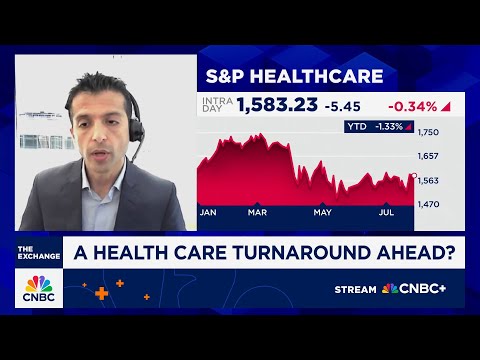
Healthcare Sector Performance & Outlook - Healthcare sector experienced its worst three-year performance in over a decade, with a 25% increase compared to the S&P 500's 57% gain [1] - The healthcare sector's outlook hinges on clarity regarding drug pricing policies, particularly concerning the Most Favored Nation (MFN) [3][9] Drug Pricing & Policy Uncertainty - Uncertainty surrounding the scope of MFN drug pricing policy (Part B vs Part D, commercial spillover) is causing hesitation among generalist investors [2][5][6] - The industry anticipates MFN policy to be limited to Part B (injectable drugs) with potential for improved price points and US-only launches for new drugs, maintaining price integrity [5][8] Innovation & Investment - There is strong innovation within the biotech space, encouraging investment, with broad consensus supporting continued innovation [7] Company Earnings - Managed care companies like Sigma and Humana, along with large-cap pharma including Bristol Myers and Merck, are reporting earnings this week [1]
FDA to Reward Drugmakers That Don't 'Rip Off' the US
Bloomberg Television· 2025-07-11 11:02
We are talking to industry constantly to figure out how we can be helpful. Which of their products being proposed are in line with our national priorities. That is meeting a large unmet public health need.Domesticating manufacturing as a national security issue. Increasing the affordability of drugs, which is an access problem. This president does not like to see Americans getting ripped off.And we've been paying more for drugs than in many wealthy countries around the world. Can you do anything about that. ...
X @Bloomberg
Bloomberg· 2025-07-09 12:58
Spain wants to create a two-tier pricing system for certain drugs that are in high demand after facing supply shortages due to off-label use of the medication https://t.co/4j6aH4R4Dp ...
US Large Cap Pharmaceuticals_ Mid-Year State Of Play
2025-07-07 00:51
Summary of US Large Cap Pharmaceuticals: Mid-Year State Of Play Industry Overview - The report focuses on the US Large Cap Pharmaceuticals sector, analyzing key companies such as ABBV, LLY, JNJ, MRK, BMY, and PFE [6][5][32]. Core Insights and Arguments 1. **Revenue Growth and Stability**: Projected revenues from growth/stable products for 2025-2030 are as follows: ABBV at $10.39 billion, LLY at $3.06 billion, JNJ at $1.68 billion, MRK at $1.37 billion, BMY at $0.60 billion, and PFE at $0.54 billion [5]. 2. **Patent Cliff Exposure**: The number of years to the next major patent cliff varies, with ABBV and MRK at 3.5 years, while LLY and JNJ face longer timelines [5]. 3. **Market Sentiment**: The report indicates a "Launch Trade" momentum, with high investor psychology impacting stock performance, particularly for ABBV and GILD as popular longs, while MRK is viewed as a funding underweight [6]. 4. **Macro Environment**: A friendlier US macro backdrop with diminished recession risks and benign inflation data is noted, which could complicate the case for large-cap biopharma relative to other sectors [6]. 5. **Drug Pricing Uncertainty**: Ongoing debates regarding drug pricing and potential implementation of Most Favored Nation (MFN) pricing are highlighted as significant uncertainties affecting investor sentiment [6]. 6. **Key Catalysts for 2H25**: Important upcoming catalysts include LLY's ATTAIN-1 data for an oral obesity pill, BMY's ADEPT-2 Phase 3 data for Alzheimer's treatment, and MRK's CADENCE trial outcomes [6]. Additional Important Considerations 1. **Tariff Implications**: The report discusses potential tariffs on pharmaceuticals, with an expected starting rate of 25% on transfer pricing, potentially dropping to around 10% based on negotiations [6]. 2. **Investor Positioning**: The healthcare sector is experiencing a positioning cleanse, with Medtech favored over large-cap biopharma [6]. 3. **Earnings Setup**: Investor sentiment is more comfortable with ABBV, PFE, and LLY, while concerns are raised regarding BMY's performance [6]. 4. **Government Exposure**: The report notes that government end-market exposure varies significantly among companies, with LLY and MRK having over 35% exposure to Medicare/Medicaid revenues [5]. Conclusion The US Large Cap Pharmaceuticals sector is navigating a complex landscape characterized by macroeconomic factors, regulatory uncertainties, and evolving investor sentiment. Key companies are positioned differently based on their revenue growth potential, patent cliff exposure, and government market dependencies. The upcoming catalysts and tariff implications will be critical in shaping the sector's performance in the second half of 2025.


