
产业链深度集成

Search documents
风电机组大型化趋缓!产业链走向深度集成
Zheng Quan Shi Bao Wang· 2025-12-09 02:39
Core Insights - The trend of large wind turbine units has slowed down significantly this year, with the focus shifting away from large-scale technology releases at industry events [1][3] - The industry is facing new challenges as wind power technology enters an "uncharted territory," leading to unprecedented technical risks and safety concerns [3][4] - Wind turbine manufacturers are extending their supply chains into core components, adopting a "main unit + core components" model to enhance technological synergy and overall competitiveness [1][4][7] Group 1: Reasons for Slowdown in Large Turbine Development - The slowdown in large turbine development is attributed to the emergence of new technical risks that lack established standards and precedents [3][4] - Manufacturers are focusing on optimizing existing platforms to improve reliability, efficiency, and grid integration, rather than pursuing blind large-scale development [4][5] - Concerns over the reliability and performance of larger turbines have led to a shift in the market, with many projects reverting to smaller models [5][6] Group 2: Industry Trends and Innovations - The "main unit + core components" model is gaining traction, allowing manufacturers to achieve technological advancements through in-house development of key components like gearboxes and blades [6][7][8] - Companies like Envision Energy are pioneering in-house gearbox development to enhance system-level optimization and improve communication between different components [6][8] - The industry is moving towards deep integration of the supply chain, with a focus on system-level architecture optimization to maintain product competitiveness [8][9] Group 3: Future Directions and Market Dynamics - The wind power industry is entering a fully market-oriented era, necessitating a shift in focus from merely increasing power output to enhancing reliability and integration with the grid [8][9] - Digitalization and AI technologies are being integrated into wind turbine systems to improve operational strategies and ensure stable power output during peak pricing periods [9] - The industry is expected to continue pursuing large turbine development as a key avenue for cost reduction and efficiency improvement, while also embracing digital and intelligent technologies [9]

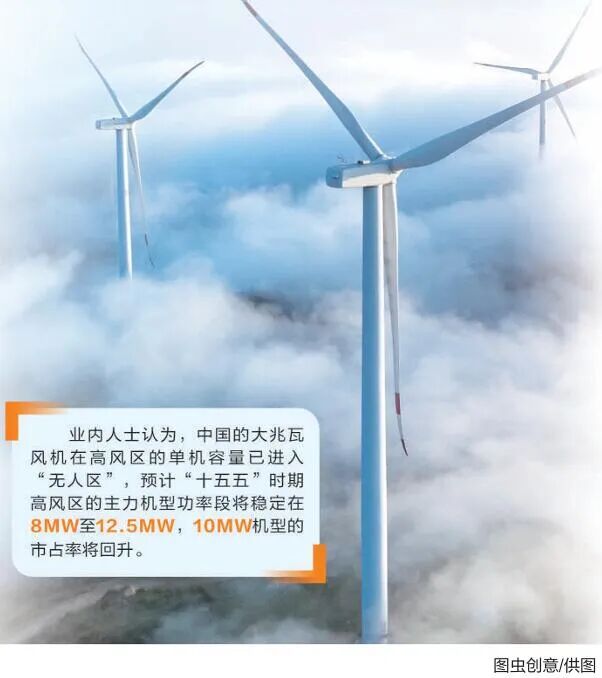
风电机组大型化趋缓 产业链走向深度集成
Zheng Quan Shi Bao· 2025-12-08 18:12
Core Insights - The trend of wind turbine large-scale development has slowed down due to new technical challenges and safety risks associated with oversized turbines [1][2][3] - Wind turbine manufacturers are extending their supply chains into core components, adopting a "main unit + core components" model to enhance overall product competitiveness [1][4][6] Group 1: Reasons for Slowdown in Large-scale Turbines - The slowdown in large-scale wind turbines is attributed to the entry of wind technology into "uncharted territory," leading to unprecedented technical risks and challenges [2][3] - Manufacturers are focusing on optimizing existing platforms to improve reliability, efficiency, and grid performance rather than pursuing larger turbine sizes [2][3] - The industry is moving away from a "arms race" mentality regarding turbine size, emphasizing the importance of reliability over sheer output [2][3] Group 2: Industry Trends and Innovations - The integration of core components into the manufacturing process is becoming a trend, with companies like Envision Energy leading the way in self-research and production of gearboxes [5][6][7] - The market for wind turbine gearboxes has shifted from foreign dominance to domestic brands, with companies like NGC and Envision emerging as key players [5] - The industry is witnessing a shift towards a comprehensive market-oriented approach, driven by the "Document 136," which emphasizes the need for reliability and collaboration with the grid [7][8] Group 3: Future Directions - The focus of wind turbine technology innovation is shifting towards enhancing reliability and integration with various industries, rather than merely increasing power output [7][8] - Companies are encouraged to transition from equipment suppliers to system solution providers, leveraging AI and digital technologies for improved operational stability [8][9] - The deep integration of components and systems is seen as a long-term direction for the industry, promoting collaboration and optimization across the supply chain [9]