
作物耐热育种

Search documents
我国科学家成功破译水稻感知并响应高温的“双重密码”
Xin Hua She· 2025-12-03 10:24
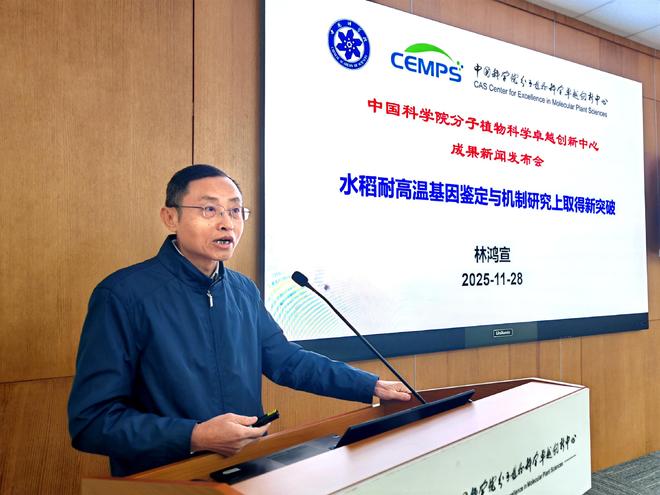
全球气候变暖给人类的粮食安全带来严峻挑战,迫切需要挖掘作物中的耐热基因,解析耐热机制,培育 适应高温气候的新品种。 第二重是细胞核内的"环核苷酸密码"。作为信使的"磷脂酸(PA)"进入细胞内部后,精准传递高温信 号,激活"中层指挥官"磷酸二酯酶(MdPDE1),并协助其进入"核心司令部"细胞核。MdPDE1通过降 解另一种信使分子环核苷酸(cAMP),促使细胞合成各种"耐热武器",从常态转入高温应急状态,抵 御高温胁迫,产生耐热表型。 记者从中国科学院分子植物科学卓越创新中心获悉,该中心林鸿宣院士团队与上海交通大学林尤舜研究 员团队、广州国家实验室李亦学研究员团队合作,经过多年努力,成功破译水稻感知并响应高温的"双 重密码",通过遗传改良培育出具有"梯度耐热性"水稻新株系。12月3日,相关研究论文在国际权威学术 期刊《细胞》(Cell)发表。 11月28日,林鸿宣院士介绍最新科研成果。新华社记者张建松 摄 据林鸿宣介绍,第一重是细胞膜上的"脂质密码"。当高温来袭,抵达植物细胞"边境的城墙"细胞膜时, 膜上"哨兵"二酰甘油激酶(DGK7)首先被激活,解码并启动第一重信号响应,大量生成名为"磷脂酸 (PA)"的脂 ...

科研团队破解水稻感知并响应高温的“双重密码”
Jie Fang Ri Bao· 2025-12-03 03:32
Core Insights - A significant breakthrough in understanding how rice perceives and responds to high temperatures has been published in the journal "Cell," revealing a dual signaling mechanism that can enhance crop heat tolerance [1][2][3] Group 1: Research Findings - The research identifies two key regulatory factors in rice: DGK7 (diacylglycerol kinase) and MdPDE1 (phosphodiesterase), which work together to convert high-temperature physical signals into biological instructions within the cell [1][2] - The first layer of the signaling mechanism involves the activation of DGK7 on the cell membrane, which generates lipid messengers that amplify the heat signal [2] - The second layer involves MdPDE1 in the nucleus, which maintains the expression of heat tolerance genes by degrading cAMP, leading to the synthesis of heat shock proteins and reactive oxygen scavengers [2] Group 2: Agricultural Implications - The discovery provides precise targets for breeding, allowing for the genetic design of rice varieties with gradient heat tolerance, which can adapt to varying climatic conditions [3] - Field trials showed that single-gene modified rice lines increased yield by 50% to 60%, while double-gene modified lines achieved nearly double the yield compared to control lines, with improved grain quality [2] - This research offers theoretical foundations and genetic resources for heat tolerance breeding in staple crops like rice, wheat, and corn, addressing food security challenges posed by global warming [3]