冬季大钻石

Search documents
星空相册|深冬有约,中国最北省份铺展星光冰雪画卷
Xin Hua She· 2026-01-28 08:17
Core Viewpoint - The winter season in Heilongjiang Province, China, presents an optimal period for stargazing, showcasing celestial phenomena such as the Orion constellation and the aurora borealis [2][24][25]. Group 1: Stargazing Highlights - The "Winter Triangle" and "Winter Diamond" are prominently visible in the night sky, along with the Orion constellation, creating a stunning visual experience [13][21][34]. - Various locations in Heilongjiang, including cities like Fuyun, Jiamusi, and Daqing, have been highlighted for their clear views of the winter sky and celestial events [6][9][11][30]. Group 2: Aurora Borealis Sightings - The aurora borealis has been observed in multiple areas, including Fuyun and Mohe, adding a dynamic element to the winter night sky [4][25][26]. - Photographs capturing the aurora and starry skies have been taken in various scenic spots, enhancing the region's appeal for winter tourism [24][26][28].


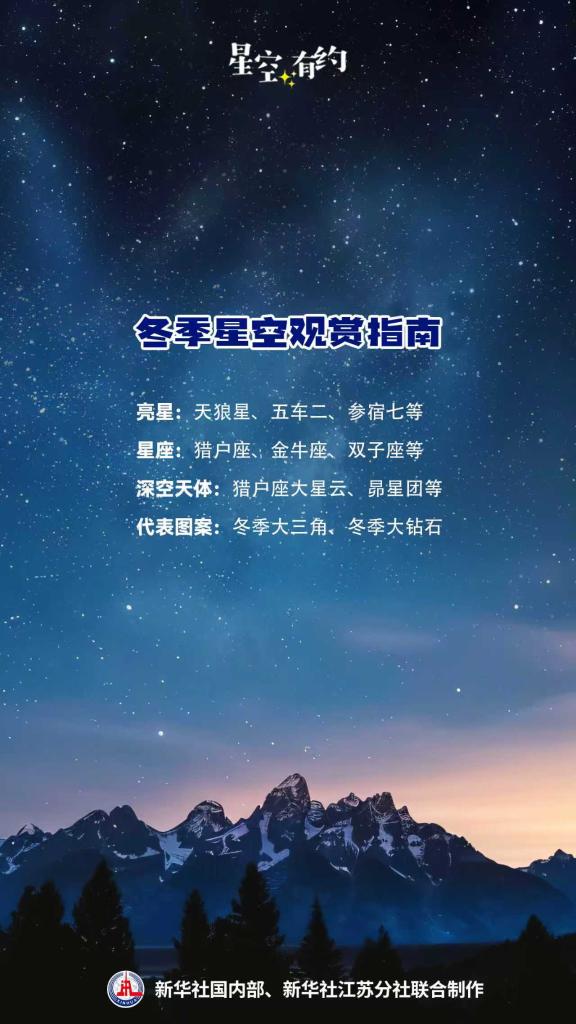
冬季“星空大戏”的黄金时段来了,这份观赏指南请查收!
Xin Hua She· 2026-01-22 03:25
Core Viewpoint - The winter night sky offers a spectacular view with numerous bright stars, making it an ideal time for stargazing, particularly with the prominent "Winter Triangle" and "Winter Diamond" formations visible in the northern hemisphere [3][5]. Group 1: Winter Sky Features - The winter sky is characterized by the highest number of visible bright stars, with over 10 stars having a visual magnitude of 2 or brighter [3]. - The "Winter Triangle," consisting of the brightest stars Sirius, Procyon, and Betelgeuse, is a key feature of the winter sky, visible across most of the northern hemisphere [3]. - The "Winter Diamond" includes stars such as Sirius, Procyon, Betelgeuse, and others, showcasing a mix of different types of stars [5]. Group 2: Notable Celestial Objects - Jupiter has recently moved into the Gemini constellation, joining the "Winter Diamond," which includes both giant planets and stars at various evolutionary stages [5]. - The Orion constellation, particularly the Orion Nebula located below the "belt," is a significant highlight of the winter sky, known for being a stellar nursery [6]. Group 3: Observational Timing - During late January, the stars rise earlier compared to the previous month due to the Earth's rotation, with Sirius rising approximately 4 minutes earlier each day [9].
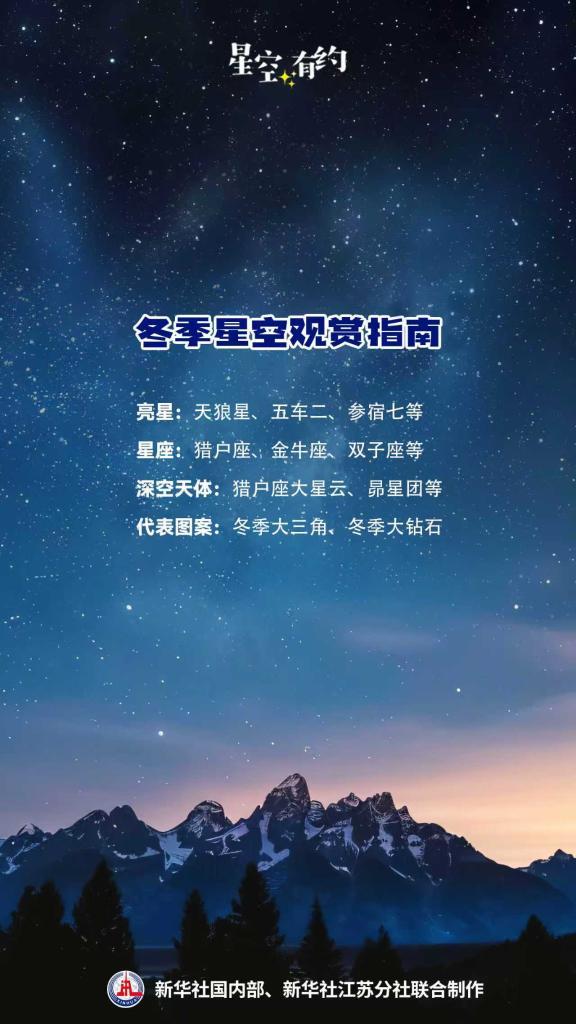
冬季“星空大戏”的黄金时段来了 这份观赏指南请查收!
Xin Hua She· 2026-01-22 02:30
Core Points - The winter night sky offers a spectacular view with numerous bright stars, making it an ideal time for stargazing [1][3] - The "Winter Triangle" and "Winter Diamond" are prominent star patterns visible in the northern hemisphere, featuring some of the brightest stars [3][5] - The Orion constellation, particularly the Orion Nebula, plays a significant role in the winter sky, serving as a region for star formation [6][9] Group 1 - The winter sky in the northern hemisphere has the highest number of visible bright stars, with over ten stars of magnitude two or brighter [3] - The "Winter Triangle" consists of Sirius, Procyon, and Betelgeuse, which are among the ten brightest stars in the sky [3] - The "Winter Diamond" includes stars such as Sirius, Procyon, and Betelgeuse, showcasing a mix of different types of stars [5] Group 2 - Jupiter's position in the Gemini constellation enhances the winter sky's appeal, as it joins the prominent stars in the "Winter Diamond" [5] - The Orion constellation, particularly its belt, is a key feature of the winter sky, with the Orion Nebula being a notable area for new star formation [6][9] - The timing of star visibility changes slightly each day, with stars rising approximately four minutes earlier each day, affecting their visibility in different lunar months [9]