创投员工跟投机制

Search documents
观察:创投跟投制度应避免异化为“员工掏钱上班”!
Zheng Quan Shi Bao Wang· 2025-09-25 13:23
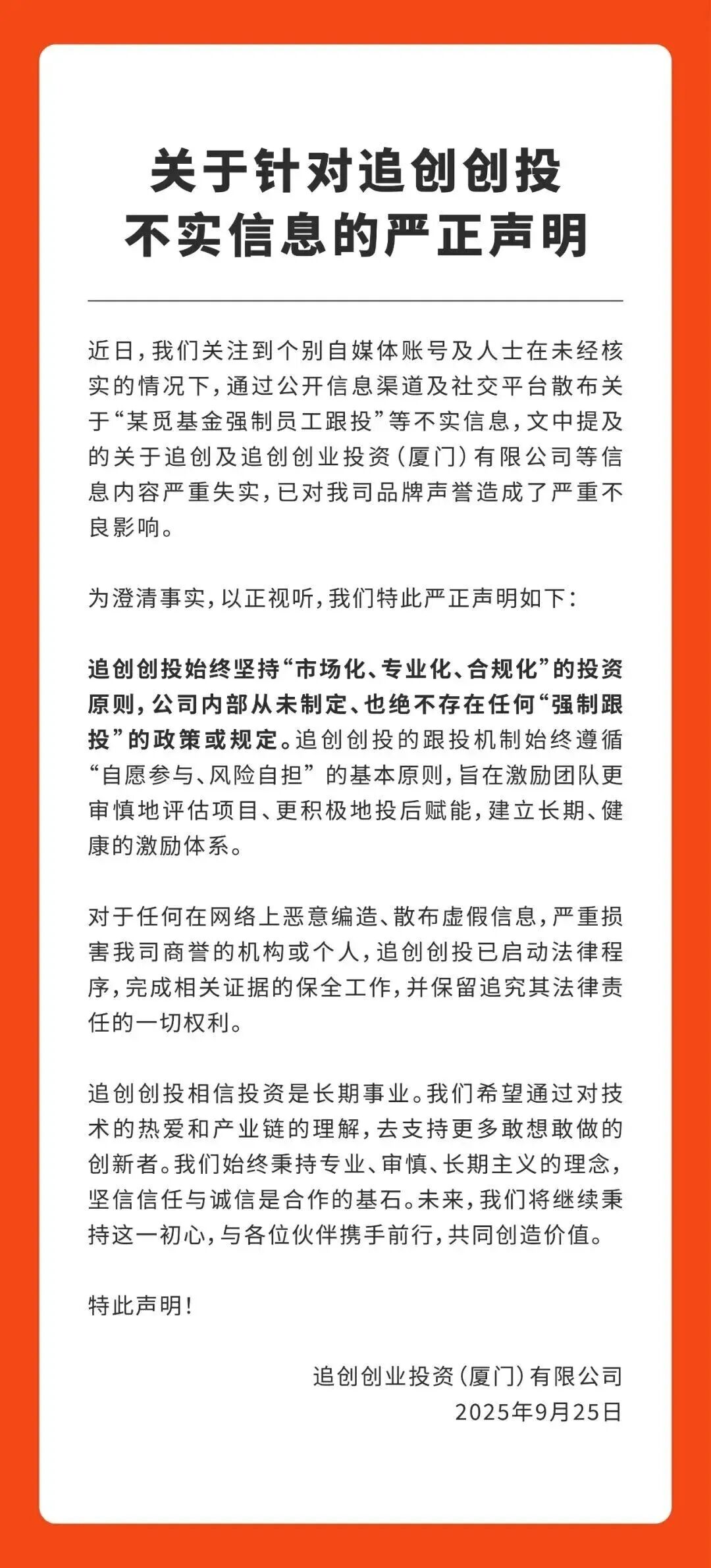
Core Viewpoint - A recent social media post has sparked industry attention regarding a private equity fund's alleged mandatory co-investment requirement for employees, which was linked to an elimination mechanism. The post included co-investment rules, with a minimum investment amount of 10,000 yuan and no upper limit. The company involved, Chuangchuang Venture Capital, has issued a statement denying these claims and emphasizing that their co-investment mechanism is based on voluntary participation and risk-bearing principles [1][3]. Group 1 - Chuangchuang Venture Capital was established in 2023 and focuses on the AI and robotics sectors, managing multiple RMB and USD funds across four key areas: hardware, robotics software, industrial robots, and service robots [3]. - Despite the company's clarification, the incident has led to widespread discussions within the industry about employee co-investment mechanisms, which are common in venture capital firms. The regulations state that employees of private equity fund managers are considered qualified investors, allowing for certain exemptions under specific conditions [3][4]. - The typical operational model for employee co-investment in venture capital firms involves mandatory co-investment for investment managers and partners, while ordinary employees participate voluntarily. The minimum investment for voluntary participation can start as low as 10,000 yuan [4][5]. Group 2 - Different types of employee co-investment serve various purposes. Mandatory co-investment for project leaders aims to align interests and mitigate risks, while voluntary co-investment by ordinary employees acts as an incentive mechanism [5][6]. - Some firms implement a combined mechanism of "mandatory co-investment + compensation incentives," where employees not only have to co-invest but also face penalties based on project performance, potentially leading to reduced disposable income and additional losses [5][6]. - The co-investment system's original intent is to ensure that investors are diligent about projects and share in the company's growth. However, it should not devolve into a situation where employees feel compelled to invest their own money as a condition of employment [6].