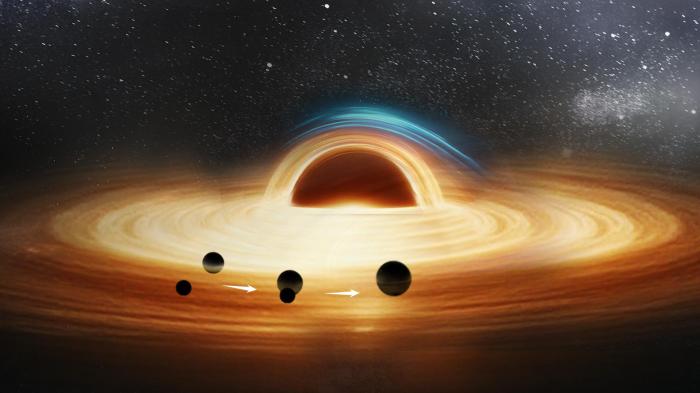
双黑洞系统

Search documents
科学家首次拍摄到双黑洞“共舞”
Ke Ji Ri Bao· 2025-10-13 07:30
Core Insights - An international research team has successfully captured the first images of two black holes orbiting each other, confirming the existence of binary black hole systems, which were previously only theorized [1][2] Group 1: Research Findings - The research was led by astronomers from the University of Turku in Finland, focusing on the exceptionally bright quasar OJ287, where two black holes were observed orbiting each other [1] - The two black holes in OJ287 are believed to orbit with a period of 12 years, creating a unique variability pattern that has been the subject of scientific inquiry for decades [1] - Traditional optical imaging techniques lacked the resolution to distinguish between the two black holes, requiring a radio telescope array with a resolution 100,000 times greater than standard optical telescopes [1] Group 2: Methodology and Observations - The research team utilized a radio telescope array, including the Russian RadioAstron satellite, to achieve the necessary resolution for imaging the black holes [1] - The newly obtained radio images matched perfectly with earlier theoretical predictions regarding the positions of the two black holes, concluding a 40-year scientific exploration [1] - Although the black holes themselves are not visible, the high-energy particle jets they emit were observed, resembling "glowing ribbons" that outline their trajectories [2]
双黑洞背后有何玄机?中国团队首次发现第三致密天体存在迹象
Zhong Guo Xin Wen Wang· 2025-07-31 20:40
Core Insights - The research team from the Shanghai Astronomical Observatory has made a significant breakthrough in gravitational wave astronomy by discovering clear evidence of a third compact object near a binary black hole merger event, which provides new clues to the formation of binary black holes [1][9] Group 1: Research Findings - The study published in the Astrophysical Journal Letters highlights the detection of a third compact object in the binary black hole merger event, marking the first time such evidence has been found [2][9] - The research team analyzed over 100 gravitational wave events detected by the LIGO-Virgo-KAGRA collaboration, with most events originating from binary black hole mergers, yet the mechanisms of their formation and evolution remain uncertain [3][5] Group 2: Methodology - The team focused on the gravitational wave event GW190814, which involved two black holes with a mass difference of nearly ten times, suggesting they may have formed in a more complex gravitational system rather than in isolation [6][9] - A new gravitational wave waveform template was constructed to capture the unique signatures of the third compact object, showing that models including line-of-sight acceleration significantly outperformed traditional isolated binary black hole models [8] Group 3: Future Implications - The discovery implies that binary black holes may not form in isolation but rather within more complex gravitational systems, which is crucial for understanding their formation pathways [9] - The advancement of next-generation ground and space gravitational wave detectors is expected to enhance the ability to detect subtle changes in gravitational wave signals, potentially leading to the discovery of more events similar to GW190814 [9]