固态锂金属电池

Search documents
全国首例!固态锂金属电池助力eVTOL完成跨海峡飞行
DT新材料· 2026-01-07 16:15
Core Viewpoint - The article highlights the successful test flight of the EHang 216 eVTOL powered by the Falcon solid-state lithium metal battery, marking a significant milestone in the application of advanced battery technology in aviation [2][4]. Group 1: Battery Technology - The Falcon solid-state lithium metal battery has an energy density exceeding 480 Wh/kg, which is 1.5 to 2 times higher than existing mainstream aviation batteries [4]. - The battery utilizes HICORE solid-state electrolyte technology and interface-oriented TIE technology to enhance ionic conductivity while reducing leakage and combustion risks [4]. - The design of the lithium metal anode achieves a volumetric energy density of 1200 Wh/L, and the battery has passed various safety tests, ensuring reliability for cross-sea flights [4]. Group 2: Project Development - On December 29, 2025, the first batch of solid-state cylindrical batteries from a 10 GWh production project by the company was launched in Hangzhou, with an initial capacity of 2 GWh aimed at consumer electronics [5]. - The second phase of the project plans to add 8 GWh of capacity, targeting eVTOLs, humanoid robots, and electric vehicles [5]. - A new project in Zhongshan, Guangdong, with a total investment of 160 million yuan, aims to establish a production line for 0.25 GWh of lithium metal solid-state batteries by 2026 [5]. Group 3: Collaboration and Future Plans - The company began collaborating with EHang in early 2023 to develop the eVTOL power system, achieving a record flight duration of 48 minutes and 10 seconds during their first test flight in November 2024 [4]. - The partnership has focused on optimizing battery output characteristics and thermal control for challenging maritime conditions, ensuring temperature increases do not exceed 18°C during flights [4]. - The company plans to mass-produce the next-generation "Falcon 2.0" solid-state battery by the end of 2026, with an expected energy density exceeding 500 Wh/kg [5].


解决行业痛点!融捷能源固态电池电解质新突破
中关村储能产业技术联盟· 2026-01-04 10:11
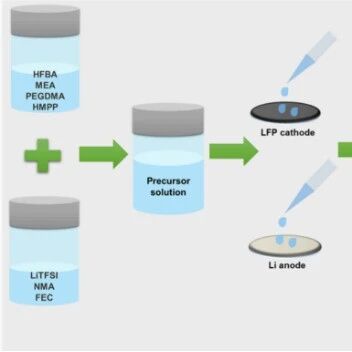
Core Viewpoint - Rongjie Energy has made significant advancements in the research of solid-state lithium metal battery electrolyte materials, achieving international academic recognition and intellectual property protection for its innovations in this field [5][6][10]. Group 1: Company Overview - Rongjie Energy, located in Nansha, Guangzhou, is the flagship new energy industry entity of Rongjie Group and is recognized as a key project in Guangzhou and Guangdong Province, falling under the category of national strategic industries [3]. Group 2: Research and Development Achievements - The research team at Rongjie Energy, led by Dr. Wang Wansheng and including key members such as Dr. Zhao Ting and Dr. Tao Zhuchen, has developed a novel polymer electrolyte called DES-PEEs, which combines the high ionic conductivity of deep eutectic solvents (DES) with the mechanical and chemical stability of fluorinated polymers [6][10]. - The DES-PEEs electrolyte exhibits a room temperature ionic conductivity of 1.65 mS cm⁻¹, which is several times higher than traditional PEO-based electrolytes, and a lithium ion transference number of 0.75, significantly reducing ionic transport losses [10]. Group 3: Technical Innovations - The DES-PEEs structure features a "dual continuous phase separation structure," consisting of an ionic highway for rapid lithium ion transport and a mechanical framework for stability, effectively addressing the industry challenge of balancing ionic conductivity and mechanical performance [8][10]. - The breakthrough in DES-PEEs technology not only highlights Rongjie Energy's foundational R&D capabilities in solid-state battery materials but also provides critical technological support for the industrialization of solid-state lithium batteries [10]. Group 4: Future Directions - Rongjie Energy aims to continue its focus on the research and development of new energy materials and storage technologies, contributing to the global transition to zero-carbon energy and the advancement of efficient energy storage solutions [10].