大型行为模型 (LBM)

Search documents
摆脱遥控器,波士顿动力人形机器人,开始「长脑子」干活了
机器之心· 2025-08-21 13:08
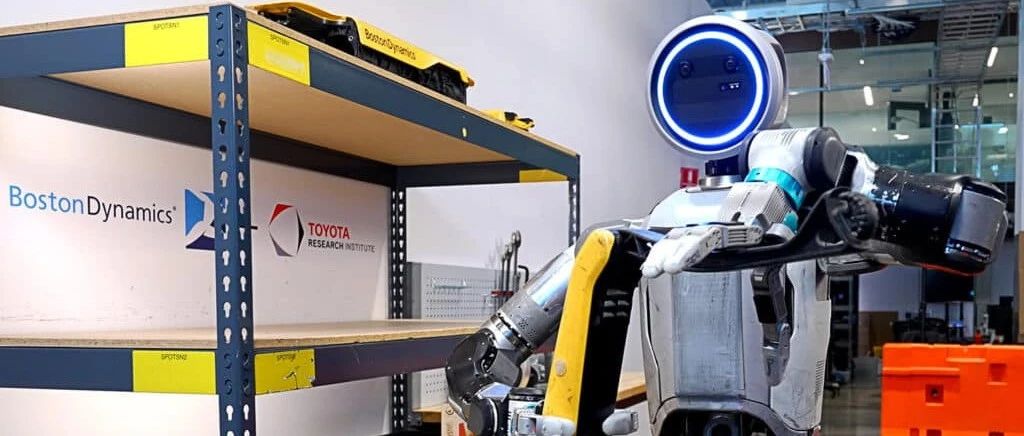
Core Viewpoint - The article discusses advancements in humanoid robotics, particularly focusing on the recent developments by Boston Dynamics and their collaboration with Toyota Research Institute to enhance the capabilities of the Atlas robot through a large behavior model (LBM) [4][5][26]. Group 1: Humanoid Robot Developments - The recent World Humanoid Robot Competition showcased various robots, including an incident involving Yushu Technology's robot that displayed unexpected behavior, sparking discussions about the need for fully autonomous humanoid robots [2][3]. - Boston Dynamics aims to make humanoid robots practical by developing a general-purpose AI capable of performing a wide range of complex tasks, which includes manipulating various objects and navigating complex environments [4][5]. Group 2: Atlas Robot's Capabilities - The Atlas robot demonstrated its ability to autonomously perform tasks such as organizing and retrieving items, showcasing its advanced decision-making skills in response to human interference [8][11][30]. - The robot's AI model allows it to recognize objects and execute tasks with precision, utilizing its humanoid form to maintain balance and avoid self-collision during operations [15][32]. Group 3: Model Development Process - The development of the LBM follows a clear iterative process involving data collection, processing, model training, and performance evaluation, which continuously improves the robot's capabilities [22][24]. - The model integrates sensory data and human language commands to provide real-time control of the Atlas robot, achieving a control frequency of 30Hz [26]. Group 4: Practical Applications and Future Prospects - The Atlas robot can perform a series of tasks autonomously, such as handling parts and organizing them efficiently, demonstrating its potential to exceed human operational efficiency in certain scenarios [33]. - The development process emphasizes creating a versatile model that can adapt to various tasks without extensive programming, allowing for rapid skill expansion and operational flexibility [34].