战新产业布局

Search documents
2025年国企利润降幅有所扩大,国资委加码稳增长力度
Xin Lang Cai Jing· 2026-01-30 09:49
Group 1 - In 2025, the total operating revenue of state-owned enterprises (SOEs) increased by 0.5% year-on-year, while total profits decreased by 6.3%, indicating significant downward pressure on the economic performance of SOEs [1] - The Ministry of Finance reported that SOEs' tax payments reached 58,782.9 billion yuan, a year-on-year increase of 0.4%, and the asset-liability ratio stood at 65.1%, up 0.4 percentage points year-on-year [1] - The State-owned Assets Supervision and Administration Commission (SASAC) has outlined key tasks for 2026, focusing on stabilizing operations, improving quality and efficiency, optimizing layout, adjusting structure, enhancing innovation, and ensuring livelihood [1] Group 2 - The SASAC emphasized the importance of stabilizing operations and improving quality and efficiency as the top priority for local state-owned enterprises in 2026 [2] - SASAC plans to promote stable operations and quality improvements by leveraging long-term special bonds and implementing key projects to stimulate demand growth [2] - The SASAC will focus on deepening reforms to address systemic obstacles, optimize the layout of state-owned enterprises, and enhance the integration of technological and industrial innovation [2] Group 3 - Liu Xingguo highlighted three main strategies for accelerating the layout of new industries by central enterprises: guiding industrial layout, increasing support for technological innovation, and utilizing performance assessment mechanisms [3] - New policies will be introduced for mergers and acquisitions, main business management, and asset securitization to enhance industrial layout [3] - The establishment of collaborative innovation bodies and technology application demonstration scenarios will be prioritized to support technological advancements [3]
中国海诚(002116) - 002116中国海诚投资者关系管理信息20250923
2025-09-23 01:40
Group 1: Company Performance and Shareholder Returns - The company has consistently returned cash dividends to investors, totaling CNY 1.22 billion over 19 years, which accounts for 44.49% of the net profit of CNY 2.742 billion during this period [4][6]. - The company aims to enhance shareholder value through improved operational performance and ongoing cash dividends, thereby increasing investor satisfaction [5][9]. - In the first half of 2025, the company achieved a net profit of CNY 152 million, representing an 8.52% year-on-year growth, laying a solid foundation for its "14th Five-Year Plan" strategic goals [4][6]. Group 2: Strategic Development and Market Positioning - The company is actively seeking acquisition targets that align with its strategic development goals, focusing on expanding its core business and exploring new growth areas [3][13]. - The establishment of the Intelligent Manufacturing Division is a strategic move to enhance service capabilities in traditional sectors through digital and intelligent upgrades [7][12]. - The company is committed to diversifying its revenue structure by venturing into new industries such as biotechnology, new energy, and new materials, while also expanding its overseas market presence [8][10]. Group 3: Market Challenges and Stock Performance - The company's stock price has been underperforming compared to the market, attributed to various factors including industry conditions and investor sentiment [5][10]. - Management acknowledges the need for strategic asset restructuring and integration to enhance competitiveness and market valuation [6][9]. - The company is focused on improving its internal value through operational excellence and effective communication with investors to foster a better understanding of its market value [6][13].

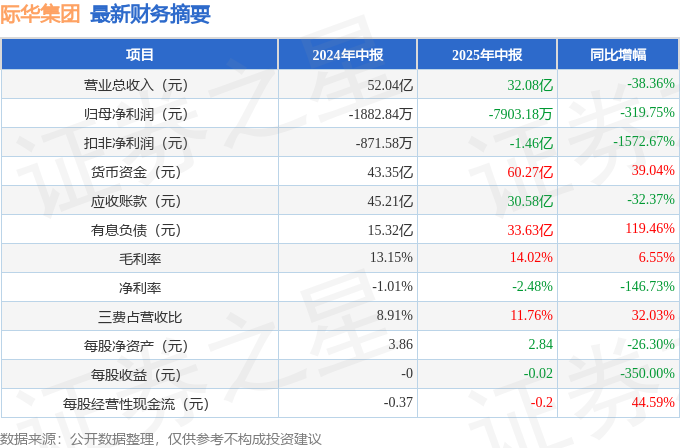
际华集团2025年中报简析:净利润同比下降319.75%,三费占比上升明显
Zheng Quan Zhi Xing· 2025-08-23 22:58
Core Viewpoint - The recent financial report of Jihua Group (601718) indicates a significant decline in revenue and profit, with total revenue dropping by 38.36% year-on-year and a net loss of 79.03 million yuan, marking a 319.75% decrease in profit compared to the previous year [1] Financial Performance Summary - Total revenue for the first half of 2025 was 3.208 billion yuan, down from 5.204 billion yuan in 2024, reflecting a decrease of 38.36% [1] - The net profit attributable to shareholders was -79.03 million yuan, compared to -1.88284 million yuan in 2024, a decline of 319.75% [1] - The gross profit margin improved slightly to 14.02%, up 6.55% year-on-year, while the net profit margin fell to -2.48%, a decrease of 146.73% [1] - The total of selling, administrative, and financial expenses reached 377 million yuan, accounting for 11.76% of total revenue, which is an increase of 32.03% year-on-year [1] - Earnings per share were -0.02 yuan, a significant drop of 350.00% compared to the previous year [1] Changes in Financial Items - Construction in progress increased by 45.0% due to investments in traditional industry digital upgrades and new industry layouts [2] - Short-term borrowings decreased by 34.23% as the company repaid due bank loans [2] - Long-term borrowings surged by 405.67% as the company increased its long-term bank loans [2] - Accounts receivable financing rose by 243.75% due to an increase in received bank acceptance bills [2] - Employee compensation payable decreased by 45.8% as a result of reduced employee wages [2] Cash Flow Analysis - Operating cash flow increased by 44.59% due to a decrease in cash paid for goods and services [3] - Investment cash flow decreased by 129.64% as the company invested in the construction of functional product production lines [3] - Financing cash flow increased by 363.61% due to a rise in cash received from borrowings [3] Business Evaluation - The company's historical return on invested capital (ROIC) has been weak, with a median of 0.7% over the past decade and a particularly poor ROIC of -25.81% in 2024 [3] - The company has reported losses in four out of its 14 annual reports since going public, indicating a generally poor financial performance [3] Debt Servicing Capability - The company maintains a healthy cash asset position, which is crucial for its debt servicing ability [3]