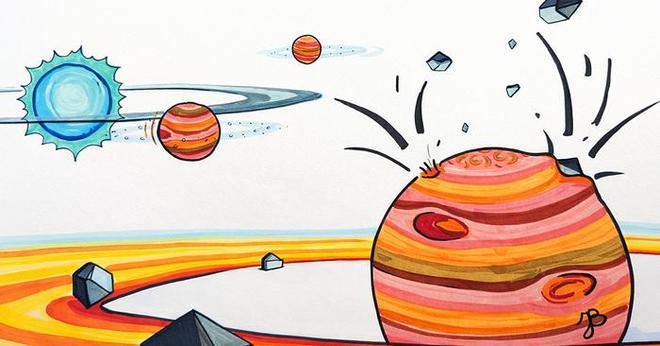
气态巨行星的形成

Search documents
气态“宇宙巨人”是怎么长成的
Huan Qiu Wang Zi Xun· 2026-02-24 01:28
Core Insights - The article discusses the discovery of gas giant planets in the HR 8799 star system, which are significantly larger than Jupiter, raising questions about their formation mechanisms [3][4]. Group 1: Formation Theories - Two primary theories exist regarding the formation of these massive gas giants: the "core accretion model," where a solid core grows by attracting gas from a surrounding disk, and the "gravitational collapse model," where a gas cloud collapses under its own gravity [3]. - A research team from the University of California, San Diego, utilized the James Webb Space Telescope (JWST) to investigate the HR 8799 system, providing critical insights into the formation of these giant planets [3][4]. Group 2: Findings from JWST - The JWST's high-resolution spectrometer allowed scientists to detect various molecular signals, including hydrogen sulfide, in the atmosphere of HR 8799c, indicating a rich presence of heavy elements [4]. - The findings suggest that these gas giants, despite being only about 30 million years old, have accumulated material in a manner consistent with the core accretion model, challenging previous assumptions about their formation [4]. Group 3: Implications and Future Research - The research raises further questions about the upper mass limit for planets, particularly as some may exceed 15 to 20 times the mass of Jupiter, blurring the line between planets and brown dwarfs [5]. - Continued exploration with advanced telescopes may eventually reveal more about the origins of these "cosmic giants" [5].