滑移强化接触熔化机制

Search documents
浙大黑科技破解储热难题:一层200纳米的超滑涂层,让热能存储速度飙升10倍
Xin Lang Cai Jing· 2026-01-30 04:31
Core Insights - The article highlights the significance of thermal energy storage, particularly focusing on phase change materials (PCMs) and their limitations in achieving both high thermal storage density and rapid charging/discharging capabilities [1][15][25] Group 1: Thermal Energy Storage Overview - Thermal energy storage is often overlooked compared to lithium batteries, yet it plays a crucial role in energy consumption, with nearly 50% of global final energy consumption utilized as heat [1][14] - Mainstream thermal storage methods include sensible heat storage, latent heat storage based on phase change, and thermochemical storage, with phase change storage being particularly effective in absorbing and releasing large amounts of latent heat [1][15] Group 2: Challenges in Phase Change Materials - A core challenge in phase change materials is the difficulty in achieving high thermal storage density alongside rapid heat transfer capabilities, which limits their performance [1][15] - Traditional approaches to enhance thermal conductivity often compromise heat storage capacity and system recyclability [5][18] Group 3: Innovative Solutions by Zhejiang University - A research team from Zhejiang University has developed a novel solution using a "slip-enhanced contact melting mechanism," achieving a power density exceeding 1 MW/m³, which is over ten times higher than conventional thermal storage devices [2][15][24] - The innovation involves applying a 200-nanometer-thick ultra-thin coating to the inner wall of the thermal storage container, combined with a preheating layer to enhance heat transfer efficiency [2][21] Group 4: Experimental Results and Stability - The prototype achieved a power density of 1.1 MW/m³ while maintaining an average power output during energy storage of 27 kWh/m³, demonstrating excellent cycle stability with less than 3% performance degradation over 50 complete charge-discharge cycles [11][24] - The team utilized erythritol as a phase change material, which maintained stable performance after 50 cycles at 150°C, and the coating showed minimal degradation even after prolonged exposure to high temperatures [11][24] Group 5: Future Applications and Challenges - The technology has potential applications in industries such as metallurgy, textiles, and chemical processing, particularly for recovering waste heat in the 100 to 200°C range, as well as in solar thermal systems and electric vehicle thermal management [25][26] - Future focus areas include enhancing the long-term cycling lifespan of phase change materials, adapting to different temperature ranges, and integrating with real-world applications [26]

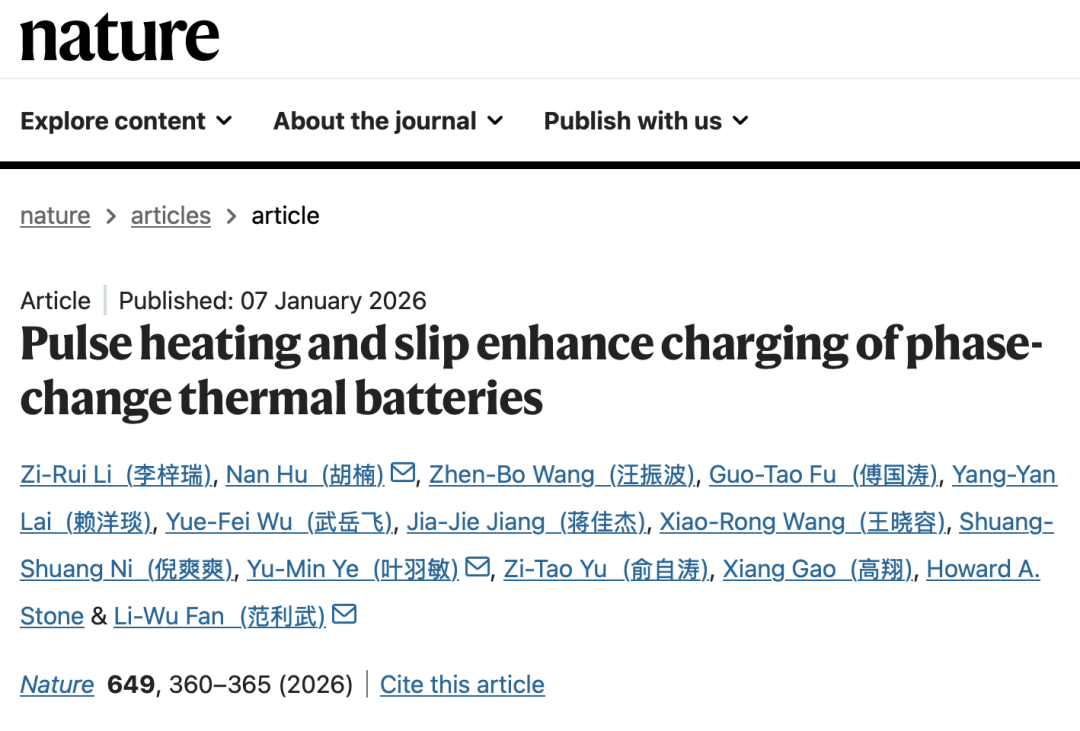
我国科研团队研制出可快充“热池”
Xin Lang Cai Jing· 2026-01-10 14:21
Core Insights - A new mechanism called "slip-enhanced contact melting" has been proposed by a research team from Zhejiang University, aiming to improve the performance of phase change thermal storage systems by optimizing the internal wall of thermal pools with a "fully solid composite surface" [1][2] - The research addresses the long-standing conflict between high energy storage capacity and rapid heat charging/discharging rates in phase change thermal pools, which utilize materials like paraffin and hydrated salts that have high latent heat storage but poor thermal conductivity [1] Group 1 - The new approach involves treating the internal walls of thermal pools to create a super-smooth surface, allowing solid phase change materials to remain in close contact with the heat source, thus maintaining high heat transfer rates throughout the process [1] - The core innovation is the "fully solid composite surface," which consists of a thin film capable of pulse heating and a "liquid-like coating" that acts as a slip interface, enhancing the efficiency of heat transfer [2] - This technology enables a dual advantage of achieving both fast charging and high storage capacity, effectively resolving the previous limitations faced by phase change thermal storage systems [2]