狭义希尔伯特第六问题

Search documents
“未来5到10年,中国一定成为数学强国”
Xin Lang Cai Jing· 2026-01-04 07:36
Group 1 - The Tenth Triennial International Congress of Chinese Mathematicians (ICCM) opened in Shanghai, with a statement from renowned mathematician Shing-Tung Yau emphasizing that China will become a mathematical powerhouse in the next 5 to 10 years [1] - The conference awarded several prestigious prizes, including the ICCM Mathematics Gold Award, Silver Award, Chen Shengshen Award, and International Cooperation Award, recognizing outstanding contributions in fundamental mathematics, applied mathematics, and interdisciplinary fields [1] - New awards such as the Hua Luogeng Award, Lin Jiaqiao Award, and Yang Le Award were introduced to encourage exceptional talent in mathematics [1] Group 2 - The ICCM was initiated by Shing-Tung Yau in 1998 and serves as a significant platform to showcase the achievements of Chinese mathematicians [2] - The conference is supported by the Shanghai Municipal Science and Technology Commission and the Yangpu District People's Government, highlighting Shanghai's commitment to promoting fundamental research and original innovation [2] - In 2024, Shanghai is expected to lead or collaborate on 49 scientific achievements that will receive national science and technology awards, accounting for 18.7% of the total in the country [2] - Shanghai scientists are projected to publish over 180 papers in prestigious journals such as Cell, Nature, and Science in 2025, representing approximately 30% of the national total [2] - The city has made significant breakthroughs in various fields, including CAR-T therapy, cellular aging mechanisms, neutral atom quantum computing, and abyssal science research [2]
北大校友包揽ICCM金奖 邓煜撰文分享学术研究进程
Huan Qiu Wang· 2025-11-04 07:44
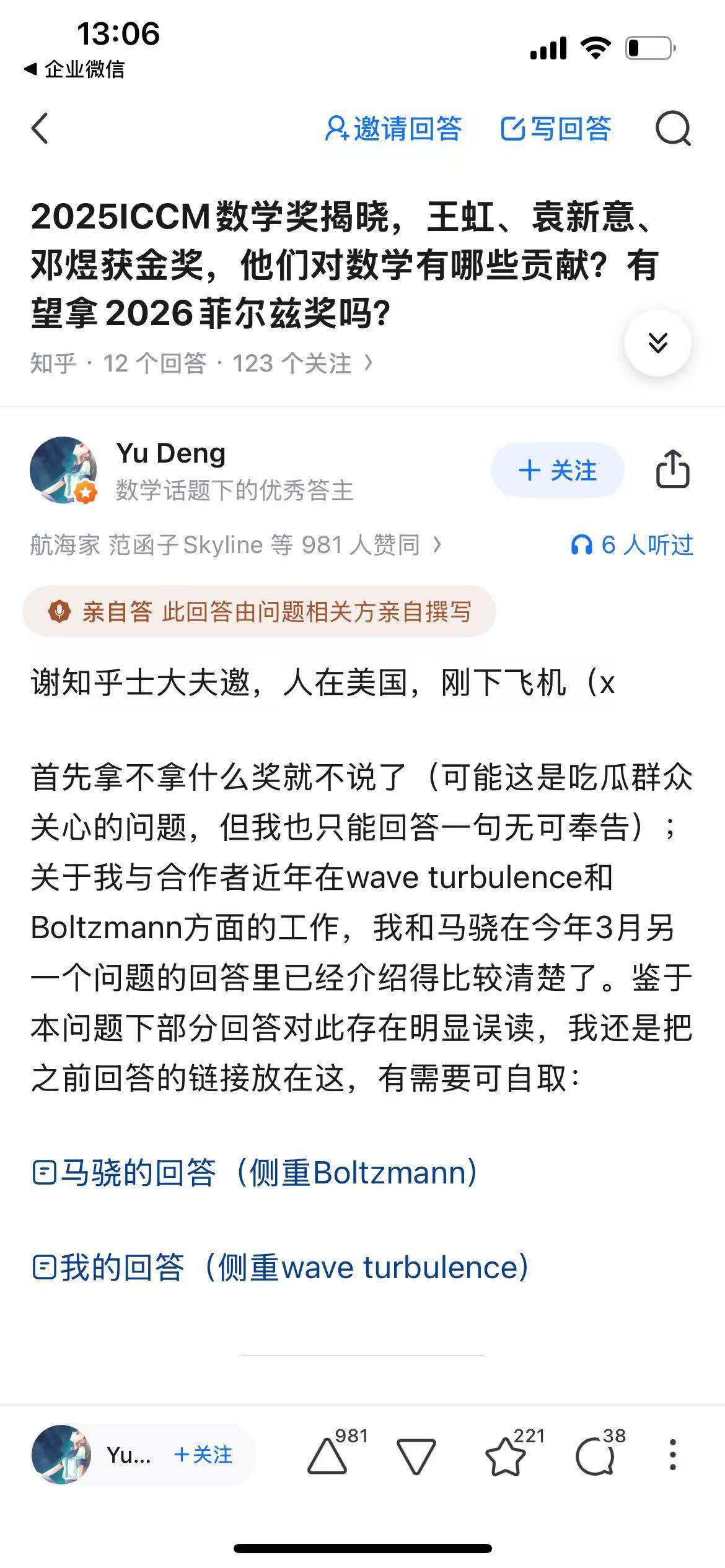
Core Points - The 10th World Chinese Mathematicians Conference (ICCM2025) awarded the gold medal to three alumni from Peking University: Wang Hong, Deng Yu, and Yuan Xinyi [1][3] - The awardees have made significant breakthroughs in their respective fields, with Wang Hong recognized for work on the Hanging Valley Conjecture and Deng Yu for solving the long-standing Hilbert's Sixth Problem [3] - There is anticipation in the academic community that both Wang Hong and Deng Yu may be contenders for the Fields Medal, often referred to as the Nobel Prize of Mathematics, in the upcoming year [3] Individual Contributions - Wang Hong has gained global attention for his groundbreaking work on classic problems such as the Hanging Valley Conjecture [3] - Deng Yu, a professor at the University of Chicago, has successfully addressed the Hilbert's Sixth Problem, a major challenge in the field of physics [3] - Yuan Xinyi, a professor at the Beijing International Center for Mathematical Research, focuses his research on number theory [3] Academic Engagement - Following the award, Deng Yu engaged with the public on Zhihu, sharing insights into his recent research direction on random initial value problems related to dispersion equations [3] - Deng Yu provided a timeline of his research journey, highlighting a pivotal moment in September 2018 when he returned to the field of random initial value problems [3]