生物碳泵

Search documents
【中国青年报】潜在深水里的“诺亚方舟”
Zhong Guo Qing Nian Bao· 2026-02-06 03:31
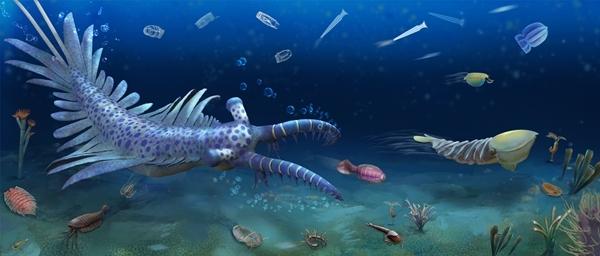
Core Viewpoint - The research on the Huayuan Biota reveals significant insights into the aftermath of the Cambrian mass extinction, highlighting the deep-sea environment as a refuge and a source of evolutionary innovation for various species [12][14]. Group 1: Discovery and Research Process - A gray stone slab, approximately palm-sized, contains a fossil of a planktonic organism from 500 million years ago, closely related to early vertebrates [3][5]. - The fossil was discovered in 2021 in Huayuan County, China, and underwent a meticulous five-year research process involving traditional geological tools and advanced digital technology [4][6]. - Over 50,000 fossil specimens were collected, with each being considered a "lucky" find due to their preservation over millions of years [8][10]. Group 2: Scientific Findings - The research identified 153 species within the Huayuan Biota, with 59% being new species, comparable in richness and diversity to other renowned fossil sites like the Cambrian Burgess Shale [12][13]. - The study provided evidence of long-distance dispersal mechanisms for Cambrian animals, suggesting that global ocean currents played a crucial role in species distribution [11][14]. - The deep-sea environment acted as a refuge during the mass extinction, allowing many species to survive and evolve, thus serving as a "hatching ground" for new life forms [11][14]. Group 3: Methodological Innovations - The research combined traditional paleontology with cutting-edge digital techniques, including advanced imaging and a global database of 3,149 species, which is unprecedented at the species level [9][10]. - The methodology emphasizes the importance of integrating fieldwork with data science to drive significant scientific discoveries [14]. Group 4: Implications for Local Community and Future Research - The findings are expected to provide new opportunities for the local community in areas such as rural revitalization and geological cultural tourism [14]. - Ongoing research will continue to explore the remaining new species and further decode the responses of ancient life to major crises [15].

我国科学家在北冰洋陆坡发现深层叶绿素极高值
Xin Hua She· 2025-10-03 11:28
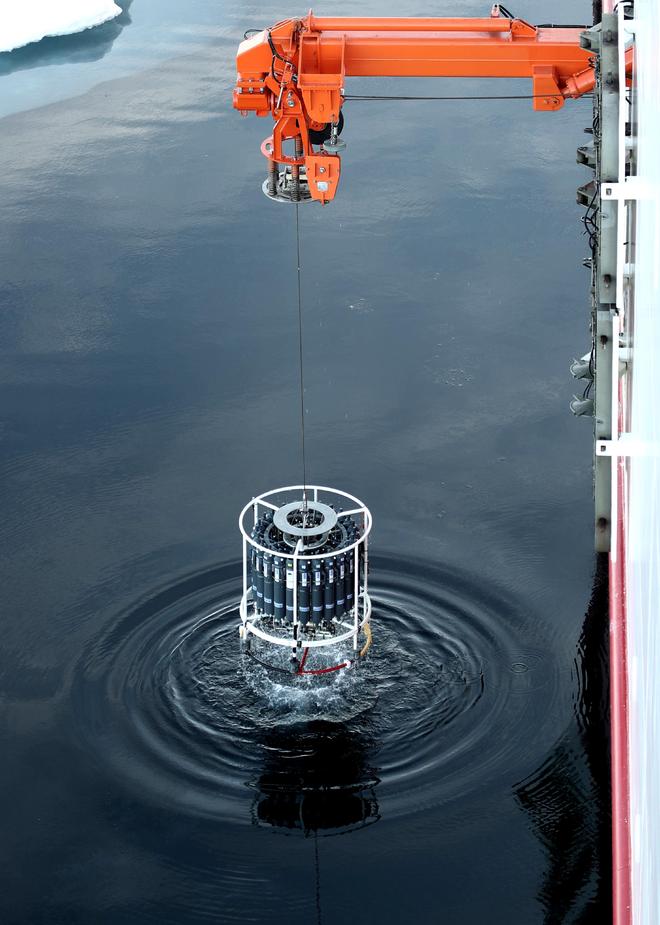
中国第15次北冰洋科学考察队日前在北冰洋楚科奇海陆坡区发现深层叶绿素极高值。专家认为,这对理 解"海雪"的形成机制及评估北极生物碳泵和深层食物网有重要的科学价值。 CTD正在回收中。新华社记者刘诗平 摄 "我们在楚科奇海陆坡区进行的一次CTD(温盐深剖面仪)采样作业中,出现了令人惊讶的一幕:CTD 在下降过程中,荧光探头上的叶绿素值一路飙升,最高达到200毫克每立方米,是我国历次北极科考作 业中发现的最高值。"本次考察队生物组组长、自然资源部第二海洋研究所副研究员郝锵说。 郝锵介绍,经考察队研究同意,科考队员在"雪龙2"号实验室保障团队配合下随即开展加密采样作业, 尝试对这一叶绿素峰值进行捕捉分析。 初步结果表明,该叶绿素峰值位于跃层的边缘,主要由大型的链状和针刺形硅藻构成,其中粒径大于20 微米的浮游植物占比超过九成。 科考队员郝锵在进行海洋叶绿素测定。新华社记者刘诗平 摄 "和中低纬度海洋中常见的次表层叶绿素高值不同,北冰洋的这个水下叶绿素峰值极为尖锐,比表层值 高100多倍,且位置和强度并不稳定,叶绿素浓度数小时内降幅可超过50%。这表明该叶绿素极高值似 乎处于正在'崩解'的状态中。"郝锵说。 考察队初 ...