
稻鸭共作

Search documents
江苏南京:稻田藏“鸭军”,浦口2万只鸭组团“打工”
Nan Jing Ri Bao· 2025-11-13 02:08
Core Viewpoint - The article highlights the innovative "rice-duck co-cultivation" model in Younian Village, where 20,000 ducks are utilized to clean up leftover rice grains after harvest, providing ecological benefits and enhancing local agricultural productivity [1][3][4]. Group 1: Ecological Benefits - The "rice-duck co-cultivation" model creates a symbiotic relationship where ducks help control pests, weeds, and provide natural fertilizer, while rice fields offer a habitat and food for the ducks [4]. - Ducks are introduced immediately after rice harvesting to consume leftover grains and pests, reducing feed costs and enhancing soil nutrition through their droppings [3][4]. Group 2: Economic Impact - The introduction of 20,000 ducks is expected to increase the village's collective income by 500,000 yuan [7]. - The village plans to expand its duck farming scale to 40,000 ducks next year, aiming to develop a unique agricultural product brand and establish a practical training base for sustainable farming [9]. Group 3: Implementation and Management - Younian Village has implemented a standardized management system for the ducks, including health monitoring, feed supply, and water quality checks to ensure the well-being of the ducks without harming rice growth [7]. - The village began with a pilot program last year, starting with 9,000 ducks, and has successfully scaled up operations this year [9].

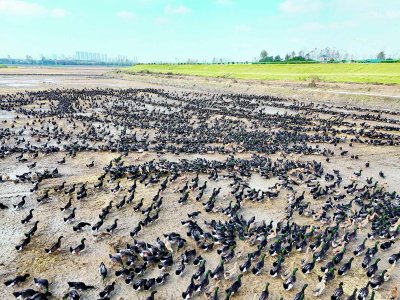
稻田藏“鸭军”,浦口2万只鸭组团“打工”
Nan Jing Ri Bao· 2025-11-13 00:03
Group 1 - The core concept of the article is the "rice-duck co-cultivation" model, which integrates duck farming with rice cultivation to enhance agricultural productivity and sustainability [3][4]. - In the "rice-duck co-cultivation" system, ducks help control pests, weeds, and provide natural fertilizer, while rice fields offer a habitat and food for the ducks, creating a mutually beneficial ecological cycle [4]. - The village of Youlian has expanded its duck farming from 9,000 ducks last year to 20,000 this year, with plans to increase to 40,000 ducks next year, aiming to generate an additional income of 500,000 yuan for the village [5]. Group 2 - The implementation of the "rice-duck co-cultivation" model has been supported by the establishment of standardized duck houses and a professional management team to ensure the health and productivity of the ducks without harming rice growth [4]. - The village has successfully connected with local markets and events to expand the sales channels for their duck products, indicating a strategic approach to market integration [5]. - Future plans include the development of a brand for their agricultural products and the establishment of a practical training base for the "rice-duck classroom," promoting standardized and branded agricultural practices [5].