老派恋爱

Search documents
测一测:一份“老式人类”自查表,你“确诊”了吗?
Xin Lang Cai Jing· 2026-01-28 16:48
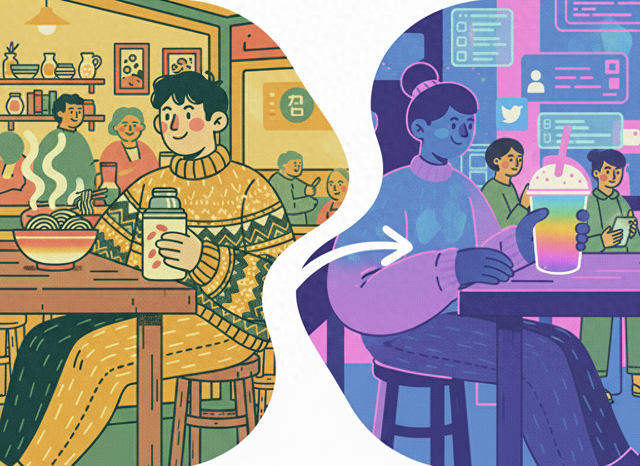
Core Perspective - A new trend among young people is emerging, identified as "old-fashioned humans," who prefer a lifestyle that is less focused on trends and more on comfort and authenticity [1][3][12] Group 1: Lifestyle Choices - Young individuals are increasingly identifying as "old-fashioned humans," contrasting with the trend-driven lifestyle that prioritizes novelty and visual appeal [3][12] - A self-checklist has been created by netizens to determine if one aligns with the "old-fashioned" lifestyle, focusing on behaviors like avoiding trendy food and clothing [3][12] - The lifestyle of "old-fashioned humans" includes enjoying simple pleasures such as local eateries and traditional foods, as exemplified by a student who prefers a small, unpretentious restaurant for her meals [5][6] Group 2: Emotional Connections - The concept of "old-fashioned" extends beyond food to emotional connections, with individuals finding comfort in traditional foods that evoke memories and feelings of nostalgia [6][9] - For some, traditional foods serve as emotional containers, linking them to cherished memories and family connections, highlighting the deeper significance of these choices [6][7][9] Group 3: Relationship Dynamics - The trend of "old-fashioned love" is gaining traction, with young people expressing a desire for slower, more meaningful relationships that prioritize depth over speed [17][19] - Characteristics of "old-fashioned partners" include being stable, polite, and traditional, emphasizing a slower pace in romantic interactions [19][20] - Young individuals are increasingly seeking relationships that allow for gradual emotional development, contrasting with the fast-paced nature of modern dating [20][22] Group 4: Societal Reflections - The rise of the "old-fashioned" lifestyle reflects a collective shift among young people from a performance-oriented existence to a more introspective and grounded approach to life [25][26] - This trend is not merely nostalgic but represents a conscious choice to prioritize comfort and authenticity in a fast-paced, competitive environment [25][26] - Experts suggest that this movement towards "old-fashioned" living is a necessary transitional phase, allowing young people to recharge and prepare for future challenges while maintaining a balance between tradition and innovation [27][28]