股权分散

Search documents
银之杰连续五年预亏,股价震荡下行,机构关注度低
Jing Ji Guan Cha Wang· 2026-02-12 01:32
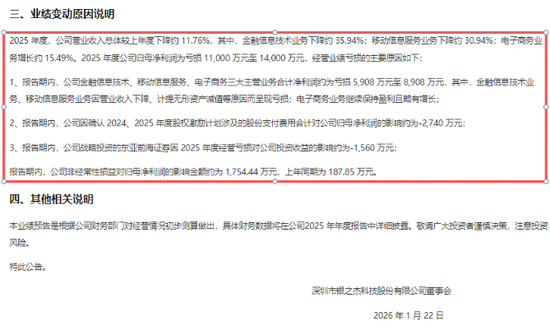
Core Viewpoint - The company, Yinzhijie, is expected to report a net loss of 110 million to 140 million yuan for the year 2025, marking its fifth consecutive year of losses due to significant declines in its financial information technology and mobile information service revenues, alongside impairment charges and strategic investment losses [1] Financial Performance - The financial information technology business revenue is projected to decline by approximately 35.94% - The mobile information service business revenue is expected to decrease by around 30.94% - The only positive aspect is the e-commerce business, which is anticipated to grow by about 15.49%, but this growth is insufficient to offset the overall decline [1] Corporate Structure and Governance - Starting from May 2025, Yinzhijie will operate without a controlling shareholder or actual controller, as the joint control agreement among the previous controlling shareholders has expired and will not be renewed - The major shareholder, He Ye, reduced his holdings by approximately 775 million yuan in 2025, raising concerns about the stability of strategic decision-making [2] Stock Performance - On February 5, 2026, Yinzhijie's stock price increased by 2.15%, with a trading volume of 1.398 billion yuan and a turnover rate of 5.39%, indicating high short-term investor interest - However, the stock price subsequently declined, closing at 38.66 yuan on February 11, down 3.18% from February 5, with a nearly 20-day decline of 17.95%, underperforming compared to the broader market and industry indices - The current technical analysis shows the stock price fluctuating near the lower Bollinger Band at 36.71 yuan, with a resistance level at 43.85 yuan [3] Institutional Perspectives - Institutional interest in Yinzhijie is relatively low, with the latest sentiment being neutral and no recent research records available - Profit forecasts from some institutions estimate a net profit of 71 million yuan for 2025, which significantly contrasts with the company's loss forecast - The fund holding ratio is only 0.04%, reflecting cautious market sentiment [4]

银之杰2025年又现预亏,无实控人格局添隐忧
Xin Lang Cai Jing· 2026-01-28 08:34
Core Viewpoint - The company Silver Zhijie (300085.SZ) is expected to report a net profit loss of between 1.1 billion to 1.4 billion yuan for the year 2025, marking its fifth consecutive year of losses since 2021 [1][6][20] Group 1: Continuous Losses and Business Pressure - The company anticipates a net profit loss of 1.4 billion to 1.1 billion yuan for 2025, compared to a loss of 1.29 billion yuan in the previous year [2][12] - The estimated loss for the fourth quarter of 2025 is projected to be between 50.6 million to 80.6 million yuan, significantly larger than the loss of 5.92 million yuan in the third quarter, representing an increase of over 8.55 times [2][12] - The main business segments, including financial information technology and mobile information services, are expected to incur a combined loss of approximately 5.908 million to 8.908 million yuan due to declining revenues and impairment of intangible assets [2][4][12] - The company has confirmed that non-recurring gains and losses will impact the net profit by approximately 17.54 million yuan, compared to 1.88 million yuan in the previous year [3][13] Group 2: Governance and Shareholding Structure - The company has entered a state of "no controlling shareholder and no actual controller" since May 26, 2025, following the expiration of a joint control agreement among its original controlling shareholders [7][17] - The current shareholding structure is highly dispersed, with no single shareholder holding more than 15%, leading to concerns about governance and strategic decision-making stability [8][18] - The top ten shareholders collectively hold 44.87% of the shares, indicating a lack of decisive influence over company decisions [18] - The original controlling shareholders have been reducing their stakes since 2016, contributing to the dilution of control and increasing the risk of governance issues [19][20]