节能降碳协同治理

Search documents
2026-2032年烟气治理行业细分市场调研及投资可行性分析报告
Xin Lang Cai Jing· 2026-01-21 13:49
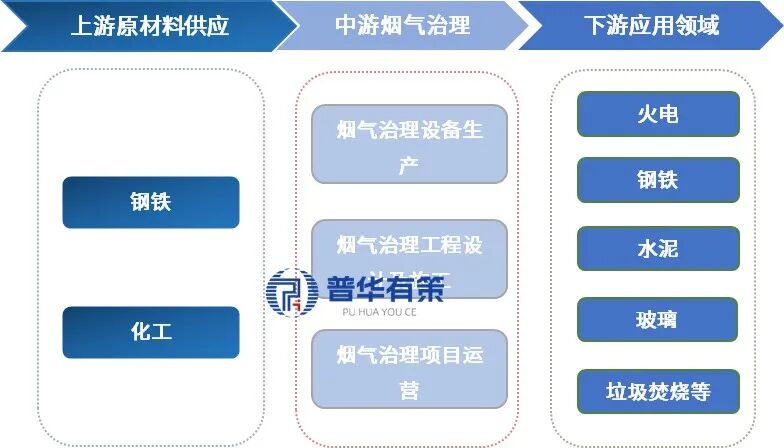
Industry Overview - The flue gas treatment industry can be categorized into dust removal, desulfurization, and denitrification based on the treatment targets, and further divided into power and non-power sectors based on industry attributes [1][2] - The development of the flue gas treatment industry in China is significantly influenced by relevant policies and standards, showcasing a clear policy-driven characteristic [2][3] Development History - The history of flue gas treatment in China can be divided into four key phases, with a focus on dust removal during the "Fifteen" period (2001-2005), desulfurization during the "Eleventh Five-Year" period (2006-2010), denitrification during the "Twelfth Five-Year" period (2011-2015), and a shift towards ultra-low emissions in the "Thirteenth" and "Fourteenth Five-Year" periods [3][4] Industry Chain - The flue gas treatment industry consists of three main stages: equipment manufacturing, engineering design and construction, and project operation and maintenance [4][5] - The upstream includes general equipment manufacturers and specialized equipment suppliers, while the downstream targets high-pollution industries such as power generation, steel, cement, and glass [4][5] Competitive Landscape - The competitive landscape of the flue gas treatment industry is characterized by concentration at the top, clear tier differentiation, and diverse segmentation, with a shift from equipment competition to a comprehensive capability competition involving technology, engineering, operation, and resource utilization [7][8] - The industry forms three competitive tiers, with leading companies dominating large projects and smaller firms focusing on niche markets [8] Industry Trends - Continuous policy deepening is driving the industry towards refined and systematic governance, with an emphasis on multi-pollutant collaborative treatment and enhanced regulatory oversight [9][10] - Non-power sector governance is becoming the main growth driver as the power sector completes its ultra-low emission upgrades, leading to increased demand in industries like steel and construction [9][10] - The integration of AI and smart technologies is enhancing operational efficiency, transitioning the industry from equipment provision to intelligent operation [10][11] - Industry consolidation is accelerating, with companies offering comprehensive solutions becoming dominant, while smaller firms seek breakthroughs through specialization [11][12] - The focus on green low-carbon initiatives and resource utilization is becoming a significant development direction, promoting energy recovery and resource recycling technologies [12][13] Entry Barriers - Technical barriers exist due to the complexity of flue gas treatment systems, which require integration of various technologies and compliance with stringent performance standards [13][14] - Qualification barriers are present as companies must meet specific regulatory requirements to participate in flue gas treatment projects, creating challenges for new entrants [14][15] - Brand and experience barriers are significant, as clients prefer established firms with proven track records, making it difficult for new entrants to gain market share quickly [15][16]