行星内部结构探测

Search documents
首次确证!火星存在固态内核
财联社· 2025-09-04 16:07
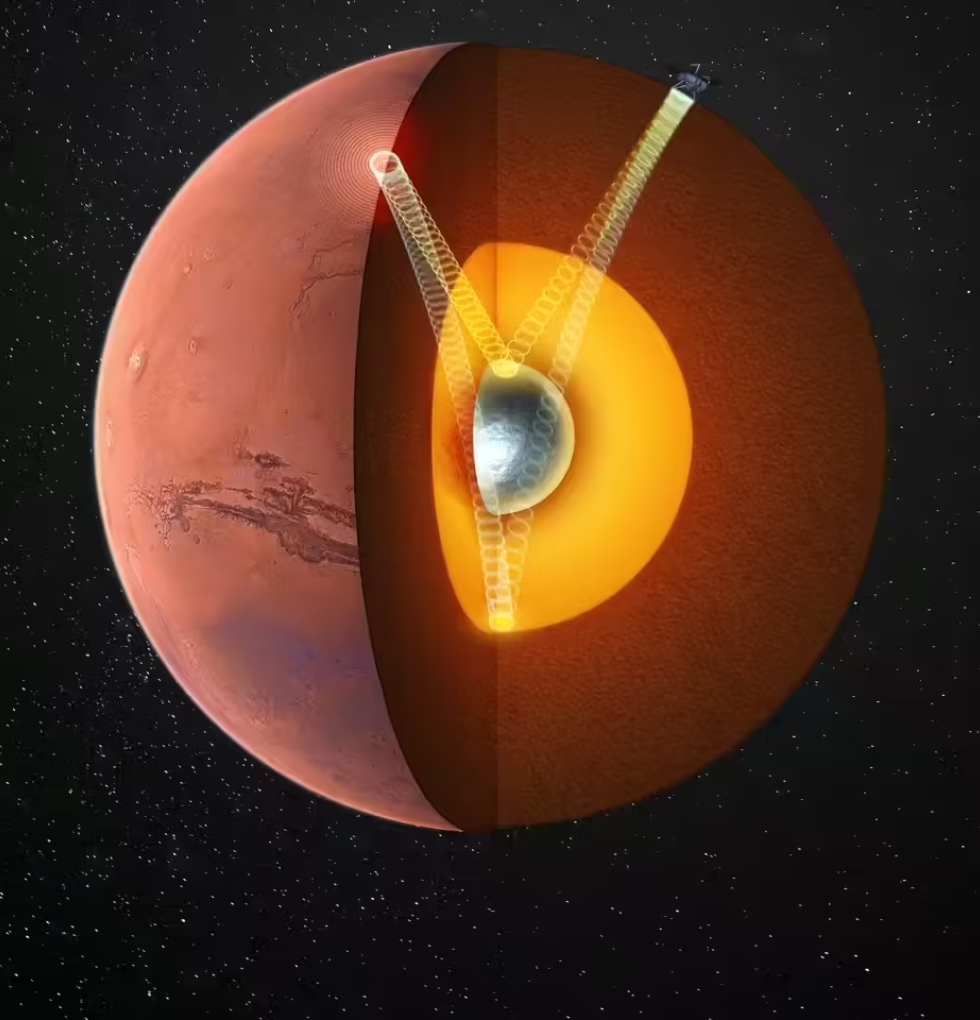
Core Viewpoint - The research team confirmed the existence of a solid inner core on Mars, measuring approximately 600 kilometers in radius, composed mainly of a crystallized iron-nickel alloy rich in light elements, marking a significant advancement in planetary science [1][2][3]. Group 1: Research Findings - The study utilized seismic data from NASA's InSight lander, analyzing 23 high signal-to-noise ratio seismic events to identify key seismic phases that traverse the Martian core [2]. - The identification of the PKiKP seismic phase provided evidence for the solid inner core, with the core's radius constituting about one-fifth of Mars' total radius [2]. - The research revealed a 30% velocity jump and a 7% density difference between the outer and inner cores, indicating a layered structure with a liquid outer core and a solid inner core [2]. Group 2: Implications and Future Research - This research is the first to confirm a solid inner core outside Earth, suggesting a similar core-mantle differentiation structure between Mars and Earth [3]. - The developed seismic methodology for Mars will serve as a reference for future lunar exploration and the study of other celestial bodies' deep structures [3]. - The findings contribute to understanding the evolution of Mars' magnetic field and provide a basis for comparing the internal evolution of Earth and other terrestrial planets [2][3].

中国科大首次证实发现火星存在固态内核
Huan Qiu Wang· 2025-09-04 04:22
Core Insights - A significant breakthrough in planetary science has been achieved by a team from the University of Science and Technology of China, confirming the existence of a solid inner core on Mars with a radius of approximately 600 kilometers, primarily composed of a crystallized iron-nickel alloy rich in light elements [1][4] Group 1: Research Findings - The research utilized seismic data from NASA's InSight lander, marking the first confirmation of a solid inner core on Mars, which is a critical step in understanding the internal structure of planets [1][3] - The study identified key seismic phases, including the PKiKP phase, which serves as a direct indicator of the solid inner core, providing strong evidence for its existence [4][5] - The analysis revealed a 30% velocity jump and a 7% density difference between Mars' outer and inner core, indicating a complex internal structure [5] Group 2: Implications - This discovery enhances the understanding of the internal structure of terrestrial planets, confirming similarities between Mars and Earth regarding core-mantle differentiation [5] - The innovative seismic analysis methods developed in this research could serve as a reference for future lunar exploration and the study of other celestial bodies [5] - The findings underscore China's growing capabilities and influence in the field of planetary science and geophysics [5]