视觉 - 语言模型(VLMs)

Search documents
当无人机遇到AI智能体:多领域自主空中智能和无人机智能体综述
具身智能之心· 2025-06-30 12:17
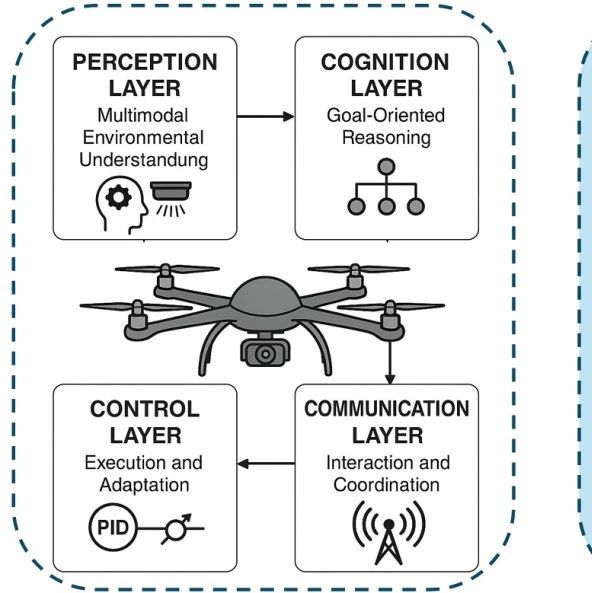
Core Insights - The article discusses the evolution of Unmanned Aerial Vehicles (UAVs) into Agentic UAVs, which are characterized by autonomous reasoning, multimodal perception, and reflective control, marking a significant shift from traditional automation platforms [5][6][11]. Research Background - The motivation for this research stems from the rapid development of UAVs from remote-controlled platforms to complex autonomous agents, driven by advancements in artificial intelligence (AI) [6][7]. - The increasing demand for autonomy, adaptability, and interpretability in UAV operations across various sectors such as agriculture, logistics, environmental monitoring, and public safety is highlighted [6][7]. Definition and Architecture of Agentic UAVs - Agentic UAVs are defined as a new class of autonomous aerial systems with cognitive capabilities, situational adaptability, and goal-directed behavior, contrasting with traditional UAVs that operate based on predefined instructions [11][12]. - The architecture of Agentic UAVs consists of four core layers: perception, cognition, control, and communication, enabling autonomous sensing, reasoning, action, and interaction [12][13]. Enabling Technologies - Key technologies enabling the development of Agentic UAVs include: - **Perception Layer**: Utilizes a suite of sensors (RGB cameras, LiDAR, thermal sensors) for real-time semantic understanding of the environment [13][14]. - **Cognition Layer**: Acts as the decision-making core, employing techniques like reinforcement learning and probabilistic modeling for adaptive control strategies [13][14]. - **Control Layer**: Converts planned actions into specific flight trajectories and commands [13][14]. - **Communication Layer**: Facilitates data exchange and task coordination among UAVs and other systems [13][14]. Applications of Agentic UAVs - **Precision Agriculture**: Agentic UAVs are transforming precision agriculture by autonomously identifying crop health issues and optimizing pesticide application through real-time data analysis [17][18]. - **Disaster Response and Search and Rescue**: These UAVs excel in dynamic environments, providing real-time adaptability and autonomous task reconfiguration during disaster scenarios [20][21]. - **Environmental Monitoring**: Agentic UAVs serve as intelligent, mobile environmental sentinels, capable of monitoring rapidly changing ecosystems with high spatial and temporal resolution [22][23]. - **Urban Infrastructure Inspection**: They offer a transformative approach to infrastructure inspections, enabling real-time damage detection and adaptive task planning [24]. - **Logistics and Smart Delivery**: Agentic UAVs are emerging as intelligent aerial couriers, capable of executing complex delivery tasks with minimal supervision [25][26]. Challenges and Limitations - Despite the transformative potential of Agentic UAVs, their widespread application faces challenges related to technical constraints, regulatory hurdles, and cognitive dimensions [43].