证据裁判原则

Search documents
一起再审改判无罪案入选年度法治实施十大事件,胡云腾点评
Xin Lang Cai Jing· 2026-01-02 05:02
Core Viewpoint - The case of wrongful conviction involving Che and others has been recognized as a significant event in China's legal system, highlighting the importance of correcting miscarriages of justice and the commitment of the judiciary to uphold fairness and justice [1][4]. Group 1: Case Overview - The case involves the wrongful conviction of Che and others for the murder and rape of a 16-year-old student, Wang, who was found dead in 2001. The initial convictions led to Che receiving a death sentence and Li a life sentence, while another individual was sentenced for perjury [1]. - After multiple appeals and a lengthy legal process, the Supreme People's Court declared Che, Li, and the other individual not guilty on September 28, 2025, after Che had served 7,863 days in prison [1]. Group 2: Judicial Insights - The case exemplifies the need for strict adherence to legal principles and the importance of judicial oversight to prevent wrongful convictions. It emphasizes the necessity for judicial bodies to be diligent in their roles throughout the legal process [2][3]. - Hu Yunteng, a legal scholar, pointed out that the case reveals systemic issues within the judicial process, including the need for better checks and balances among the prosecution, defense, and judiciary to prevent miscarriages of justice [3]. Group 3: Recommendations for Improvement - The judiciary must implement strict rules for the exclusion of illegal evidence, uphold procedural fairness, and ensure that evidence is evaluated rigorously to prevent wrongful convictions [2][3]. - There is a call for enhanced cooperation and accountability among judicial entities to address cases with insufficient evidence, advocating for the principle of "presumption of innocence" to be upheld rigorously [3].
服刑7年出狱5年,始终没认罪!福建女商人林惠荣坚持申诉,今天被改判无罪
Mei Ri Jing Ji Xin Wen· 2025-12-23 12:36
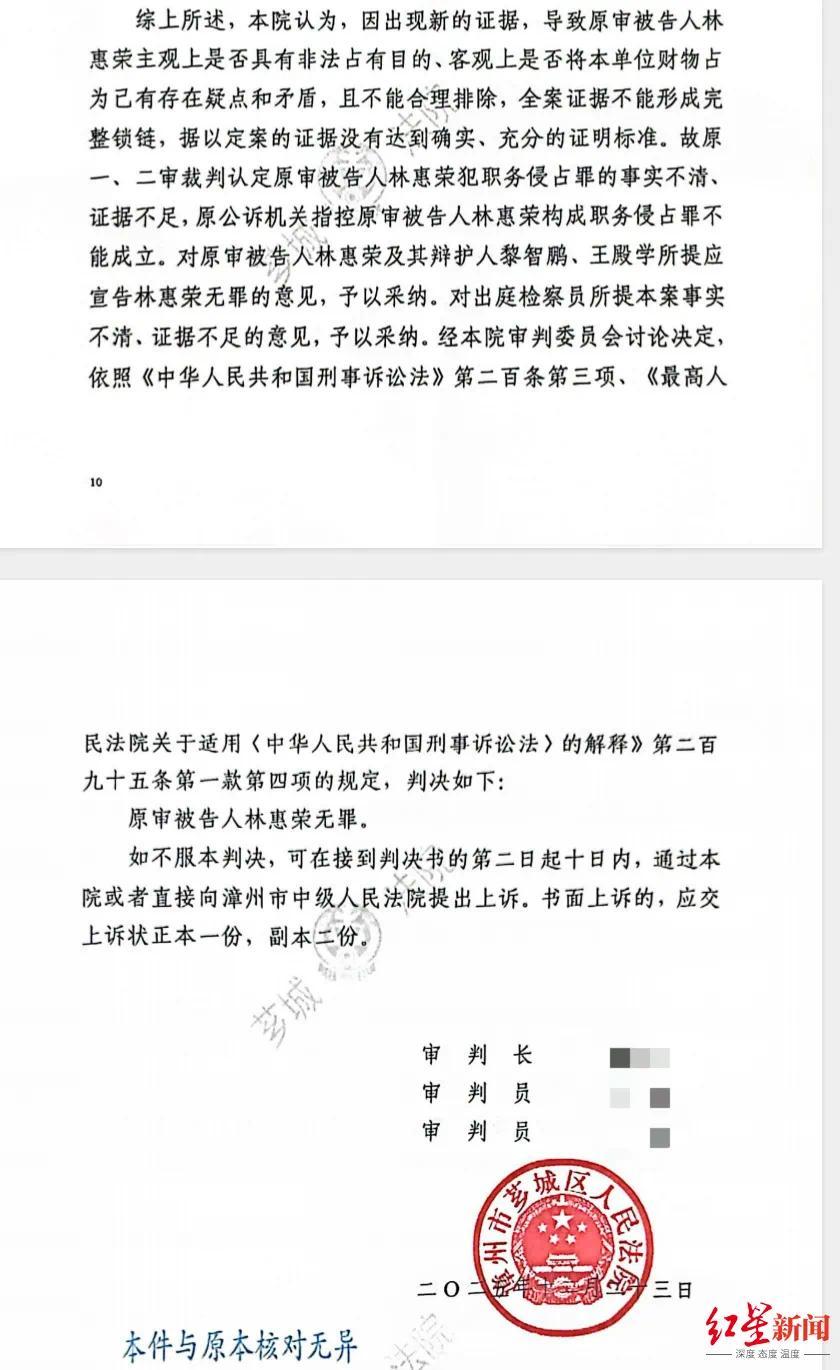
Core Viewpoint - The case of Lin Huirong, a former businesswoman from Fujian, has culminated in a not guilty verdict after a lengthy legal battle, highlighting issues of evidence sufficiency and judicial fairness in the context of corporate governance and criminal law [1][11]. Group 1: Case Background - Lin Huirong was the legal representative of Jinfurong Trading (Fujian) Co., Ltd., which was established in 2010 with a registered capital of 10 million yuan [2]. - The company faced operational difficulties due to financial constraints, leading to a partnership agreement where Lin Huirong held 40% of the shares and other partners held 60% [2]. - Disputes arose in 2012 regarding financial misconduct, resulting in the withdrawal of goods valued at over 1.6 million yuan by the partners [2]. Group 2: Legal Proceedings - In May 2016, Lin Huirong was convicted of embezzlement and sentenced to seven years in prison, a decision upheld by the appellate court later that year [3][4]. - Throughout her imprisonment, Lin maintained her innocence and continued to appeal her conviction, even after her release in 2020 [5]. Group 3: New Evidence and Reassessment - The case saw a significant turning point with the emergence of new evidence, particularly regarding the legitimacy of the shareholding claims made by the other partners [6][8]. - A judicial review in May 2023 led to a re-examination of the case, with the higher court finding that the original evidence was insufficient and unclear [7]. Group 4: Final Verdict and Implications - On December 23, 2025, the court ruled Lin Huirong not guilty, citing doubts about her intent to illegally occupy shares and the lack of conclusive evidence [9][11]. - The ruling emphasizes the importance of evidence-based judgments in criminal cases and reflects a commitment to correcting judicial errors, aligning with national policies to protect private enterprises [11].