
金星探测

Search documents
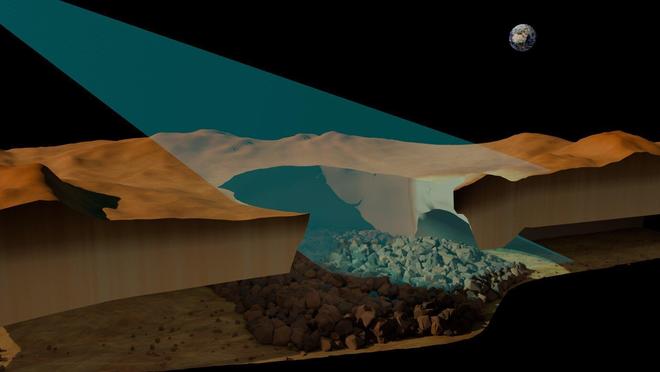
金星可能有条大型“地下通道”
Huan Qiu Wang Zi Xun· 2026-02-12 01:45
Core Insights - Venus and Earth are similar in size and origin but have vastly different environments, with Venus having surface temperatures exceeding 480°C and atmospheric pressure nearly 100 times that of Earth [2] - Radar data from NASA's Magellan spacecraft revealed that Venus's surface is dominated by volcanic features, indicating a geological evolution heavily influenced by volcanic activity [2] Group 1 - The research focuses on the presence of collapse pits or "skylights" on Venus's surface, which may indicate the existence of underground cavities [3] - A significant collapse pit was discovered in the Nix Mountains region, suggesting a possible connection to a large underground channel with a diameter of approximately 1 kilometer and a depth exceeding 375 meters [3] - The unique environmental conditions on Venus, such as lower surface gravity and denser atmosphere, may allow for the formation of larger underground cavities compared to Earth [3] Group 2 - Although the findings are promising, the evidence remains indirect, and confirmation of these channels requires higher resolution radar and new exploration missions [3] - Future missions, including ESA's "EnVision" and NASA's "Veritas," are expected to provide advanced radar and imaging capabilities to further investigate Venus's surface and subsurface structures [3]

苏联探测器抵达金星始末
Huan Qiu Wang Zi Xun· 2025-11-23 23:11
Core Insights - The successful soft landing of the Soviet "Venera 9" on Venus on October 22, 1975, marked a significant milestone in space exploration, showcasing the capabilities of Soviet space scientists and technology [1] Group 1: Technological Achievements - The "Venera 4" mission in 1967 provided crucial data about Venus's atmosphere, revealing a dry environment primarily composed of carbon dioxide and surface temperatures reaching a lethal 276 degrees Celsius [2] - The "Venera 9" and "Venera 10" missions utilized a dual spacecraft approach to enhance the success rate of the exploration, with both spacecraft weighing five times more than their predecessors due to additional scientific instruments and fuel [3] - The "Venera 9" and "Venera 10" spacecraft were launched from Baikonur Cosmodrome, with "Venera 9" launched on June 8 and "Venera 10" on June 14, covering over 300 million kilometers in 136 days [3] Group 2: Scientific Discoveries - The "Venera 9" successfully transmitted data and images back to Earth for 53 minutes after landing, providing humanity with the first images of another planet's surface [3] - The two spacecraft discovered diverse geological features on Venus, including sharp-edged rocks and solidified lava, and identified regions with both mountains and plains [4] - The missions also revealed valuable information about Venus's climate, including the first detection of thunderstorms and lightning in its cloud layers, leading to hypotheses about the planet's past oceanic conditions [4] Group 3: Future Implications - The success of the Venus exploration missions demonstrated the effectiveness of modern technology in scientific endeavors, paving the way for future exploration and advancements in space research [5] - The achievements of the 1975 missions have inspired ongoing interest in manned missions to Venus, contingent upon advancements in protective technologies for harsh atmospheric conditions [5]
俄发布月球探测新时间表:“月球-26”将于2028年发射
Yang Shi Xin Wen· 2025-08-22 09:19
Core Viewpoint - Russia's upcoming lunar exploration missions are set to begin in 2028 with the launch of the "Luna-26" spacecraft, while the Venus exploration mission has been postponed to 2036 [1] Group 1: Lunar Exploration Missions - The "Luna-26" spacecraft is scheduled to be launched in 2028 to enter lunar orbit [1] - Two "Luna-27" spacecraft will be launched in 2029 and 2030 to explore the lunar poles [1] - The "Luna-28" mission aims to return lunar soil samples to Earth within three to four years after the "Luna-27" missions [1] - A lunar station, "Luna-29," is also planned for future deployment [1] - By 2035-2036, a heavy lunar rover, "Luna-30," will be sent to the Moon for long-term scientific research [1] Group 2: Venus Exploration Missions - The launch of the new Russian automatic interplanetary station "Venera-D" has been rescheduled to 2036 [1] - Previous statements indicated that the Venus exploration mission could be postponed to 2034-2035, which is now later than the newly set date [1]