
金融司法与自律监管协同联动

Search documents
制度优化 司法创新 双轮驱动化解私募治理清算困局
Zhong Guo Zheng Quan Bao· 2025-11-11 20:47
Core Viewpoint - The recent revisions to the Private Investment Fund Registration Guidelines No. 3 by the Asset Management Association of China, in collaboration with the Beijing Financial Court, signify a new phase in the risk management of private funds, emphasizing a combination of self-regulation and judicial practice [1][6]. Summary by Relevant Sections Regulatory Changes - The revised guidelines optimize the management change process and respect contractual autonomy, providing a clear institutional path to address issues of "lost" or "ineffective" fund managers [1][2]. - The new guidelines reduce the number of articles from 19 to 16, reflecting a streamlined approach to managing fund changes [2]. - Key revisions include respecting contractual agreements, simplifying decision-making documents, clarifying procedural bases, focusing on management changes, and expanding the applicability of management changes [2][3]. Judicial Support - The Asset Management Association of China and the Beijing Financial Court released two typical cases that provide judicial examples for addressing the challenges posed by ineffective fund managers [4][5]. - These cases illustrate how courts can facilitate the resolution of fund management issues and protect investor rights through flexible legal measures [4][5]. Industry Implications - The new guidelines and judicial cases are expected to enhance the operational efficiency of changing fund managers, thereby addressing existing risks and safeguarding investor interests [3][6]. - The collaborative approach between regulatory and judicial bodies marks a significant step towards a more transparent and sustainable development of the private fund market [6][7]. Future Directions - The Asset Management Association of China plans to continue strengthening financial legal cooperation under the guidance of the China Securities Regulatory Commission, aiming to create a more regulated and vibrant industry ecosystem [7].
制度优化 司法创新双轮驱动化解私募治理清算困局
Zhong Guo Zheng Quan Bao· 2025-11-11 20:09
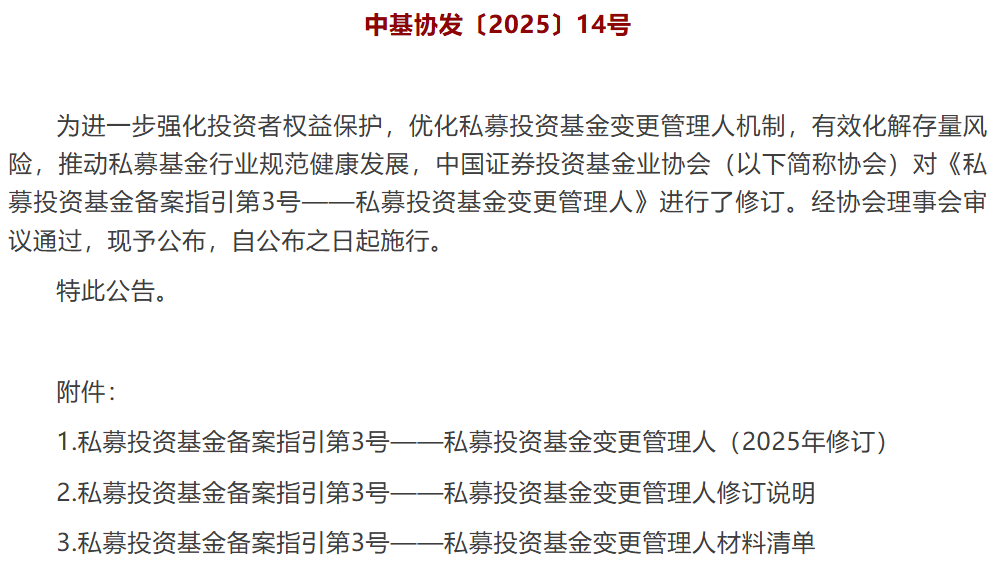
具体来说,主要修订内容包含五个方面:一是尊重合同约定,增加"生前遗嘱"条款;二是简化决议文 件,优化投资者决议变更管理人程序;三是明确办理依据,畅通司法仲裁与自律衔接;四是聚焦管理人 变更,删除成立清算组相关条款;五是响应投资者诉求,扩大管理人变更适用范围。 君合律师事务所王曼表示,本次修订在调研行业意见、总结司法实践基础上,对原有规则进行了系统优 化,旨在提升制度的适用性与操作性,推动形成"以契约自治为基础、以自律监管为保障"的风险处置机 制。新版指引通过优化表决机制、简化程序要求、畅通司法衔接、扩大适用范围等关键环节的系统改 进,显著提升了私募基金变更管理人的操作性与效率,为化解存量风险、维护投资者权益提供了制度保 障。 近日,中国证券投资基金业协会发布修订后的《私募投资基金备案指引第3号——私募投资基金变更管 理人》,并与北京金融法院联合推出两则典型案例,标志着私募基金风险处置步入"自律规范+司法实 践"协同发力新阶段。 新规通过优化变更程序、尊重契约自治等五大方面修订,为化解管理人"失联""失能"困境提供了清晰的 制度路径;而配套案例则从代表诉讼与强制执行等司法层面,为破解清算僵局提供了关键实操范例。 ...
私募新规+典型案例!这些重点需关注
Zhong Guo Zheng Quan Bao· 2025-11-11 13:28
Core Viewpoint - The revised guidelines for private equity fund management aim to address issues related to "missing" or "incapacitated" fund managers, facilitating smoother transitions and protecting investors' rights [3][4]. Group 1: Regulatory Changes - The China Securities Investment Fund Industry Association has released a revised version of the "Private Investment Fund Filing Guidelines No. 3," which clarifies the standard procedures and documentation required for changing fund managers [3][4]. - The revision compresses the original 19 articles into 16, reflecting the need for adaptation to current industry realities and judicial practices [3][4]. Group 2: Key Amendments - The revised guidelines include five main changes: 1. Respect for contractual agreements with the addition of a "living will" clause 2. Simplification of resolution documents to optimize the process for investors to change fund managers 3. Clarification of the basis for processing, enhancing the connection between judicial arbitration and self-regulation 4. Focus on manager changes by removing clauses related to the establishment of liquidation groups 5. Expansion of the applicability of manager changes in response to investor demands [4][5]. Group 3: Judicial Support - The association, in collaboration with the Beijing Financial Court, has published two typical cases addressing the issue of incapacitated fund managers, providing judicial examples for fund risk resolution [5][6]. - These cases illustrate how investor meetings can authorize representatives to handle fund liquidation and legal claims, thereby confirming the legitimacy of such actions in court [5][6]. Group 4: Future Directions - The new guidelines and judicial cases reflect a coordinated effort between financial regulation and judicial enforcement, aiming to enhance the quality and transparency of the private equity fund industry [7]. - The association plans to continue strengthening financial legal cooperation under the guidance of the China Securities Regulatory Commission, promoting deeper governance within the private equity sector [7].

金融司法与自律监管协同联动 北京金融法院联合中基协发布重磅成果
Zheng Quan Ri Bao Wang· 2025-10-28 11:06
Core Insights - The Beijing Financial Court and the Asset Management Association of China (AMAC) jointly released revised guidelines for private investment fund manager changes and typical cases, addressing issues related to manager disconnection and incapacity in the private fund industry [1][2] - The initiative aims to enhance investor protection and maintain market order amid the rapid evolution of the private fund sector, which has seen a rise in the elimination of underperforming managers and associated governance challenges [1] Group 1 - The release of the revised guidelines is a collaborative effort to tackle the challenges posed by disconnected and incapacitated fund managers, which have hindered the high-quality development of the industry [1] - The guidelines were developed in response to the requirements of the Central Financial Work Conference and the new "National Nine Articles," focusing on judicial support and self-regulatory oversight [1][2] - The AMAC has established a standardized path for changing fund managers and improved investor relief mechanisms under the guidance of the China Securities Regulatory Commission and support from the Beijing Financial Court [1] Group 2 - The Beijing Financial Court has published two typical cases that provide judicial support for orderly exits of related institutions and the resolution of risks in existing funds [2] - One case allows investors to authorize representative litigation through a fund holder meeting resolution, addressing the legitimacy and feasibility of this approach in situations where managers are unresponsive [2] - Another case permits creditors to secure their claims by providing guarantees, balancing the interests of both the executing party and potential creditors, thus exploring new pathways to resolve liquidation deadlocks [2]