
长读长测序

Search documents
Pacific Biosciences of California (NasdaqGS:PACB) FY Conference Transcript
2026-03-02 20:32
Summary of Pacific Biosciences of California FY Conference Call Company Overview - **Company**: Pacific Biosciences of California (NasdaqGS:PACB) - **Event**: FY Conference Call on March 02, 2026 Key Industry Insights - **Sequencing Technology**: The company focuses on long-read sequencing technology, which is gaining traction in clinical markets, particularly for whole genome sequencing in rare diseases and carrier screening applications [4][8][52] - **Competitive Landscape**: The company positions itself against competitors like Illumina, emphasizing its unique capabilities in long-read sequencing and the ability to provide comprehensive genomic data [10][11][15] Financial Performance and Projections - **2025 Performance**: The company reported a 55% growth in clinical consumables shipments, indicating strong demand and market penetration [32][44] - **2026 Guidance**: The company anticipates continued growth in clinical revenue, driven by expanding customer projects and the introduction of new products like SPRQ-Nx chemistry [6][41][66] - **Academic Market Challenges**: The U.S. academic market remains challenging, with a significant revenue gap of approximately $30 million to recover, but the company expects to grow outside the U.S., particularly in Europe [16][22][24] Product Developments - **SPRQ-Nx Chemistry**: This new product is expected to enhance performance, increase throughput, and lower costs for customers, making it competitive with short-read sequencing [5][6][73] - **Revio Utilization**: Current average utilization of Revio systems is around 20%, with expectations to increase as projects scale and the new chemistry is adopted [89][94] Market Opportunities - **Rare Diseases**: The primary focus area, with an estimated 300-400 million patients globally, highlighting the need for improved diagnostic capabilities [52][54] - **Carrier Testing**: The PureTarget 2.0 assay is gaining traction, allowing customization for specific genes across the genome [56] - **Newborn Screening**: The company is involved in initiatives in Thailand to integrate whole genome sequencing into newborn screening programs, showcasing the economic value of sequencing [57][60] Strategic Priorities - **Higher Throughput Sequencer Development**: A key priority to enable larger clinical testing laboratories to adopt the technology [65] - **Health Economics Studies**: Focus on demonstrating the cost-effectiveness of HiFi sequencing compared to other technologies [66][70] Conclusion - **Strong Positioning**: The company believes it is in a better position than ever, with a comprehensive product portfolio, improving financial metrics, and a strong global presence [96][97] - **Future Outlook**: The leadership anticipates significant growth opportunities in 2026 and beyond, with a focus on expanding clinical applications and market share [99][101]

“寄生虫”DNA片段会破坏癌症基因组稳定性
Huan Qiu Wang Zi Xun· 2026-02-28 03:29
Core Viewpoint - The study published in "Science" reveals that LINE-1 (L1) elements, known as genetic "parasites," play a significant role in destabilizing cancer genomes, challenging traditional views on cancer evolution [1][2] Group 1: Research Findings - The research focuses on the abnormal activity of L1 elements in tumors, utilizing long-read sequencing technology to comprehensively depict the impact of these "jumping genes" on cancer genome structure [1] - A total of 6,418 jumping events were observed in 10 tumors with high L1 activity, with approximately 1 in every 40 jumps leading to large-scale structural alterations, including deletions and translocations, which are often undetectable by traditional short-read sequencing [1] Group 2: Implications for Cancer Evolution - About 65% of L1 events occur in the early stages of tumor evolution, primarily before the significant event of "whole-genome doubling," indicating that L1 activity is a crucial factor in early genomic reshaping during cancer formation rather than a consequence [2] - The lower methylation levels of L1 promoter regions in tumor tissues align with the hypothesis that epigenetic changes may awaken these dormant elements, providing new insights into the origins of genomic instability in cancer [2] Group 3: Future Directions - The findings emphasize the potential value of long-read sequencing in cancer research, suggesting it may guide the development of early intervention strategies in the future [2]
PacBio Q4 Earnings and Revenues Beat Estimates, Gross Margin Up
ZACKS· 2026-02-13 16:25
Core Insights - Pacific Biosciences of California, Inc. (PacBio) reported an adjusted loss per share of 12 cents in Q4 2025, an improvement from a loss of 20 cents per share in the previous year, exceeding the Zacks Consensus Estimate by 36.8% [1] - The company achieved total revenues of $44.6 million in Q4, reflecting a year-over-year increase of 13.8% and surpassing the Zacks Consensus Estimate by 9.4% [2] Revenue Breakdown - Revenues from the Americas reached $20.7 million, a 3% increase year over year [3] - The Asia-Pacific region generated $9.3 million in revenues, marking a 4% year-over-year growth [3] - The EMEA region saw revenues of $14.6 million, which is a significant 45% increase year over year [3] Segment Analysis - Total product revenues were $38.9 million, up 14.3% from the same quarter last year [4] - Instrument revenues accounted for $17.3 million, reflecting a 13.1% year-over-year increase, including sales of 21 Revio and 42 Vega sequencing systems [4] - Consumables revenues for Q4 were $21.6 million, up 14.9% year over year, with annualized Revio pull-through per system at $242,000 [5] Margin and Expense Trends - Adjusted gross profit increased by 44.7% year over year to $17.8 million, with adjusted gross margin expanding by 900 basis points to 41% [6] - Sales, general, and administrative expenses decreased by 18.2% year over year to $34.1 million, while research and development expenses fell by 16.7% to $22.9 million [6] - Total operating loss narrowed to $41.2 million from $153 million in the prior year [7] Financial Position and Guidance - PacBio ended Q4 2025 with cash and investments totaling $279.5 million, down from $298.7 million at the end of Q3 2025 [10] - For 2026, the company projects revenues to grow between 3% and 12% year over year, estimating total revenues of $165 million to $180 million [11] Strategic Developments - The company advanced its focus on long-read sequencing through various clinical and research initiatives, including joining the iHope initiative and collaborations with the n-Lorem Foundation and EspeRare [13] - PacBio launched CiFi, a new long-read 3C method, and completed the sale of its short-read sequencing assets for approximately $48.1 million, enhancing its financial position [14]


Axbio International Limited - B(H0129) - Application Proof (1st submission)
2025-11-10 16:00
The Stock Exchange of Hong Kong Limited and the Securities and Futures Commission take no responsibility for the contents of this Application Proof, make no representation as to its accuracy or completeness and expressly disclaim any liability whatsoever for any loss howsoever arising from or in reliance upon the whole or any part of the contents of this Application Proof. Application Proof of 安序源科技* Axbio International Limited (the "Company") (Incorporated in the Cayman Islands with limited liability) WARN ...
诺禾致源20251023
2025-10-23 15:20
Summary of the Conference Call for 诺禾致源 (Nuohe Zhiyuan) Company Overview - **Company**: 诺禾致源 (Nuohe Zhiyuan) - **Period**: January to September 2025 Key Financial Metrics - **Total Revenue**: 15.81 billion CNY, up 4.05% year-on-year [2][3] - **Q3 Revenue**: 5.41 billion CNY, up 3.47% year-on-year [3] - **Overseas Revenue**: 7.92 billion CNY, up 4.1% year-on-year, accounting for 50.09% of total revenue [2][3] - **Q3 Overseas Revenue**: 2.58 billion CNY, down 0.48% year-on-year [3] - **Domestic Revenue**: 7.89 billion CNY, up 4% year-on-year [2] - **Q3 Domestic Revenue**: 2.82 billion CNY, up 7.37% year-on-year, and up 8.61% quarter-on-quarter [5] - **Gross Margin**: 41.9%, down 0.7 percentage points year-on-year [10] - **Net Profit**: 1.16 billion CNY, down 10.17% year-on-year, with a net profit margin of 7.31% [11] - **R&D Investment**: 56.1 million CNY in Q3, focusing on emerging fields [12] Revenue Breakdown by Market - **Americas**: Q3 revenue down 12% due to changes in research funding and policy impacts [4] - **EMEA**: Q3 revenue down 12%, affected by project completion and funding transitions [4] - **Europe**: Q3 revenue up 19%, indicating strong performance [4] - **Customer Segmentation**: 70% of revenue from universities and research institutions, 30% from hospitals and enterprises [6] Product and Service Performance - **Life Sciences Research Services**: Revenue of 5.52 billion CNY, up 6.21% year-on-year [7] - **Monitoring and Sequencing Platform Services**: Revenue of 7.7 billion CNY, up 3.23% year-on-year, but Q3 revenue down 3.42% [7] - **Emerging Business Contributions**: Approximately 32% of total revenue, up 4 percentage points year-on-year, with a growth of about 20% [8] R&D and Innovation - **R&D Focus Areas**: Single-cell genomics, spatial genomics, proteomics, metabolomics, epigenetics, and long-read sequencing [12][18] - **AI Integration**: Progress in AI applications, particularly in omics data analysis and virtual cell modeling [20][28] Market Challenges and Strategies - **Domestic Market Competition**: Increased competition leading to a 30% price drop; company aims to reduce competition through mergers and acquisitions [16][23] - **Geopolitical Impact**: U.S. market affected by geopolitical tensions, but the company maintains strong relationships in key regions [21] - **Cash Flow Management**: Operating cash flow was negative 87 million CNY for the first nine months, but turned positive in Q3 at 77 million CNY [14] Future Outlook - **Expansion Plans**: Continued investment in overseas markets, including new laboratories in Singapore and Europe [30] - **Focus on NGS and AI**: Anticipated growth in NGS applications and AI integration to enhance research capabilities [24][28] Additional Insights - **Customer Base Growth**: Stable customer structure with a slight increase in contributions from universities and research institutions [6] - **Cash Flow Volatility**: Short-term fluctuations in cash flow due to proactive risk management strategies [14] - **Regulatory Environment**: Ongoing adjustments to align with changing policies in the domestic and international markets [26][27]

人类染色体“牵手”之谜揭开,罗伯逊易位融合点首次精确定位
Ke Ji Ri Bao· 2025-09-25 06:18
Core Insights - The research conducted by the Stowers Institute for Medical Research has successfully pinpointed the fusion points of human chromosomes during the formation of Robertsonian translocations, marking a significant milestone in understanding chromosomal behavior and stability [1][3] Group 1: Mechanism of Robertsonian Translocation - Robertsonian translocation occurs in approximately 1 in every 800 individuals, where two chromosomes fuse, leading to a unique chromosomal structure [3] - Carriers of Robertsonian translocations are often unaware of their condition, as they are generally healthy but may face infertility or miscarriage risks, and an increased likelihood of having children with Down syndrome [3] - The research utilized long-read sequencing technology to obtain complete sequences of Robertsonian translocated chromosomes, revealing that breakpoints are located within a repetitive DNA sequence known as SST1 [3][4] Group 2: Stability of Fusion Chromosomes - The study found that the mechanism of Robertsonian translocation involves the fusion of the long arms of two chromosomes while losing the short arms, resulting in 45 chromosomes instead of the typical 46 [3] - The stability of the fused chromosomes is attributed to the presence of two centromeres, with only one being active during cell division, preventing the chromosomes from being pulled in opposite directions [3] Group 3: Broader Implications - The SST1 sequence on chromosome 14 is arranged in a reverse order, allowing it to fuse with chromosomes 13 or 21, thus forming stable new structures that retain most of the original genetic information [4] - Robertsonian translocations are not exclusive to humans; they are also found in various plants and animals, providing new insights into the chromosomal differences across species in nature [5]
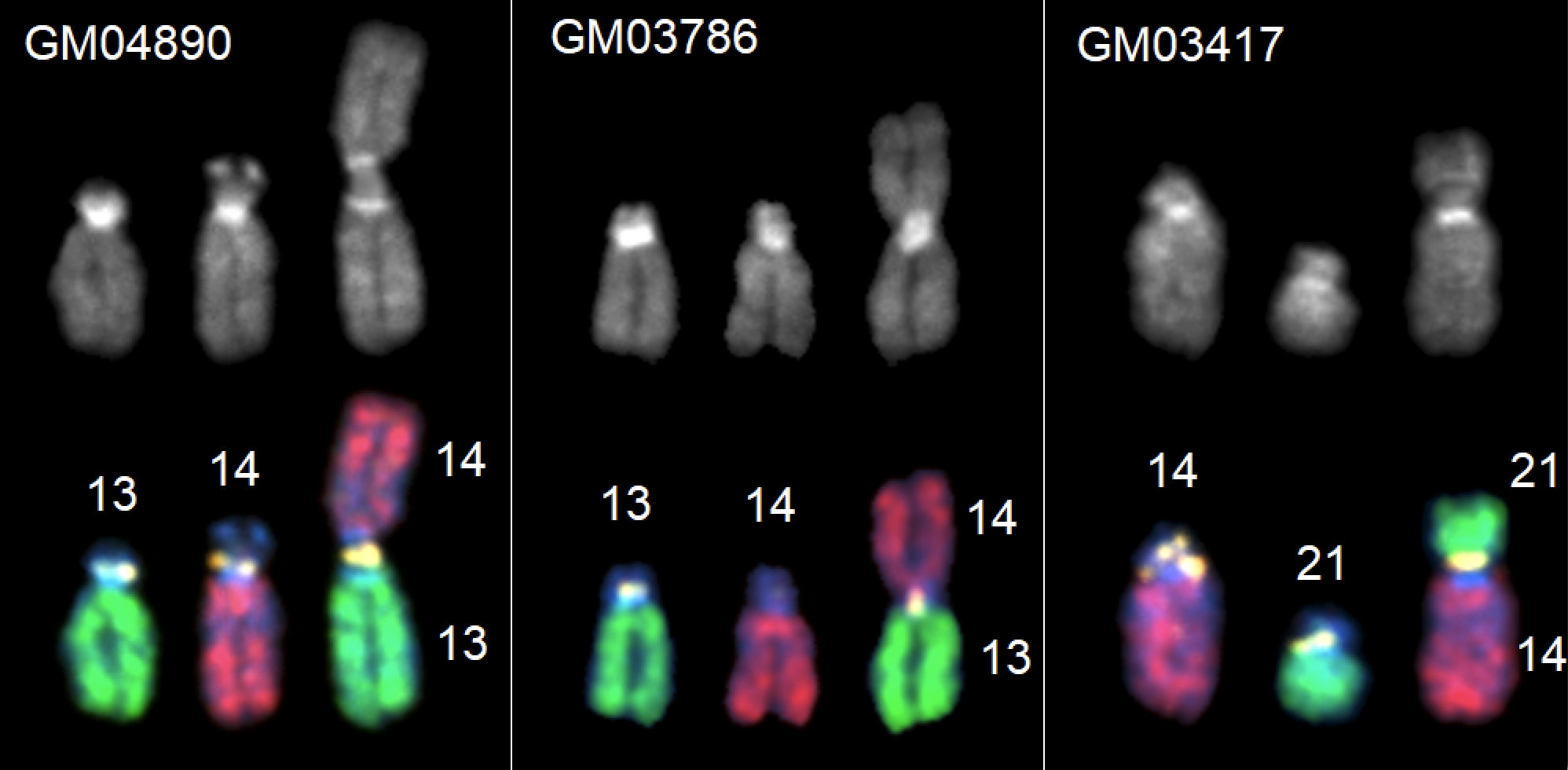
人类染色体“牵手”之谜揭开 罗伯逊易位融合点首次精确定位
Ke Ji Ri Bao· 2025-09-24 23:48
Core Insights - The research conducted by the Stowers Institute for Medical Research has successfully pinpointed the fusion points of human chromosomes during the formation of Robertsonian translocations, marking a significant milestone in understanding chromosomal behavior and evolution [1][2] - The study reveals that previously considered "junk" DNA, specifically repetitive DNA sequences, may play a crucial role in genomic organization and evolution [1] Group 1: Mechanism of Robertsonian Translocation - Robertsonian translocation occurs when the long arms of two chromosomes fuse, resulting in a total of 45 chromosomes instead of the usual 46, which can lead to infertility issues [2] - The research indicates that the stability of the fused chromosomes is maintained because, despite having two centromeres, only one is active, preventing them from being pulled apart during cell division [2] Group 2: Genetic Implications and Broader Context - The study found that the SST1 repetitive DNA sequence is located at the breakpoints of the Robertsonian translocation chromosomes, suggesting that proximity of these sequences in the nucleolus may trigger fusion [1][2] - Robertsonian translocations are not exclusive to humans; they are also prevalent in various plant and animal species, providing new insights into chromosomal differences across species in nature [2]
Pacific Biosciences of California (PACB) FY Conference Transcript
2025-06-11 15:40
Summary of Pacific Biosciences of California (PACB) FY Conference Call Company Overview - **Company**: Pacific Biosciences of California (PACB) - **Focus**: Long read sequencing technology, specifically HiFi technology capable of reading genomes at lengths of 15,000 to 20,000 base pairs [2][3] Key Priorities and Technology Advancements - **Cost Reduction**: Significant progress in reducing the cost of long read sequencing from $3,000-$4,000 to $500 per genome, aiming for further reductions to a few hundred dollars [4][5] - **Throughput Increase**: The REVIO platform can now sequence 2,500 genomes per year, up from 90 genomes previously, with plans to increase this to tens of thousands [5] - **New Product Launches**: Introduction of the Vega platform aimed at clinical and biopharma markets, enhancing access to new customers [8] Financial Performance - **Consumable Revenue**: Achieved $20.1 million in consumable revenue, representing a 26% year-over-year growth, marking a record quarter for the company [11] - **Clinical Market Growth**: Notable traction in clinical markets, with 15% of the customer base now classified as clinical, including partnerships with Myriad Genetics and Quest Diagnostics [28][30] Market Dynamics - **Academic Sector Challenges**: The company faces headwinds in the academic sector due to capital expenditure constraints, with approximately 15%-20% of revenue tied to NIH funding [17][18] - **Global Market Potential**: Potential for increased academic research spending in Europe and China as US funding declines [22][23] Product Development and Innovation - **Spark Chemistry**: Launched Spark chemistry, which increases output by 33% and reduces DNA input requirements, allowing for a broader range of sample types [13][14] - **Multiuse SMART Cells**: Development of multiuse SMART cells to lower costs further and enhance the value proposition of the REVIO platform [41] Path to Profitability - **Top Line Growth**: Targeting to capture a larger share of the $3 billion whole genome market, currently holding about 2%-3% [52] - **Gross Margin Enhancement**: Expected gross margins to exceed 40% by the end of the year, driven by a shift towards consumables and cost reductions in manufacturing [60][61] - **Operational Efficiency**: Aiming for a reduction in annualized operating expenses by $45 million to $50 million, primarily by pausing high throughput short read development [66][67] Balance Sheet and Financial Health - **Cash Position**: Exited the last quarter with approximately $350 million in cash, providing confidence for R&D and growth initiatives [71] - **Debt Management**: Proactive refinancing strategies have extended debt maturities and reduced principal, positioning the company favorably for future debt management [73][74] Conclusion - **Strategic Focus**: PACB is concentrating on long read sequencing technology, enhancing clinical applications, and improving operational efficiencies to navigate current market challenges and drive future growth [48][56]