
AI ASIC技术路线

Search documents
微软(MSFT.US)新一代自研AI芯片“Maia 200”出鞘! 推理狂潮席卷全球 属于AI ASIC的黄金时代到来
智通财经网· 2026-01-27 00:34
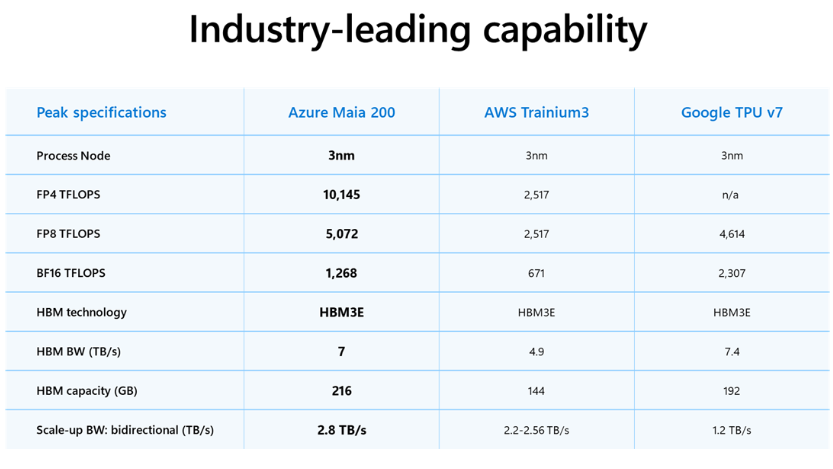
Core Viewpoint - Microsoft has launched its second-generation AI chip, Maia 200, aimed at providing a cost-effective alternative to NVIDIA's AI GPU series for cloud AI training and inference tasks [1][3]. Group 1: Product Launch and Specifications - The Maia 200 chip, manufactured by TSMC, is designed for high-performance AI inference tasks and is being deployed in Microsoft's AI data centers [1][3]. - The chip features over 1.4 trillion transistors and is built on a 3nm process, offering more than 10 petaFLOPS of performance at FP4 precision and over 5 petaFLOPS at FP8 precision, all within a power consumption of 750 watts [5][6]. - Maia 200's performance per dollar is reported to be 30% better than Microsoft's current hardware, and it outperforms Amazon's Trainium by three times in FP4 performance [5][8]. Group 2: Competitive Landscape - The launch of Maia 200 positions Microsoft as a strong competitor against Amazon's Trainium and Google's TPU, with claims of superior performance in AI inference tasks [3][4]. - Major chip design companies like Marvell and Broadcom are increasingly focusing on developing custom AI ASIC solutions for cloud giants, indicating a competitive shift in the industry [2]. Group 3: Strategic Importance - The development of Maia 200 reflects Microsoft's serious commitment to in-house chip engineering, driven by the growing energy demands of large AI data centers and the need for cost-effective solutions [9]. - The AI ASIC technology route is becoming crucial for major tech companies, as they aim to enhance the cost-effectiveness and energy efficiency of their AI computing systems [10][11].


AI ASIC需求继续狂飙!迈威尔(MRVL.US)净利润暴增876% 豪掷32.5亿美元押注光互连
智通财经网· 2025-12-03 00:28
Core Viewpoint - Marvell Technology (MRVL) reported strong Q3 earnings and raised its revenue outlook, highlighting the robust demand for AI ASIC chips in the data center market, particularly in competition with Nvidia's AI GPU technology [1][3]. Financial Performance - For Q3 of FY2026, Marvell's total revenue reached $2.07 billion, a 37% year-over-year increase, slightly above Wall Street's expectation of $2.05 billion [3]. - Non-GAAP earnings per share (EPS) were approximately $0.76, exceeding the analyst consensus of $0.74 and up from $0.43 in the same quarter last year [3]. - The company reported a GAAP net profit of approximately $1.9 billion, a significant increase from a net loss of $676 million in the same quarter last year [3]. Future Outlook - Marvell's management expects Q4 revenue to be around $2.2 billion, which is significantly higher than the analyst average estimate of $2.18 billion [2]. - The company anticipates total revenue for the next fiscal year to reach approximately $10 billion, with a projected 25% growth in data center business revenue [2]. Strategic Acquisition - Marvell announced a $3.25 billion acquisition of Celestial AI, a startup focused on optical interconnect technology, to enhance its networking product portfolio [1][4]. - The acquisition is expected to leverage Celestial AI's research in silicon photonics, which could significantly improve AI model performance and energy efficiency in data centers [4][5]. Market Dynamics - The demand for AI ASIC technology is expected to grow exponentially, driven by the increasing need for AI computing infrastructure [8]. - Marvell and its competitor Broadcom are collaborating with major cloud providers like Amazon and Google to develop customized AI ASIC solutions for their data centers [3][4]. Competitive Landscape - The competition in the AI ASIC market is intensifying, particularly with Broadcom, as both companies aim to capture a larger share of the growing demand for AI computing solutions [1][4]. - Analysts have noted a bullish sentiment towards both Marvell and Broadcom, with target price increases reflecting confidence in their future performance [13].

