AI Boom

Search documents
A New U.S. Facility Could Break China’s Grip on Critical Materials
Yahoo Finance· 2026-03-19 09:00
The rare earth supply chain moves through several stages. Ore is mined and processed into concentrates, which are then separated into individual oxides such as neodymium and praseodymium.REAlloys’ metallization operations in Euclid, Ohio represent one of the few facilities in North America already converting rare-earth oxides into metals and magnet-grade alloys.That concentration now represents a strategic exposure for Western industry and defense planners alike. Beginning in 2027, U.S. procurement rules wi ...
Six Stocks That Could Soar in an Era of Regional Instability
Yahoo Finance· 2026-03-12 09:00
Group 1: Geopolitical Impact on Oil and Defense Sectors - Occidental Petroleum (OXY) is positioned as a key beneficiary amid geopolitical tensions, with its assets located far from conflict zones, providing a "safe" production environment [1][7][10] - The closure of the Strait of Hormuz has led to skyrocketing shipping costs and oil prices, with Brent crude surpassing $100 per barrel, indicating a significant disruption in global oil supply [4][3] - The ongoing conflict has resulted in a substantial financial burden for the U.S., estimated at $1 billion per day, affecting global trade dynamics and pricing in futures contracts [5][6] Group 2: Company-Specific Developments - OXY's recent earnings report shows a production of 1,481 Mboed, exceeding guidance, and a robust organic reserve replacement ratio of 107%, indicating strong operational performance [8] - The company has strategically reduced its debt to $15 billion following the $9.7 billion sale of OxyChem, allowing for increased production capacity without over-leveraging [9] - Lockheed Martin (LMT) is experiencing unprecedented demand for its defense products, with plans to triple PAC-3 missile production and a record backlog of $194 billion, reflecting a shift in military procurement strategies [20][23] Group 3: Fertilizer and Rare Earth Materials - CF Industries, as the largest producer of nitrogen fertilizers, is capitalizing on the disruption in Middle Eastern supply lines, leading to increased urea prices from $475 to over $700 per ton [25][28] - MP Materials operates the only scaled rare earth mine in the U.S. and is expanding its production capabilities, positioning itself as a critical supplier for high-tech and military applications [30][32] - REalloys is addressing the metallization bottleneck in defense manufacturing, with a partnership to secure 80% of production from a rare earth processing facility, crucial for U.S. defense needs [11][14]


Two Energy Names To Watch Amid Soaring Oil Prices, AI Demand
Investors· 2026-03-09 16:30
Core Insights - GE Vernova and Cheniere Energy are highlighted as key players in the energy sector, with both companies experiencing significant stock price increases in 2026, driven by geopolitical events and market demand for energy products [1] Group 1: Cheniere Energy - Cheniere Energy's stock rose 30% this year, reaching a record high of 259.24 before closing below the buy point of 257.65 [1] - The company reported that 95% of its capacity for the next 10 years is under contract, with only one million metric tons of unsold open capacity remaining in 2026 [1] - Natural gas prices surged nearly 12% following the onset of the U.S.-Israel war against Iran, impacting Cheniere's stock positively [1] Group 2: GE Vernova - GE Vernova's stock was upgraded from sell to buy by Rothschild & Co Redburn, with the price target increased from $560 to $1,100, indicating a potential 40% upside from its recent trading price [1] - The company is positioned to meet the rising demand for energy products, particularly in relation to the AI boom, with analysts forecasting higher demand and margins for its new equipment in 2026 and 2027 [1] - GE Vernova's stock has gained about 10% since breaking out from a consolidation at a buy point of 731 in late January [1]


Greenland’s Untested Oil Basin Could Be the Next Big Discovery
Yahoo Finance· 2026-03-09 15:00
Core Viewpoint - Greenland Energy is positioning itself to explore the Jameson Land basin, which is believed to contain significant undeveloped petroleum resources, potentially over 13 billion barrels of recoverable oil, based on reinterpretation of historical seismic data [1][7]. Group 1: Company Formation and Leadership - Greenland Energy is formed through a merger of March GL, Greenland Exploration Ltd., and Pelican Acquisition Corporation, with plans to operate under the ticker GLND on Nasdaq [3]. - The company is led by veteran oil executive Robert Price, who has extensive experience in drilling and has identified the Jameson Land basin as a significant opportunity [2][15]. Group 2: Exploration Objectives and Strategy - The primary objective is to drill the first modern exploration wells in the Jameson Land basin, which is considered one of the last unexplored petroleum systems in the Arctic [2][5]. - Greenland Energy plans to drill two exploration wells in 2026, with the first well estimated to cost around $40 million and the second at approximately $20 million [17][18]. Group 3: Geological Significance - The Jameson Land basin is part of the same geological formations that have produced major oil fields in the North Sea, indicating a high potential for oil discovery [10][9]. - Historical data from Atlantic Richfield, which includes 1,800 kilometers of seismic data, has been reprocessed using modern technology to identify promising drilling targets [1][14]. Group 4: Geopolitical Context - Greenland has gained geopolitical significance due to its strategic location and potential natural resources, including rare earth elements, attracting interest from various governments and oil explorers [4][21]. - The renewed interest in Greenland is driven by the opening of Arctic shipping routes and the increasing presence of global powers like Russia and China in the region [4][20].
6 High-Yield Energy Stocks Paying Up To 14.8%
Forbes· 2026-02-28 14:55
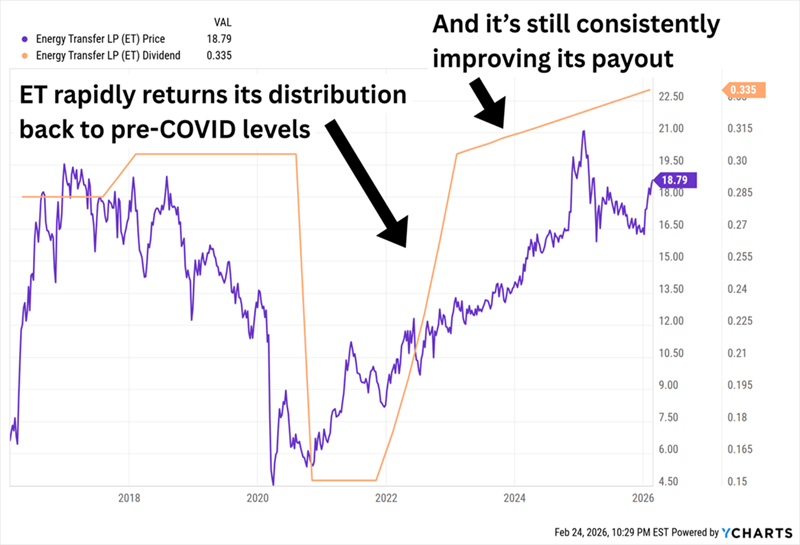
Core Viewpoint - The article emphasizes the importance of focusing on stable, high-yield investments in the energy sector, particularly pipeline companies, rather than chasing volatile opportunities linked to fluctuating oil prices. Group 1: Current Oil Market Dynamics - Crude oil prices have been rising due to factors such as a weak dollar, OPEC+ production cuts, and geopolitical tensions, particularly regarding Iran [5] - The current environment has led many investors to pursue high-risk investments, akin to attempting three-point shots in basketball, rather than opting for safer, more reliable options [4][6] Group 2: Investment Opportunities in Energy Infrastructure - Companies that operate pipelines, referred to as "toll takers," benefit from consistent fees regardless of oil prices, making them attractive investments [7] - Enterprise Products Partners LP (EPD) offers a 6.1% distribution yield and has a strong operational track record, including record cash flow and distribution increases [8][9] - Energy Transfer LP (ET) has a 7.1% distribution yield and is actively expanding its infrastructure to support the growing demand from data centers and power plants [10][11] - MPLX LP (MPLX) provides a 7.3% distribution yield and has consistently increased its annual distribution, with several growth projects expected to come online [12][14] - Kimbell Royalty Partners LP (KRP) has an 11.3% dividend yield and operates a unique business model that allows it to benefit from energy price fluctuations while maintaining lower volatility compared to traditional energy stocks [15] - Mach Natural Resources LP (MNR) is a newer player with a 14.8% distribution yield, showing potential for growth despite its current valuation lagging behind the MLP benchmark [17][18]





6 Energy Stocks That Pay Us Up to 14.8% (Middle East Chaos or Not) – The Contrary Investing Report
Contraryinvesting· 2026-02-27 10:00
Core Insights - The article emphasizes the importance of focusing on reliable investment strategies, akin to taking "layup" shots in basketball rather than risky "three-pointers" [2][7]. Oil Market Overview - Crude oil prices have been rising due to factors such as a weak dollar, OPEC+ production cuts, U.S. military actions in Venezuela, and potential conflicts with Iran, which could further increase prices [3][4]. Investment Strategies - The article advocates for investing in "toll takers," companies that earn fees from oil and gas transportation regardless of market prices, as a safer investment strategy [8]. Company Profiles - **Enterprise Products Partners LP (EPD)**: - Offers a 6.1% distribution yield with extensive pipeline infrastructure and a history of 27 consecutive annual distribution hikes [9]. - Recently reported record natural gas processing and cash flow, indicating strong operational performance [13]. - **Energy Transfer LP (ET)**: - Provides a 7.1% distribution yield and has been actively expanding its infrastructure to support the growing demand from the AI sector [14][15]. - Has consistently raised its distribution since 2021, showcasing reliability [16]. - **MPLX LP (MPLX)**: - Offers a 7.3% distribution yield and has shown consistent growth in distributions since its inception, with several growth projects expected to come online [19][20]. - **Kimbell Royalty Partners LP (KRP)**: - Features an 11.3% dividend yield and operates a unique business model by owning royalty interests in oil and gas, which is less volatile than traditional energy stocks [24][25]. - **Mach Natural Resources LP (MNR)**: - Newly public with a 14.8% distribution yield, operates primarily in the Anadarko Basin, and is considered undervalued compared to its peers [28][29]. Tax Considerations - The article notes that most "toll taker" companies pay distributions rather than dividends, leading to different tax treatments and complexities such as the K-1 form [31]. Preferred Investment Vehicle - The Alerian MLP ETF (AMLP) is recommended as a preferred investment option, offering nearly 8% yield with simpler tax implications compared to individual MLPs [32].
'Big Short' investor Michael Burry warns a 'troubling' number in Nvidia's earnings could be 'catastrophic' for its finances
Business Insider· 2026-02-26 15:08
Core Viewpoint - Nvidia is in a precarious position regarding its microchip supply obligations, which could lead to significant financial repercussions if demand for AI products declines, as highlighted by investor Michael Burry [1][5]. Group 1: Supply Obligations and Financial Risks - Nvidia's purchase obligations surged from approximately $16 billion to $95 billion over 12 months, driven by TSMC's demand for longer contracts and upfront cash [2]. - The company's total supply obligations of $117 billion are nearly equivalent to its operating cash flow for the year ending January 25, indicating a tight financial situation [2]. - Burry emphasizes that Nvidia's current strategy of locking in supply chain capacity is unprecedented and poses substantial risks [2][4]. Group 2: Historical Comparisons and Market Dynamics - Burry draws parallels between Nvidia's situation and Cisco during the dot-com bubble, where Cisco faced severe losses after overcommitting to supply chain obligations amid a sudden drop in IT spending [3]. - The high profit margins Nvidia currently enjoys are attributed to strong demand, but these margins could diminish if demand weakens, increasing the company's vulnerability [4]. Group 3: Market Performance and Investor Sentiment - Despite a 65% increase in revenue and net income over the past year, Nvidia's stock fell nearly 3% recently, reflecting investor concerns [7]. - Nvidia's stock has decreased by 8% from its all-time highs in October but remains over 13 times higher since the beginning of 2023, maintaining its status as the world's most valuable public company with a market capitalization of $4.6 trillion [8].


Markets, the Fed, the AI Boom Face a K-Shaped Test. Here's Why.
Barrons· 2026-02-20 11:50
Core Insights - The Supreme Court is set to make a significant decision regarding tariffs that could impact market stability and investor sentiment [1] - Concerns are rising in the private credit sector, indicating potential vulnerabilities within this financial segment [1] - Ongoing discussions in the White House regarding a stalled cryptocurrency bill suggest regulatory uncertainty that may affect the crypto market [1] Group 1: Tariff Decision - The upcoming Supreme Court ruling on tariffs is anticipated to have a profound effect on market dynamics, potentially leading to increased volatility [1] - Investors are closely monitoring this decision as it could influence trade policies and economic forecasts [1] Group 2: Private Credit Concerns - There is a growing apprehension about the state of private credit markets, with indications that defaults may rise, affecting overall credit availability [1] - This sector's health is crucial for funding small to medium-sized enterprises, and any downturn could have broader economic implications [1] Group 3: Cryptocurrency Regulation - The White House's protracted negotiations over the cryptocurrency bill highlight the complexities of regulatory frameworks in the digital asset space [1] - The delay in legislation may hinder innovation and investment in the cryptocurrency sector, as companies await clearer guidelines [1]

3 Dividend Growth ETFs to Buy With $500 and Hold Forever
Yahoo Finance· 2026-02-19 15:20
Group 1 - The return of non-tech stocks has become a dominant theme in 2026, with investors rotating into more defensive and value-oriented areas of the market due to concerns about the AI boom [1] - Dividend stocks have significantly benefited from this shift, as long-term dividend growth strategies can provide returns in risk-off environments [1] Group 2 - The Vanguard Dividend Appreciation ETF (VIG) targets U.S. large-cap stocks that have increased their annual dividends for at least 10 consecutive years, focusing on quality and durability rather than high income [4] - The top five sector holdings of VIG include Technology (27%), Financials (22%), Healthcare (17%), Industrials (11%), and Consumer Staples (10%), indicating a mix of cyclical and defensive sectors [5] Group 3 - The Schwab U.S. Dividend Equity ETF (SCHD) follows the Dow Jones U.S. Dividend 100 Index, targeting stocks with strong dividend history and balance sheet quality [6] - SCHD's portfolio has a significant allocation to Energy (20%) and Consumer Staples (19%), which has contributed to its top-tier performance in 2026, while minimal exposure to Technology (8%) has also been beneficial [7]
Gold lowers on easing tensions, but rate cut bets, China demand provide floor
Invezz· 2026-02-10 06:10
Core Viewpoint - Gold prices have decreased due to easing geopolitical tensions, but expectations of rate cuts and strong demand from China are providing support for prices, keeping them above $5,000 per ounce [1]. Group 1: Gold Market Dynamics - Gold prices fell to $5,045.59 per ounce, down 0.7% from the previous close, ending a two-day positive streak [1]. - The decline in gold prices is attributed to reduced political uncertainty following Japan's snap election and decreased tensions in the Middle East [1]. - Despite the drop, gold remains above the critical level of $5,000 per ounce, supported by central bank demand [1]. Group 2: Economic Influences - Expectations of at least two 25-basis-point rate cuts by the US Federal Reserve in 2026 are bolstering gold prices [1]. - The US dollar is trading near its lowest point in over a week, which is beneficial for gold as it is a non-yielding asset [1]. - Traders are cautious ahead of the upcoming US Nonfarm Payrolls report and consumer inflation figures, which could influence market sentiment [1]. Group 3: China's Gold Demand - The People's Bank of China has continued its gold accumulation for the 15th consecutive month, purchasing approximately 40,000 ounces in January [1]. - This sustained demand is driven by fiscal instability in major global economies and a strategic shift in China's reserves policy to reduce reliance on the US dollar [1]. - China's gold purchases are seen as a long-term strategy to enhance the international standing of the renminbi and provide a politically neutral store of value [1]. Group 4: Silver Market Update - Silver prices dropped over 2% to $80.243, influenced by a slight recovery in the dollar and profit-taking by traders [1]. - Improved US economic data, including a rise in the Consumer Sentiment Index to 57.3, has strengthened the dollar and pressured commodity prices [1]. - Geopolitical tensions may still drive demand for silver as a safe-haven asset [1].