AI Native Company

Search documents
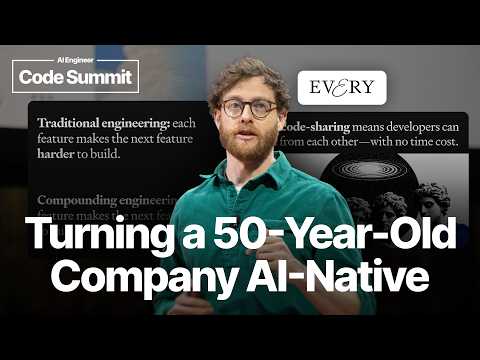
How to build an AI native company (even if your company is 50 years old) – Dan Shipper, Every
AI Engineer· 2025-12-18 18:00
AIE is coming to London and SF! see dates and sign up to be notified of sponsorships, CFPs, and tickets: https://ai.engineer ...

喝点VC|a16z内部复盘:AI行业不是所有公司都能受益的领域,选对赛道与团队比以往任何时候都重要
Z Potentials· 2025-10-08 02:57
Core Insights - The current state of the AI industry is characterized by rapid growth and fragmentation, with companies needing to adopt more nuanced strategies tailored to specific subfields rather than a one-size-fits-all approach [4][5][11] - AI companies are experiencing growth rates and scales that exceed expectations, with value accumulation occurring at every layer of the technology stack, but this is accompanied by a looming "淘汰危机" (elimination crisis) [4][10] - The market is not a rising tide that lifts all boats; careful selection of sectors and teams is more critical than ever due to heightened risk thresholds [4][28] AI Industry Landscape: Growth and Fragmentation - The AI landscape has evolved rapidly over the past two and a half years, with significant value accumulation across various sectors [4][10] - There is a growing recognition that the AI market is not monolithic but consists of numerous disparate subfields, each requiring specialized strategies [5][11] - The application layer is benefiting from substantial infrastructure investments, making AI capabilities more accessible [12][13] Basic Models vs Applications: Who is Leading? - The application layer is currently reaping the benefits of significant investments in foundational models, but companies must develop core software capabilities to succeed [6][12] - The market is not uniformly benefiting; selecting the right sector and team is crucial for success [6][11] Rise of AI-Native Companies - AI-native companies are growing at a pace that far exceeds traditional SaaS companies, with many achieving significant revenue milestones rapidly [17][18] - The shift in enterprise budgets from pure software to intelligent services is becoming evident, with AI-native companies benefiting from a lack of historical baggage [18][19] Defensive Strategies and Moats in AI - AI companies face challenges in customer retention despite solving initial customer acquisition issues [20] - Brand recognition is becoming increasingly important in the AI space, with companies like OpenAI dominating market perception [20] Case Study: Cursor and ROI - Cursor exemplifies successful commercialization in AI, leveraging familiar user interfaces and timely model advancements to achieve significant productivity gains for users [22][23] - The shift in enterprise attitudes towards AI has moved from exploratory to a focus on clear ROI, with companies reporting substantial productivity improvements [23][24] Market Evolution from Individual to Enterprise Users - The initial adoption of AI technologies often starts with individual users, which eventually leads to enterprise-level sales pipelines [25][26] - Companies must focus on user retention and the potential for individual users to convert into enterprise clients to sustain growth [26] Winners, Losers, and Investment Insights - The current funding landscape shows that many companies are securing large investments without delivering tangible results, leading to increased pressure to perform [27] - The importance of selecting top-tier teams and avoiding mediocre options is emphasized as a key investment strategy [27][28] Investment Focus in AI - Investment strategies should prioritize companies with clear growth trajectories and visionary founders who can leverage AI effectively in their verticals [31][32] - The competitive landscape in foundational models is intense, necessitating a cautious approach to investment in this area [31] Conclusion - The AI market is experiencing unprecedented growth and fragmentation, requiring investors to be more discerning than ever [34] - The distinction between hype and genuine growth momentum is critical for successful investment decisions [34]