AI disruption in software

Search documents
宏观研究核心议题 - 霍尔木兹海峡中断与能源价格全解析-What's Top of Mind in Macro Research_ All about Strait of Hormuz disruptions and energy prices
2026-03-13 04:46
12 March 2026 | 5:07PM EDT Economics Research What's Top of Mind in Macro Research: All about Strait of Hormuz disruptions and energy prices This week: n Iran conflict: longer Strait of Hormuz disruptions n AI software disruption concerns Transcript Jenny Grimberg +1(212)934-0199 | jenny.grimberg@gs.com Goldman Sachs & Co. LLC Allison Nathan +1(212)357-7504 | allison.nathan@gs.com Goldman Sachs & Co. LLC Ashley Rhodes +1(212)934-4876 | ashley.rhodes@gs.com Goldman Sachs & Co. LLC Iran conflict: longer Strai ...
SaaS Markets Have Crashed in 2026. But Is Private Credit the Even Bigger Risk?
SaaStr· 2026-02-20 15:10
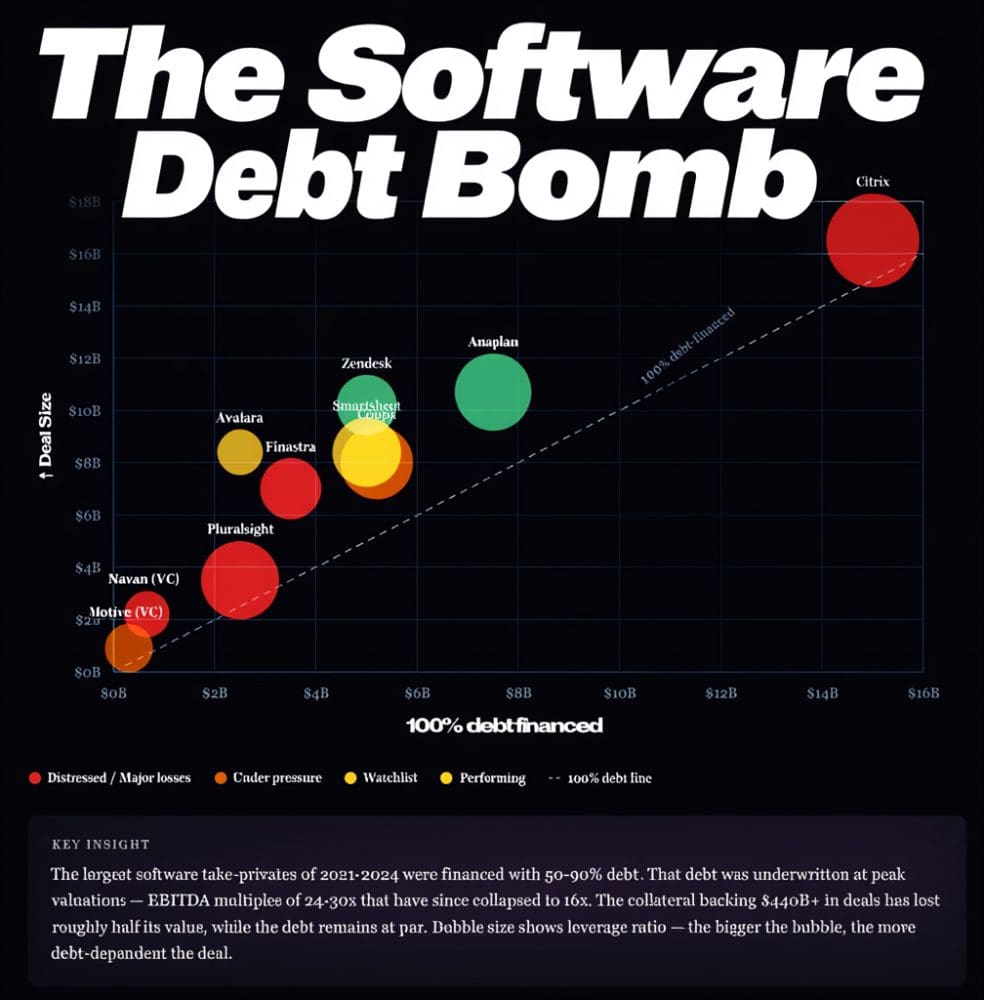
Core Insights - The software stock market has entered a bear phase in 2026, with significant declines in valuations and market capitalizations, raising concerns about the private credit market's exposure to software companies [1][2][52] - The private credit market, valued at $3 trillion, has a substantial portion tied to software, with estimates indicating that 20-35% of private credit deals involve SaaS companies [8][9] - The potential for widespread defaults in private credit could have far-reaching implications for the entire financial ecosystem supporting B2B operations, including venture debt and M&A activities [7][52] Market Performance - The IGV index has dropped over 23% year-to-date, with $285 billion in market cap lost in a single day, and software price-to-sales ratios have decreased from 9x to 6x [1] - Major software IPOs have seen drastic declines, with Figma down over 80% from its peak and Navan down 60% since its IPO [5][27] Private Credit Exposure - Private credit's exposure to software companies is estimated between $600 billion and $750 billion, raising concerns about the reliability of debt repayment [2][52] - The private credit market has financed over $440 billion in software acquisitions from 2015 to 2025, with many loans now under stress due to changing market conditions [9][10] Distressed Debt Levels - As of early February, $46.9 billion in US tech company loans are trading at distressed levels, with a record $25 billion of software-sector loans below the distress threshold [15][16] - The average EBITDA multiples for software companies have collapsed from 30x at the end of 2022 to approximately 16x today, indicating a significant reduction in collateral value for loans [21] Risk of Defaults - Default rates for US private credit could reach 13% if AI disruption accelerates, significantly higher than projected high-yield default rates [30] - The interconnectedness of private credit and the broader financial system poses risks, as tightening credit conditions could lead to a cascade of defaults across the software sector [36][50] Structural Issues - The private credit market operates differently from public equity markets, with illiquid loans often held to maturity and valued by lenders themselves, which can delay the recognition of problems [34] - The potential for a "doom loop" scenario exists, where missed payments lead to markdowns, triggering redemption requests that funds may struggle to meet [37][50] Industry Outlook - The SaaSpocalypse reflects a broader concern about the sustainability of software companies in an AI-driven market, where traditional revenue models may no longer hold [6][52] - The private credit market's heavy reliance on software companies, combined with the current economic climate, suggests a challenging environment ahead for both lenders and borrowers [52][53]


Blue Owl CEO Says 'No Red Flags' In Relation To Software Disruption
Benzinga· 2026-02-05 22:56
Core Viewpoint - Blue Owl Capital's co-CEO Marc Lipschultz expressed confidence in the firm's software AI portfolio, stating there are no "red flags" or even "yellow flags," indicating a strong outlook for tech lending [1][2]. Financial Performance - Blue Owl's total assets under management (AUM) increased by 22% since December 31, 2024, reaching $307 billion, driven by capital raised and the acquisition of IPI [5]. - Fee-paying AUM rose by 17% since December 31, 2024, totaling $187 billion, attributed to capital raised and the IPI acquisition [6]. - The firm's credit platform AUM grew by 16% since December 31, 2024, due to capital raised in direct lending and alternative credit strategies [6]. Software Loan Portfolio - The software loan book remains robust, with no performance decreases noted, and these loans average 30% of enterprise value, supported by significant equity cushions [3][4]. - Blue Owl's total exposure to software loans is 8% of its AUM [5]. Market Dynamics - Lipschultz emphasized that sophisticated buyers are actively seeking the right software solutions, suggesting that a narrow view of AI adoption could lead to missed opportunities [4]. - CFO Alan Kirshenbaum acknowledged that the firm is currently "behind its Investor Day goals" due to challenges in private credit and AI, but expects a modest increase in fee-related earnings per share this year [7][8]. Stock Performance - Blue Owl Capital's stock closed down 3.49% on Thursday, with after-hours trading showing a slight recovery of 1.45% to $11.80 per share [8].