Agent Harness

Search documents
OpenClaw 之后,我只想未来 3-6 个月的事情|42章经
42章经· 2026-03-22 14:02
Core Insights - The article discusses the evolution of AI Agents, particularly focusing on the emergence of Coding Agents and their impact on various industries. It highlights the shift from traditional SaaS models to more dynamic, AI-driven solutions that can adapt and evolve based on user needs [3][5][16]. Group 1: Evolution of AI Agents - The recent wave of AI Agents, exemplified by OpenClaw, represents a significant advancement in the capabilities of Coding Agents, which are now seen as essential for various tasks beyond coding, including data analysis and marketing [5][8]. - The article suggests that the future of AI Agents lies in their ability to integrate and scale across different scenarios, reducing the need for specialized vertical Agents [5][6][16]. Group 2: Market Dynamics - The discussion indicates a potential decline in the relevance of traditional SaaS models as AI Coding Agents become more capable and accessible, allowing for customized solutions that can replace the need for specialized software [16][17]. - The article posits that the user base for AI Agents could reach 1 billion, given the current low penetration rate of less than 1% [23][24]. Group 3: Long-term Tasks and Proactive Agents - Long-term tasks are defined as those requiring multiple steps, with the potential for Agents to handle hundreds or even thousands of steps, showcasing their improved problem-solving capabilities [27][29]. - Proactive Agents are expected to evolve to anticipate user needs and provide solutions without explicit instructions, marking a shift towards more autonomous AI systems [39][41]. Group 4: Product Development and Future Directions - The article emphasizes the importance of productization in making AI Agents accessible to a broader audience, with a focus on simplifying the user experience [22][66]. - Future developments may include creating systems that manage multiple AI Agents, enhancing efficiency and reducing the complexity of configuration [66][70].


红杉对话 LangChain 创始人:2026 年 AI 告别对话框,步入 Long-Horizon Agents 元年
海外独角兽· 2026-01-27 12:33
Core Insights - The article asserts that AGI represents the ability to "figure things out," marking a shift from the era of "Talkers" to "Doers" in AI by 2026, driven by Long Horizon Agents [2] - Long Horizon Agents are characterized by their ability to autonomously plan, operate over extended periods, and exhibit expert-level features across complex tasks, expanding from coding to various domains [3][4] - The emergence of these agents is seen as a significant turning point, with the potential to revolutionize how complex tasks are approached and executed [3][21] Long Horizon Agents' Explosion - Long Horizon Agents are finally beginning to work effectively, with the core idea being to allow LLMs to operate in a loop and make autonomous decisions [4] - The ideal interaction with agents combines asynchronous management and synchronous collaboration, enhancing their utility in various applications [3][4] - The coding domain has seen the most rapid adoption of these agents, with examples like AutoGPT demonstrating their capabilities in executing complex multi-step tasks [4][5] Transition from General Framework to Harness Architecture - The distinction between models, frameworks, and harnesses is crucial, with harnesses being more opinionated and designed for specific tasks, while frameworks are more abstract [8][9] - The evolution of harness engineering is particularly advanced in coding companies, which have successfully integrated these concepts into their products [12][14] - The integration of file system permissions into agents is essential for effective context management and task execution [24] Future Interactions and Production Forms - Memory is identified as a critical component for self-improvement in agents, allowing them to retain and utilize past interactions to enhance performance [35] - The future of agent interaction is expected to blend asynchronous and synchronous modes, facilitating better user engagement and task management [36] - The necessity for agents to access file systems is emphasized, as it significantly enhances their operational capabilities [39]


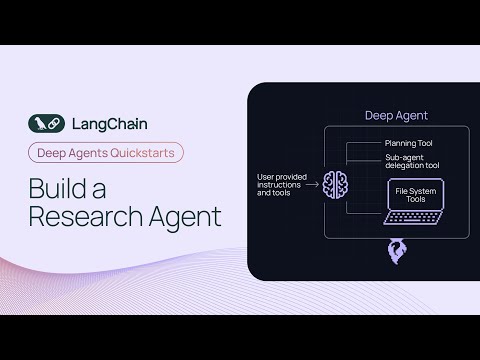
Build a Research Agent with Deep Agents
LangChain· 2025-11-20 17:02
Deep Agents Overview - Deep Agents is an open-source agent harness incorporating planning, computer access, and sub-agent delegation tools, commonly found in agents like Manis and Cloud Code [1][46] - The harness is designed to be easily adaptable with custom prompts, tools, and sub-agents [2][47] Key Features and Tools - Deep Agents provides built-in tools such as planning, sub-agent delegation, and file system operations [6][7] - The built-in tools enable interaction with the file system, shell command execution, planning via to-dos, and task delegation [8] - Custom tools, instructions, and sub-agents can be added to Deep Agents to tailor it for specific use cases [6][47] Quick Start and Research Application - The Deep Agent quick start repo offers examples for different use cases, starting with research [2][5] - The research quick start includes tools like a search tool (using Tavi search API) and an optional "think" tool for auditing agent trajectory [12][13][14] - Task-specific instructions and sub-agents can be supplied to Deep Agents for any given use case [12] Agent Loop and Middleware - Deep Agents utilizes Langraph for orchestrating the agent loop, which involves the language model (LLM) calling tools in a loop [29] - Middleware serves as hooks within the agent loop, allowing for actions like summarization when context exceeds 170,000 tokens [30][32] - Middleware can provide tools to the agent, such as file system middleware, and perform actions like summarization and prompt caching [31][34] File System and State Management - By default, Deep Agents writes to an internal in-memory state object, but it supports different backends like a sandbox or local file system [37][38] - File reading and writing operations occur within the Langraph state object, enabling easy retrieval into the LLM's context window [40] Deployment and Visualization - Deep Agents can be run in a Jupyter notebook for interactive inspection or deployed as an application using Langraph [10][44] - A UI can be connected to the local Langraph server for visualizing generated files and agent interactions [3][45]
Building a Typescript deep research agent
LangChain· 2025-11-06 18:30
Check this out. I just asked an agent to answer one of the world's greatest debates. Is Messi or Ronaldo the greatest soccer player of all time.This isn't an easy question to answer, and it definitely requires a good amount of research. The agent automatically spawned two parallel sub agents to look into each of their achievements. This meant searching the web over a dozen times, compiling a comprehensive report with cited sources.To be extra thorough, the agent then critiqued its own report and plugged any ...