Automation of Programming

Search documents
不怕你走,就怕你不用AI写代码,OpenAI Codex负责人亲口承认:内部已很少再打开IDE
3 6 Ke· 2026-02-25 05:41
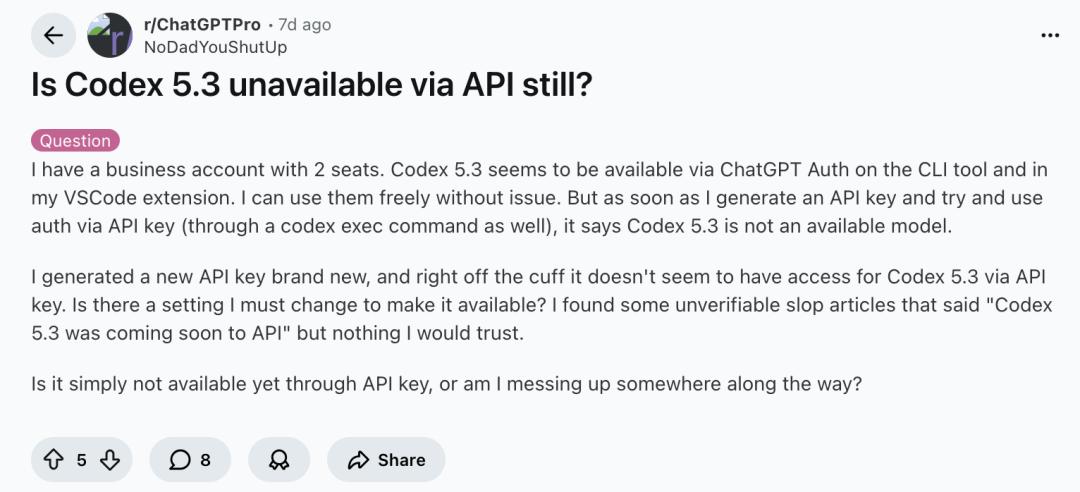
Core Insights - OpenAI has launched its latest programming AI model, GPT-5.3-Codex, which significantly enhances capabilities in reasoning, efficiency, and workflow support compared to its predecessor, GPT-5.2-Codex [1] - The new model shows remarkable performance improvements in various industry benchmarks, with a 25% increase in overall reasoning speed, and aims to enable AI to collaborate with developers throughout the software engineering process [1] Group 1: Model Performance and Feedback - GPT-5.3-Codex has received mixed feedback from developer communities, with some praising its smoother operations and clearer feedback in planning modes, while others criticize the limited API access for integration in custom environments [2][4] - Users have reported that the model's performance in certain editors, like Zed, is still immature, leading some to revert to older versions [4] - Some developers feel that the model does not consistently deliver the advertised performance, particularly in web generation tasks, and find competing models to be more efficient for daily tasks [6] Group 2: Product Vision and Workflow Changes - Alexander Embiricos, the product lead for OpenAI Codex, emphasizes that the goal is to create an AI that acts as an active engineering teammate throughout the software development lifecycle, rather than just improving code writing [6][8] - The internal structure of the Codex team is evolving, with traditional roles becoming less distinct, requiring engineers to possess broader skills and engage in both design and product decision-making [7][8] - The release of GPT-5.2 Codex marked a shift in workflow, where engineers began to delegate entire tasks to AI rather than collaborating in real-time, leading to a significant change in how coding is approached within OpenAI [8][29] Group 3: Future of Engineering Roles - Alexander predicts that the number of engineers will increase in the next five years, as the definition of roles like "software engineer" continues to evolve [8] - The compression of talent stacks is evident, with engineers becoming more versatile and involved in defining problems and ensuring quality rather than merely executing tasks [7][8] Group 4: AI Integration and User Experience - The Codex App is designed to facilitate task delegation and management of multiple AI agents, moving away from traditional IDE functionalities [32] - OpenAI is focusing on making AI tools more accessible and user-friendly, aiming for a future where users can seamlessly integrate AI into their workflows without extensive training [20][32] - The company is also exploring ways to enhance user retention and engagement by lowering the switching costs between different AI tools and ensuring a competitive edge through superior performance and user experience [36][38] Group 5: Market Position and Competitive Landscape - OpenAI acknowledges the competitive landscape and believes that collaboration with other companies can lead to mutual learning and improvement, rather than a monopolistic approach [38] - The company is committed to providing its models to competitors, viewing this as a long-term strategy to enhance its own offerings and maintain a leadership position in the AI space [38]