
Average Hourly Earnings

Search documents
Nasdaq Down Over 300 Points; US Economy Loses 92,000 Jobs In February
Benzinga· 2026-03-06 14:40
Market Overview - U.S. stocks experienced a decline, with the Nasdaq Composite dropping over 300 points on Friday. The Dow fell by 1.62% to 47,179.83, the NASDAQ decreased by 1.47% to 22,414.12, and the S&P 500 dropped by 1.38% to 6,736.10 [1] Employment Data - The U.S. economy reported a loss of 92,000 nonfarm payrolls in February 2026, a significant decrease from January's revised job gains of 126,000, and below economists' expectations of 59,000. The unemployment rate increased from 4.3% to 4.4%, surpassing forecasts of 4.3%. Average hourly earnings rose by 0.4% month-over-month, matching January's pace and exceeding consensus estimates of 0.3% [2] Commodity Market - In commodity trading, oil prices increased by 8.3% to $87.74, while gold rose by 0.4% to $5,099.00. Silver also saw a gain of 0.5% to $82.625, whereas copper experienced a slight decline of 0.1% to $5.7970 [3] European Market Performance - European shares declined, with the eurozone's STOXX 600 falling by 1.7%. Spain's IBEX 35 Index decreased by 1.6%, London's FTSE 100 dropped by 1.4%, Germany's DAX dipped by 1.7%, and France's CAC 40 fell by 1.5% during the session [4] Asian Market Performance - Asian markets closed mostly higher, with Japan's Nikkei 225 gaining 0.62%, Hong Kong's Hang Seng index increasing by 1.72%, China's Shanghai Composite rising by 0.38%, while India's BSE Sensex dipped by 1.37% [5]


X @Wu Blockchain
Wu Blockchain· 2026-03-06 13:34
U.S. nonfarm payrolls fell by 92,000 in February, while the unemployment rate remained at 4.4%. Average hourly earnings rose 0.4% month-over-month to $37.32, up 3.8% year-over-year. ...
X @TylerD 🧙♂️
TylerD 🧙♂️· 2026-02-11 13:35
Huge jobs beat (somehow)*Walter Bloomberg (@DeItaone):🚨 US LABOR JAN NONFARM PAYROLLS +130K; CONSENSUS +55KUS JAN UNEMPLOYMENT RATE 4.3%; CONSENSUS 4.4%US JAN AVERAGE HOURLY EARNINGS +0.41%, OR +$0.15 TO $37.17; OVER YEAR +3.71%US JAN PRIVATE SECTOR PAYROLLS +172K AND GOVERNMENT PAYROLLS -42KUS JAN AVERAGE WORKWEEK +0.1 ...
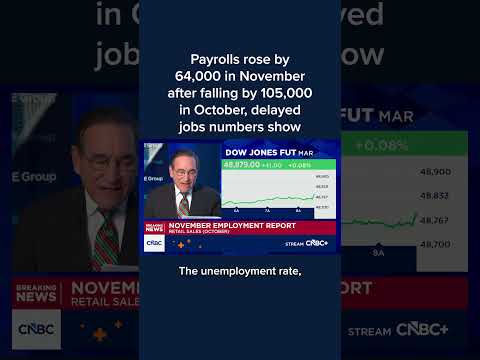
Payrolls rose by 64,000 in November after falling by 105,000 in October, delayed job numbers show
CNBC Television· 2025-12-16 14:45
Employment Data - Non-farm payrolls increased by 64,000 [1] - Average hourly earnings rose by 01% month-over-month and 35% year-over-year [1] Unemployment Rate - The unemployment rate increased to 46%, the highest since July 2021 [2] - The underemployment rate (U6) also reached 87%, a level last seen in July 2021 [2][3] - The average work week expanded to 343% [2] - Labor force participation expanded [3]
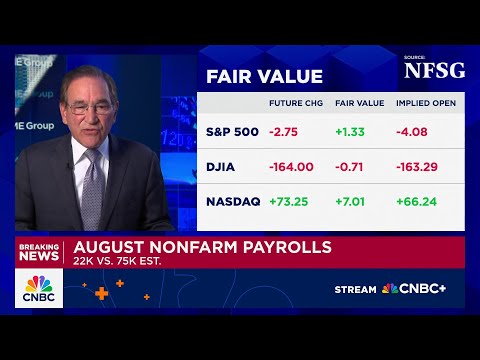
Payrolls rose 22,000 in August, less than expected in further sign of hiring slowdown
CNBC Television· 2025-09-05 13:00
Employment Data - Non-farm payrolls increased by 22,000 [1] - The unemployment rate rose to 43% [2] - Average hourly earnings increased by 03% month-over-month and 37% year-over-year [3] - Average hours worked were 342% the second lowest of the year [4] - The labor force participation rate decreased to 623% [5] - The underemployment rate (U6) increased to 81% the highest of the year [6] Interest Rates - Interest rates were hovering around 411% after the data release, having dipped to 409% [7] - Last week's close was 423%, with the year's low close at approximately 4% [7]
美国_就业增长低于预期,前几个月数据大幅下修;失业率上升-USA_ Payroll Growth Below Expectations and Revised Sharply Lower in Prior Months; Unemployment Rate Rises
2025-08-05 03:16
Summary of Key Points from the Conference Call Industry Overview - The report focuses on the U.S. labor market, specifically analyzing nonfarm payrolls, unemployment rates, and wage growth trends. Core Insights and Arguments 1. **Nonfarm Payroll Growth**: - Nonfarm payrolls increased by 73,000 in July, which was below expectations. - Revisions for previous months showed a downward adjustment of 133,000 for June (revised to 14,000) and 125,000 for May (revised to 19,000), totaling a cumulative revision of 258,000 across both months [1][3][5]. 2. **Sector Contributions**: - The cumulative revision was nearly evenly distributed between public and private sectors, with state and local government education accounting for most of the public sector revision (-109,000) [3][5]. - In July, job growth was strongest in healthcare (+73,000), retail trade (+16,000), and finance (+15,000), while the weakest sectors included professional and business services (-14,000), nondurable goods manufacturing (-11,000), and government (-10,000) [5][6]. 3. **Unemployment Rate**: - The unemployment rate rose by 0.13 percentage points to 4.25%, reflecting a decline in employment by 260,000 and a decrease in the labor force size by 38,000 [6][8]. - The labor force participation rate fell to 62.2%, indicating a decline in both foreign-born and native-born participation rates [6]. 4. **Wage Growth**: - Average hourly earnings increased by 0.33% month-over-month in July, aligning with consensus expectations. Year-over-year growth rose by 0.20 percentage points to 3.91% [7]. - Sectors with the largest wage increases included retail trade (+1.2%), financial activities (+0.5%), and professional and business services (+0.4%), while utilities (-0.3%) and nondurable goods (-0.2%) saw the slowest growth [7]. 5. **Underlying Job Growth Estimate**: - The estimated underlying pace of job growth, based on payroll and household surveys, is now at just 28,000 [8]. Additional Important Insights - The payrolls diffusion index increased in June (+4.0 points to 51.2) but remained unchanged on a three-month average basis at 46.8, significantly below the average of 56.5 in Q4 2019 [5]. - Employment in industries sensitive to immigration policy changes saw a decline of 4,000 on a three-month average basis through June [9]. - The U6 underemployment rate increased by 0.2 percentage points to 7.9%, and the job-finding rate for unemployed workers decreased by 0.9 percentage points to 26.8% in July [6]. This comprehensive analysis provides a detailed overview of the current state of the U.S. labor market, highlighting key trends and potential implications for investors and policymakers.
U.S. economy added 147,000 jobs in the month of June
NBC News· 2025-07-03 13:41
Labor Market Overview - US economy added 147,000 jobs in June [1] - Unemployment rate fell slightly to 4.1% [1] - Average hourly earnings grew 3.7% over the past year [1] Sector Analysis - State government jobs drove job growth [1] - Private sector job growth was the weakest since last October [1]
X @Bloomberg
Bloomberg· 2025-07-03 12:31
Labor Market Overview - US average hourly earnings rise 0.2% month-over-month in June, below the estimated +0.3% [1] - US unemployment rate in June is 4.1%, lower than the estimated 4.3% [1]