Bitcoin cycles

Search documents
X @CryptoJack
CryptoJack· 2026-03-20 14:35
Everyone thinks Bitcoin cycles are broken, but the chart shows otherwise. https://t.co/nnQz1LILbC ...
X @Cointelegraph
Cointelegraph· 2025-12-15 14:16
RT Gareth Jenkinson (@gazza_jenks)So, @saylor just bought another 10,645 Bitcoin for ~$980M.Yet the price of Bitcoin remains unaffected. Why?We spoke to @michaelterpin to unpack how @strategy stacking impacts Bitcoin.Can one man hoarding so much BTC impact Bitcoin cycles?His prediction for 2026 is 🤯👇 https://t.co/dOVNG2cK6d ...
X @Cointelegraph
Cointelegraph· 2025-12-12 15:05
Bitcoin Cycles & Market Analysis - Discussion on the Bitcoin Supercycle, questioning its status as myth or reality [1] - Examination of the potential demise of the 4-year Bitcoin cycle [1] - Analysis of Bitcoin's future trajectory and potential next moves [1] Expert Opinions - Interview with @michaelterpin, author of a book on Bitcoin cycles [1] - Insights shared by @rkbaggs on @Cointelegraph Chain Reaction [1]
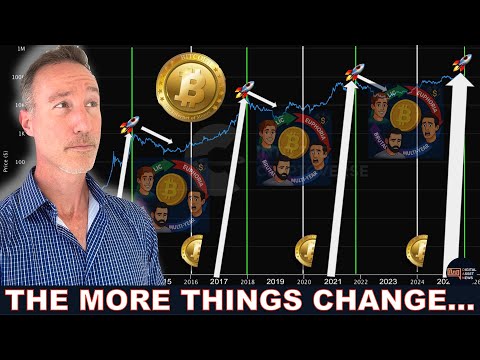
Bitcoin: The More Things Change, The More They Stay The Same. Why They Will Dump On You.
Digital Asset News· 2025-08-30 13:50
Market Cycles & Historical Analysis - The analysis suggests that Bitcoin's four-year cycles are likely to continue, despite potential disturbances [1] - Bitcoin's history shows recurring patterns: a halving event, followed by an all-time high, then a dip and reset [2][3] - Past bull markets were driven by different factors: early adopters in 2013, retail investors in 2017, and institutions in 2021 [7][8][12][21] - Each cycle faced hurdles like exchange collapses (Mount Gox), ICO bubble bursts, and regulatory crackdowns [9][10][15][16] - The analysis highlights that human nature and market exuberance contribute to the cyclical pattern [17][19][20][55] Current Market & Future Risks - The current bull market (2025) is driven by favorable US regulations, potential Fed rate cuts, and the approval of spot Bitcoin and ETH ETFs [29][30][31] - Institutions hold over 10% of Bitcoin, potentially buffering volatility [32][33][34] - Risks include short-term pullbacks, profit-taking by institutions, and potential unwinding of leverage in the system [35][36][39] - The analysis suggests that the market is still macro-dependent, and any delays in Fed rate cuts or a flare-up in inflation could cause a violent retracement [42][43] Quantitative Easing (QE) & Tightening (QT) - Quantitative easing involves central banks buying assets, adding money, increasing the money supply, and lowering interest rates to stimulate growth [44][45] - Quantitative tightening involves central banks selling assets or letting them expire, decreasing the money supply, pushing rates up, and slowing growth to curb inflation [45][46] - Historical data shows that Bitcoin can hit all-time highs even as the Fed funds rate goes up [48]