Checks and Balances

Search documents
X @Bloomberg
Bloomberg· 2025-12-21 13:15
Government & Politics - The report suggests that in 2025, the states, rather than Congress, serve as checks and balances within the American system of government [1]
Rule of Law vs. Rule by Law | Muhammad Saeed | TEDxRoshni Chowk
TEDx Talks· 2025-12-19 16:54
Core Argument - The rule of law, encompassing principles like equality before the law and judicial independence, is crucial for a country's prosperity and institutional growth [5][14] - The document contrasts the "rule of law" with "rule by law," where law is used as a tool for power consolidation, highlighting the dangers of the latter [8][10] - The author emphasizes the importance of constitutional awareness and civic duties, especially among young people, to ensure government accountability and prevent crises [12][13] Pakistan's Context - Pakistan's constitution, particularly the 1973 version, inherently includes the rule of law, yet the country has faced constitutional crises and instances of "rule by law" [6][7] - The Objectives Resolution of 1947-1949 emphasized Pakistan as an Islamic republic with republican democracy, protection of minority rights, and guaranteed judicial independence [6] - Erosion of judicial independence, such as parliamentary selection of top judges, undermines the separation of powers and the rule of law in Pakistan [8][9] Global Implications - The American system of checks and balances and separation of powers serves as a model for constitutions worldwide [3][5] - Countries that disregard the rule of law face a bleak future, as exemplified by recent examples in Nepal, Sri Lanka, and Bangladesh [10] - The youth, informed by social media, play a vital role in upholding the rule of law and holding governments accountable [11][12]


Trump's Executive Orders: Are They Legal? #shorts
Bloomberg Television· 2025-12-13 09:00
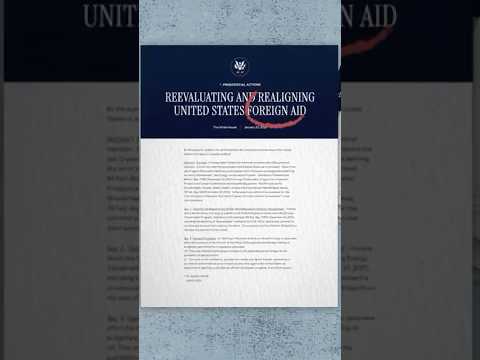
Executive Orders & Legal Framework - Executive orders are written orders from the President, aiming to implement specific actions [2] - Executive orders are not laws and are subordinate to the Constitution and federal statutes [2][3] - The legality and constitutionality of executive orders are ultimately determined by the judiciary, especially the Supreme Court [3] - Congress can also act if it has the political will to do so [3] Potential Impact & Concerns - The report highlights concerns about the extent to which President Trump has used executive orders to reshape government and society [1] - Trump's executive orders have targeted areas such as law firms doing business with the government, the Department of Education, and requirements to vote in political elections [1] - One executive order challenged a common understanding of the Constitution to end birthright citizenship [1]
Trump wants to rebrand his 'big, beautiful bill' amid poor polling
MSNBC· 2025-08-27 10:51
Tax Policy & Public Opinion - The Trump administration is considering rebranding its tax legislation, previously known as the "big, beautiful bill," due to its unpopularity and lack of public understanding [1][2][4] - The legislation includes tax cuts for the middle class and jobs, with no tax on tips, social security, or overtime [2] - Despite the administration's efforts, the tax provisions primarily extend existing benefits and may lead to millions losing Medicaid coverage, fueling Democratic criticism [6] - Public sentiment towards the legislation remains negative, with constituents expressing anger and concern at town halls [7][9][10] Judiciary & Executive Branch - A federal judge, a Trump appointee, dismissed a lawsuit filed by the Trump administration against federal judges in Maryland, deeming it an unprecedented and inappropriate attack on the judiciary [12][14] - The judge warned that siding with Trump would undermine the checks and balances system in the United States [14] - The judiciary is facing pressure from the executive branch, with concerns raised about the administration's efforts to diminish its power [13][15] - The administration's actions, including defying court orders and insulting judges, are seen as a threat to the constitutional system of checks and balances [17][18]
Autocrat alert: Ari reports Trump has worst record for power grab orders of ANY POTUS
MSNBC· 2025-07-10 23:55
Executive Power and Legislation - The analysis indicates a significant increase in the use of executive orders by the current administration compared to previous administrations, including its own first term, suggesting a shift in governance strategy [11] - The report highlights that the current administration has signed over 35 times as many executive orders as new laws, indicating a preference for executive action over legislative collaboration [15] - The analysis contrasts the current approach with that of past presidents like FDR, who balanced executive orders with legislative action, passing approximately 80-90 laws alongside executive orders during a pivotal period [14] - The report points out that the current administration's approach deviates from historical norms, with concerns raised about potential autocratic tendencies due to the heavy reliance on executive orders [16] Constitutional and Legal Concerns - The analysis suggests that the administration's actions, particularly the issuance of executive orders, are facing legal challenges and are often being struck down in court [17][18] - The report raises concerns about the administration's interpretation of Article Two of the Constitution, with claims that it is being used to justify an expansion of presidential power beyond established limits [4][5] - The analysis emphasizes that the administration's pursuit of policy goals through executive orders, bypassing Congress, is seen as an effort to change the government's structure and potentially undermine democratic checks and balances [9][18] Political Context and Opposition - The report notes a shift in the Republican party's dynamics, with congressional leaders now more aligned with the administration's agenda compared to the first term [1] - The analysis mentions the emergence of a "Trump resistance" and public backlash against the administration's actions, indicating opposition to the perceived expansion of executive power [6]
'Not a bipartisan issue' but a 'Trump issue': Weissmann on Congress' ability to check power
MSNBC· 2025-06-26 21:01
Constitutional & Legal Issues - The Constitution grants Congress the power to declare war, while the President serves as commander-in-chief during a declared war [2] - Significant legal debate exists regarding what constitutes a "war" domestically, considering duration and goals [2][3] - International law considerations include assessing intelligence to determine if military action was a defensive maneuver, involved an imminent threat, and was a proportional response [3] - The White House is limiting intelligence sharing with Congress, raising concerns about transparency and oversight [4] Checks and Balances & Congressional Oversight - Concerns are raised that the current administration believes Congress has no role in reviewing executive actions, mirroring arguments made in courts [6] - Traditionally, presidents from both parties have briefed Congress on intelligence matters, highlighting the current administration's deviation from this practice [7][8] - Congress has been abdicating its responsibility regarding war powers since World War II, the last time a formal declaration of war occurred [13] - The lack of accountability after military action, specifically regarding providing information to assess the legality under international law, is a key concern [23] International Law Considerations - Under international law, a country can act in self-defense or collective self-defense if there is imminent harm, the action is necessary, and the response is proportional [21][22] - Determining whether a military strike violates international law requires access to pre-strike intelligence [23]