Code Intelligence

Search documents
北航一篇304页的Code Agent综述!近30家机构参与
自动驾驶之心· 2025-12-10 00:04
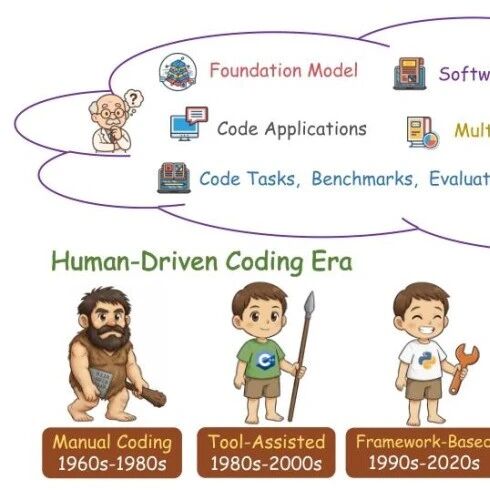
Core Insights - The article discusses the transformative shift in code intelligence from being an "assistive tool" to becoming an "autonomous developer" driven by advancements in large language models (LLMs) [2][8] - A comprehensive review paper by 28 institutions outlines the evolution of code models and establishes a complete technical framework for intelligent software engineering [2][8] Evolution of Code Intelligence - The evolution of code intelligence spans six distinct phases from manual coding in the 1960s to the anticipated AI autonomous era post-2025, highlighting key technological advancements at each stage [8][9] - The core driving force behind this evolution is the transition from rule-based systems to transformer-based models, enabling significant improvements in code understanding and generation capabilities [9][11] Code Foundation Models - Current mainstream models are categorized into General LLMs and Code-Specialized LLMs, each with unique advantages and technological synergies [11][12] - Code-specialized models have emerged through focused data, architectural innovations, and task-specific fine-tuning, surpassing general models in coding tasks [15][18] Training and Evaluation - The paper outlines a comprehensive evaluation system for code tasks, categorized into statement/function/class-level tasks, repository-level tasks, and intelligent agent system tasks [18][19] - Evaluation metrics have evolved to include execution-based indicators, emphasizing the importance of not just generating code but ensuring its functionality [19][22] Alignment Techniques - Two primary alignment techniques are discussed: Supervised Fine-Tuning (SFT) and Reinforcement Learning (RL), both crucial for ensuring models meet human requirements [22][28] - Various data synthesis methods for alignment tasks are highlighted, including single and multi-round SFT, as well as RL methods that leverage human and AI feedback [25][27] Software Engineering Agents (SWE Agents) - SWE Agents are described as advanced systems capable of autonomously completing complex engineering tasks across the software development lifecycle [31][32] - The paper identifies four key stages of SWE Agents' application: requirements engineering, software development, software testing, and software maintenance [31] Future Trends - The article identifies three core trends for the next 3-5 years: the shift from general to specialized models, increased autonomy of SWE Agents, and the integration of multimodal inputs for enhanced code intelligence [33][34][35] - The ultimate goal of code intelligence is to automate repetitive coding tasks, thereby allowing human developers to focus on higher-level creative tasks [37][38]