Compounding Interest

Search documents
Chicago man has $300K in cash and $400K in a savings account. Ramsey Show has a plan that could turn his money into $2M
Yahoo Finance· 2026-03-16 11:00
Core Insights - A Chicago caller revealed he has approximately $300,000 in cash at home, which he accumulated over a decade through a personal challenge of saving $100 bills [1] - Financial experts advised him to invest this cash rather than keep it idle, suggesting that investing could potentially grow it to nearly $2 million by retirement [2] Group 1: Investment Advice - Experts emphasized the importance of investing cash to harness the power of compounding interest, which is absent when cash is kept at home [5] - They recommended investing in the stock market, particularly in basic index funds or mutual funds, which could yield an average annualized return of around 10% [6] Group 2: Economic Implications - Keeping cash at home leads to a loss of purchasing power due to inflation, with an example showing that $300,000 in 2016 would need to grow to about $411,857 by 2026 to maintain its value [4] - The average inflation rate over the past 20 years has been approximately 2.5%, indicating that cash stored at home effectively loses value over time [5]
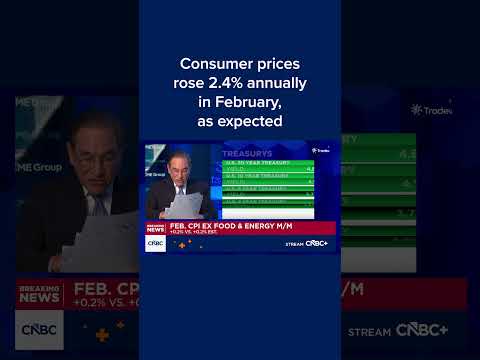
Consumer prices rose 2.4% annually in February, as expected
CNBC Television· 2026-03-11 14:25
This is the February read. Headline number expected to be up 3/10. Andrew delivers exactly up 3/10.And the rearview mirror still unrevised is up 210. We had a lot of up 310 last year. Find a higher number.You're going all the way back to January of 25. The high water mark last year was January and that was uh up 4/10. Now if we strip out food and energy and come up with the core expected up 2/10, that's exactly where it comes out.up 210. Here we go with the year-over-year numbers and zero progress, but not ...

If the Average American Saved at the Rate of the Richest 1%, How Long Would It Take To Reach $1 Million?
Yahoo Finance· 2026-01-14 14:12
Core Insights - The wealth accumulation of the richest 1% is not solely dependent on saving discipline, but rather on various factors including income levels and investment returns [1][5] - The top 1% save or invest between 40% to 50% of their incomes, which includes contributions to retirement and other investments [3] - The average American saves significantly less, typically around 3% to 7% of their income, compared to the recommended 10% to 15% [4] Savings Behavior Comparison - The richest 1% reinvest their income, allowing compounding interest to enhance their wealth over time [3] - The disparity in savings rates between the wealthy and average Americans contributes to the long-term wealth gap [4] - Financial constraints such as volatile income and rising costs limit the average American's ability to save more [4] Investment and Wealth Accumulation - An average earner adopting the savings habits of the top 1% would still face a lengthy timeline to reach $1 million, influenced by their income and investment returns [5][6] - For example, an individual earning $60,000 who saves 40% of their income could potentially reach $1 million in approximately 19 years with a 7% return on investment [5]
Finding Comfort in Bitcoin Volatility & Using "Triple Compounding"
Youtube· 2025-11-25 19:30
Core Insights - The discussion centers around the volatility of cryptocurrency markets and the investment strategies employed by Kiana Danielle, who manages an $18 million portfolio with $2 million allocated to crypto [1][2]. Investment Strategy - Kiana Danielle emphasizes the importance of historical patterns in cryptocurrency, particularly Bitcoin, which has shown repetitive price movements over time [3][4]. - The past performance of Bitcoin includes significant drops, such as an 84% decline from $20,000 in 2018 and a 77% drop from nearly $70,000 in 2022, highlighting the cyclical nature of the market [4][5]. - Danielle notes that after reaching a new high of $124,000, Bitcoin is currently down 34% from its peak, suggesting potential buying opportunities if historical trends continue [6][7]. Triple Compounding Concept - Danielle introduces the concept of "triple compounding," which involves three layers of investment: investing in oneself, creating income from external sources, and then investing in external assets like stocks and crypto [8][9]. - The first layer focuses on personal development and emotional resilience to market volatility, which is crucial for making informed investment decisions [12][13]. - The second layer involves generating income through various means, such as employment or entrepreneurship, which can then be reinvested into a portfolio [14][15]. - The final layer is the investment in external assets, where the investor has less control but can benefit from market growth [16][17].

Tony Robbins: Ignoring This Investing Concept Could Cost You $600K
Yahoo Finance· 2025-11-09 20:00
Core Insights - Tony Robbins emphasizes the importance of starting to invest early and utilizing compounding interest to build wealth over time [2][4][6] Investment Strategies - Starting early can significantly impact long-term wealth accumulation, as illustrated by two hypothetical investors: one who invests $300 monthly from age 19 to 27 and another who starts at 27 and continues until 65 [3][4] - The investor who starts at 19 ends up with approximately $1,985,000 by age 65, while the later investor accumulates about $1.38 million, highlighting a difference of nearly $600,000 due to the power of compounding [4] Common Investment Mistakes - Robbins identifies several common pitfalls investors should avoid, including misallocating assets, using brokers instead of fiduciaries, neglecting tax implications, overpaying for high-cost mutual funds, and failing to regularly rebalance portfolios [5] Personal Investment - Robbins recalls advice from Warren Buffett, emphasizing that the most crucial investment is in oneself, reinforcing the idea of starting early and maintaining consistency in investment strategies for a prosperous financial future [6]
We Asked ChatGPT, Grok and 3 Other AIs About the No. 1 Investing Tip for the Middle Class: Here’s What They Said
Yahoo Finance· 2025-11-04 15:25
Core Insights - The reliance on AI assistants for information has increased, potentially impacting independent and critical thinking [1] - AI platforms are improving in addressing current issues and factual errors, but responses from different AI assistants often show similarities [2] Investment Strategies from AI Assistants - ChatGPT recommends investing in low-cost index funds for long-term wealth building, highlighting that a $500 monthly investment over 25 years at an 8% return could yield over $472,000 [4] - Claude emphasizes the importance of starting investments early, stating that "time in the market beats timing the market" [5] - DeepSeek presents a unique perspective by focusing on the behavioral aspect of investing, suggesting the principle of "paying yourself first" to combat financial drains faced by the middle class [6][7]
Direxion's BRKU, BRKD ETFs Allow Speculators To Trade Warren Buffett's Berkshire Hathaway Conglomerate
Benzinga· 2025-10-29 13:12
Core Viewpoint - The article discusses the performance and investment strategy of Berkshire Hathaway Inc, led by Warren Buffett, highlighting its resilience in a potentially declining market and its long-term growth compared to benchmarks like the S&P 500 and Nasdaq Composite [1][3][4]. Company Performance - Berkshire Hathaway's BRK-B stock has gained over 8% since the beginning of the year, underperforming the S&P 500's approximately 15% increase, but has risen more than 130% over the past five years, outperforming the S&P's 94.45% and Nasdaq's 99% during the same period [3][4]. - The company's diversified portfolio, which includes insurance, railroads, utilities, manufacturing, and retail, provides a natural resilience against market fluctuations, allowing it to potentially outperform in the long run [6]. Investment Strategy - Warren Buffett's conservative investment approach focuses on core business principles rather than chasing trends, which may not appeal to all investors but has proven effective over time [4][5]. - Berkshire Hathaway is viewed as a defensive investment option amid market volatility, appealing to investors seeking stability [7]. ETF Options - For investors looking to leverage their positions on Berkshire Hathaway, Direxion offers two ETFs: the BRKU, which provides 200% leverage on BRK-B's daily performance, and the BRKD, which tracks the inverse performance of BRK-B [8][9]. - The BRKU ETF has lost about 3% since the start of the year and nearly 22% over the past six months, while the BRKD ETF has lost 8.5% since January but is up nearly 9% in the last six months [11][14]. Market Dynamics - The price action of the BRKU ETF has shown weakness, slipping below key moving averages, with a target of $26.17 for recovery, while the BRKD ETF has recently bounced off its moving averages, with a target of $24.27 [13][17].

If You Invested Your Social Security Check, Here’s How Much More It Could Be Worth
Yahoo Finance· 2025-09-14 11:22
Core Insights - Social Security provides a reliable income source for retirees, but it may not match pre-retirement earnings, suggesting the need for investment strategies to enhance monthly benefits [1][2] Short-Term Investing - For investments between one to five years, a conservative estimate of 6% return can be expected from stock markets or high-quality bonds, focusing on preserving and slightly growing Social Security income [3] Medium-Term Investing - A 10-year investment using a balanced 60/40 portfolio could grow an investment of $237,120 to approximately $310,300, yielding a gain of $73,180, while a conservative bond or high-yield savings account could still net over $35,000 [4] Long-Term Investing - Over 20 years, the compounding effect becomes significant, with a full year's Social Security benefit of $23,712 potentially growing to about $25,120 after one year at a 6% return, and a five-year investment could increase to $127,510 from an initial $118,560 [5]
2 Soaring Growth Stocks to Buy and Hold Forever
The Motley Fool· 2025-07-08 09:10
Group 1: Meta Platforms (Facebook) - Meta Platforms has over 3.4 billion daily users across its apps and is investing billions in technology and AI to enhance its services [3][6] - The company reported a 16% increase in revenue and a 37% increase in earnings in Q1, benefiting from the expanding digital advertising market, which is valued at $700 billion [4][7] - Meta AI has seen significant growth, with nearly 1 billion monthly users, and the company has launched a stand-alone app powered by the Llama 4 large language model [5] - CEO Mark Zuckerberg is focused on hiring top talent and plans to invest between $64 billion to $72 billion in infrastructure to support growth [6][7] - The stock is reasonably priced at 28 times this year's consensus earnings estimate, indicating a solid investment opportunity [8] Group 2: Netflix - Netflix has experienced significant stock growth due to its affordable ad-supported plans and paid sharing initiative, leading to new all-time highs [9][10] - The company reported a 12.5% year-over-year revenue increase in Q1, with expectations for 15.4% growth in Q2, driven by regular subscription price increases [11] - Netflix is expanding its operating profit margin, which supports a growing content budget and positions the company to capture more of the 1.5 billion broadband users worldwide [12] - The company is tapping into advertising revenue opportunities, with management guiding for a doubling of ad revenue by 2025 [12] - Netflix's total viewership exceeds 700 million, and the company is expanding into live broadcasts, which presents further advertising growth potential [13][14]