Debt-to-Income Ratio

Search documents
5 Wealth Benchmarks That Will Help You Accurately Evaluate Your Financial Position
Yahoo Finance· 2026-02-03 20:02
Core Insights - Net worth serves as a fundamental measure of wealth, providing a clearer financial picture than income alone, as it accounts for both assets and liabilities [2][5] - Financial benchmarks, including net worth, savings rate, debt-to-income ratio, retirement readiness, and liquidity, are essential for assessing financial health and making informed decisions [3][25] Group 1: Net Worth and Financial Health - Net worth is calculated by subtracting liabilities from assets, representing overall financial position [2] - Comparing net worth with others can be detrimental; it is more beneficial to track individual progress over time [1][5] - Financial health should be evaluated regularly, regardless of income level, to ensure wealth is being built [3][28] Group 2: Savings Rate - The savings rate is a critical benchmark that indicates future financial trajectory, with experts recommending a savings rate of at least 15% to 20% of gross income [9][11] - Individuals earning less but saving a higher percentage can build wealth faster than those with higher incomes saving less [9] - Progress in savings is more important than meeting specific percentage targets, especially for those living paycheck to paycheck [11] Group 3: Debt Management - The debt-to-income ratio (DTI) is a key indicator of financial health, with a healthy DTI generally below 36% [12][13] - High DTI can hinder wealth accumulation, as it indicates a significant portion of income is dedicated to past debts [13][14] - Prioritizing debt repayment is crucial for improving financial stability and net worth [14][27] Group 4: Retirement Readiness - Retirement readiness benchmarks suggest saving a multiple of annual salary by certain ages, with variations based on individual circumstances [16][18] - Retirement needs differ significantly based on lifestyle choices and personal situations, emphasizing the importance of tailored financial planning [18] - The power of compound growth highlights the benefits of early and consistent retirement contributions [18][19] Group 5: Liquidity and Emergency Funds - Maintaining liquidity is essential for financial security, with recommendations to have three to six months of essential expenses in an accessible savings account [20][21] - High net worth does not guarantee financial security if assets are illiquid, which can lead to forced sales during market downturns [23][24] - Emergency funds act as a safety net, allowing individuals to stay invested and maintain savings rates during income disruptions [24] Group 6: Comprehensive Financial Evaluation - Evaluating wealth involves understanding the interplay between various financial metrics, rather than focusing on a single measure [25] - A structured approach to financial priorities—debt repayment, emergency savings, and retirement contributions—can enhance overall financial health [27] - Regular financial assessments are necessary to adapt to changing life circumstances and maintain a long-term perspective [30][31]
I Discovered My Husband Had $150,000 in Gambling Debt After We Got Married and Had a Baby
Yahoo Finance· 2026-01-31 13:39
Core Financial Reality - The household is burdened with $150,000 in gambling debt against a current income of $68,000, resulting in a debt-to-income ratio exceeding 3:1 solely from gambling debt [3][4] - Additional secured debts, including house and vehicles, amount to $142,000, leading to a total debt burden of $292,000 [3][4] - The husband's potential income, once recovered, is estimated between $95,000 and $110,000, which could significantly impact their financial situation [3][4] Recovery Plan - A three-step recovery plan is proposed, focusing on income generation, aggressive debt repayment, and accountability [5] - Immediate action is required, with the husband needing to secure remote work to increase household income, which could nearly double with a $50,000 role [6][7] - With a combined income exceeding $160,000, the household could allocate $4,000-$5,000 monthly towards debt repayment, potentially eliminating gambling debt within three years [4][7] Economic Context - The economic backdrop includes a consumer sentiment index at 52.9, indicating deep pessimism, and an unemployment rate of 4.4%, which adds pressure to the household's financial situation [5] - Despite the challenges, the moderately healthy job market presents remote work opportunities that align with the husband's earning potential [5]
Will Paying Off Student Loans With an Inheritance Hurt Your Credit Score?
Yahoo Finance· 2026-01-31 11:03
Core Insights - Paying off student loans can lead to a temporary dip in credit scores, but the long-term financial benefits outweigh this concern [1][7] - Credit scores are influenced by factors such as payment history and amounts owed, which remain unaffected by early loan repayment [6] Group 1: Credit Score Impact - Paying off a student loan results in account closure, which alters credit mix and reduces the average age of active accounts [3][4] - The change in credit score is usually minor and temporary, with accounts in good standing remaining on credit reports for up to ten years [5] - The most significant factors affecting credit scores, such as payment history, are preserved even after loan repayment [6] Group 2: Benefits of Paying Off Loans - Eliminating student loans improves monthly cash flow and reduces future interest payments, potentially saving thousands [8] - Paying off loans lowers the debt-to-income ratio, which is crucial for obtaining mortgages or refinancing [8] - Reducing debt alleviates financial stress and simplifies overall financial management [8]
How to get preapproved for a mortgage
Yahoo Finance· 2026-01-21 16:29
Core Insights - The article emphasizes the importance of mortgage preapproval in the homebuying process, highlighting how it provides buyers with a clear understanding of their borrowing capacity and enhances their credibility with sellers. Group 1: Importance of Preapproval - Mortgage preapproval is a statement from a lender indicating how much money they are willing to lend based on a review of the buyer's financial profile, including income, assets, debts, and credit history [5][6][18] - Preapproval helps buyers focus their home search within their budget and makes their offers more compelling to sellers, especially in competitive markets [4][6][26] Group 2: Steps to Obtain Preapproval - Key steps in the mortgage preapproval process include checking credit scores, calculating debt-to-income (DTI) ratios, gathering necessary financial documents, and shopping around for lenders [7][9][12][17] - Lenders typically require a minimum credit score that varies by loan type, with conventional mortgages requiring a score of at least 620, FHA loans varying from 580 to 500 depending on down payment, and VA loans usually requiring around 620 [8] Group 3: Financial Documentation - Essential documents for mortgage preapproval include pay stubs, W-2s, proof of additional income, account statements, and identification [15][16] - Self-employed individuals may need to provide more detailed documentation, such as profit-and-loss statements [13] Group 4: Impact of Preapproval on Credit - During the preapproval process, lenders conduct a hard credit inquiry, which may slightly lower the credit score but can be grouped into a single entry if multiple inquiries occur within 45 days [19][20] - Preapproval does not guarantee a loan, as final approval requires a thorough review of finances and the property being purchased [22][24] Group 5: Handling Denials and Renewals - If denied preapproval, buyers can improve their credit score, reduce debt, or apply with different lenders, as qualification thresholds may vary [31][32] - Preapprovals are typically valid for 90 days, and renewing them may involve a recheck of credit and finances [27][28]
How much income is needed to afford a $500,000 mortgage?
Yahoo Finance· 2026-01-14 16:22
Core Insights - The article discusses the financial requirements and considerations for qualifying for a $500,000 mortgage, emphasizing the importance of income in determining affordability [1][4]. Mortgage Costs - The estimated monthly payment for a $500,000 mortgage, including principal, interest, taxes, and insurance, is approximately $3,669 based on national averages [2][15]. - Additional costs include a down payment, which can vary based on the type of mortgage, and closing costs that typically range from 2% to 5% of the loan amount, translating to $10,000 to $25,000 for a $500,000 loan [3]. Income Requirements - The article outlines three commonly used rules to estimate the income needed for a $500,000 mortgage: the 28/36 rule, the 35/45 rule, and the 25% rule [4]. 28/36 Rule - Under the 28/36 rule, the front-end ratio should be 28% or less of monthly pretax income, while the back-end ratio should be 36% or lower. To afford a $500,000 mortgage, an estimated monthly income of about $13,100 or an annual income of $157,200 is required [5][6][8]. 35/45 Rule - The 35/45 rule focuses on the back-end ratio, allowing for higher debt levels. It requires a back-end DTI ratio of 35% or less of pretax income and 45% or less of post-tax income. For a $500,000 mortgage, a pretax monthly income of just under $10,500 or an annual income of $126,000 is needed [9][10]. 25% Rule - The 25% rule considers only the front-end ratio based on post-tax income, requiring that housing payments be 25% or less of total monthly take-home pay. This translates to a need for a monthly post-tax income of nearly $14,700 to afford a $500,000 mortgage [12]. Additional Considerations - The article notes that these calculations are estimates based on averages, and individual circumstances may allow for different income levels to qualify for a mortgage [13][16].
Here’s the Minimum Income Needed To Buy a $500K Home in 2026
Yahoo Finance· 2025-12-16 15:09
Core Insights - The housing market is expected to shift as mortgage interest rates decrease and home prices stabilize, impacting new homebuyers' opportunities in 2026 [1][3] Group 1: Mortgage Rates and Market Trends - Mortgage rates are projected to drop from approximately 6.24% in November 2025 to around 6% in 2026, which may influence buyer behavior [3] - The National Association of Realtors (NAR) indicates that while the housing market may recover in 2026, it may not favor first-time homebuyers, particularly those looking for homes priced at $500,000 or higher [4] Group 2: Financial Requirements for Homebuyers - For a $500,000 home with a 20% down payment at a 6.24% mortgage rate, the estimated monthly payment would be between $3,000 and $3,200, including property taxes and insurance [5] - To qualify for a $500,000 home, lenders suggest that the monthly housing expense should not exceed 28% of income, requiring an annual income of approximately $137,000 based on a $3,200 monthly payment [6] - Considering total debt, the required annual income for homebuyers could range from $110,000 to $140,000, depending on individual financial circumstances [7]
Personal loan eligibility: What is the minimum income required?
MINT· 2025-12-16 10:13
Core Insights - The article discusses the importance of income criteria for personal loan eligibility set by various banks and NBFCs, emphasizing the need for a good credit score, age range, minimum income, and debt-to-income ratio [1][2][17] Income Criteria for Personal Loans - Banks and NBFCs assess borrowers' repayment capacity based on their income and existing debt obligations, particularly for unsecured personal loans [2][3] - A debt-to-income (DTI) ratio of 35% or lower is generally considered favorable for loan approval, although some banks may accept higher ratios [4][5][6] Minimum Income Requirements by Bank - **HDFC Bank**: Requires a minimum monthly net income of Rs. 25,000 for its XPRESS Personal Loan, with no mention of self-employed eligibility [8] - **Axis Bank**: Sets a minimum monthly income of Rs. 15,000 for existing customers and Rs. 25,000 for non-customers [9][10] - **Kotak Bank**: Requires Rs. 25,000 for salary account holders and Rs. 30,000 for non-holders, with a lower requirement of Rs. 20,000 for Kotak employees [11][12] - **State Bank of India**: Requires Rs. 20,000 for Government employees and Rs. 25,000 for corporate sector employees [13] Variability in Income Requirements - Minimum income requirements can vary by bank, city of residence, and employment status, with higher requirements in metropolitan areas due to the cost of living [14][15] - Government and PSU employees may have lower income requirements compared to private sector employees due to perceived lower risk [15] Strategies to Improve Loan Approval Chances - Applicants with low salaries can improve approval chances by including a co-applicant or guarantor, reducing the loan amount, or extending the loan tenure [16]


Evaluate Your Wealth With These 5 Key Benchmarks To Know Exactly Where You Stand
Yahoo Finance· 2025-12-05 10:25
Core Insights - The article emphasizes the importance of net worth as a financial measurement tool, advising against comparisons with others to maintain financial well-being [1][5][31] Group 1: Understanding Net Worth - Net worth is defined as the total assets minus total liabilities, providing a clearer picture of financial health than income alone [2][25] - A person with a high income but significant debt may be in worse financial shape than someone with a lower income and no debt [2][12] Group 2: Financial Benchmarks - Five key benchmarks are suggested to assess financial health: net worth, savings rate, debt-to-income ratio, retirement readiness, and liquidity/emergency funds [3][25] - Regular evaluations of financial health are recommended to identify gaps and make informed decisions [3][28] Group 3: Age-Based Financial Goals - Financial milestones are outlined, such as being debt-free by age 30 and maximizing retirement accounts by age 40, which can lead to a net worth exceeding a quarter million [5][6] - Retirement benchmarks suggest saving a multiple of annual salary by certain ages, but these should be tailored to individual circumstances [16][18] Group 4: Savings Rate and Debt Management - The savings rate is highlighted as a critical factor for wealth building, with recommendations to save at least 15% to 20% of gross income [9][11] - A debt-to-income ratio below 36% is considered healthy, while a high ratio can indicate financial stress [12][13] Group 5: Emergency Funds and Liquidity - Maintaining three to six months of essential expenses in an emergency fund is advised to ensure financial security [20][21] - Liquidity is crucial for avoiding forced sales of investments during market downturns, which can hinder wealth accumulation [23][24] Group 6: Long-Term Financial Strategy - A structured approach to financial priorities is recommended, starting with debt elimination, followed by building an emergency fund, and then maximizing retirement contributions [27][30] - Regular financial check-ins are encouraged to adapt to life changes and maintain a long-term perspective on wealth [28][30]
What happens after I pay off my loan?
Yahoo Finance· 2025-11-19 22:55
Core Insights - Paying off a personal loan can impact credit scores, monthly budgets, and long-term financial plans, necessitating a strategic approach to maximize benefits [1][2] Group 1: Credit Score Impact - Paying off a personal loan may lead to a temporary drop in credit scores, particularly if it is the only installment loan, as credit scoring models favor a mix of credit types [4][5][6] - The expected dip in credit score is typically small, around 5 to 10 points for those with decent credit, and is likely to rebound within 30 to 45 days post-payoff [7] - Maintaining on-time payments contributes positively to credit scores in the long term, as these payments can remain on credit reports for up to 10 years [7] Group 2: Debt-to-Income Ratio - Paying off a personal loan improves the debt-to-income (DTI) ratio, which is beneficial for future lending opportunities [8][9] - A lower DTI enhances financial flexibility and can lead to better credit offers, although caution is advised to avoid falling back into debt [10] Group 3: Record Keeping and Credit Report Monitoring - After the final payment, borrowers should keep confirmation of the loan payoff and check their credit report within 30 to 60 days to ensure the account is marked as "closed" [11][15] - Monitoring for any discrepancies between the credit report and lender records is crucial for financial protection [12] Group 4: Budgeting for Extra Cash Flow - With the elimination of monthly loan payments, it is essential to have a plan for the additional cash flow to avoid unnecessary spending [13] - Recommended actions include increasing retirement contributions, redirecting payments to other debts, or building an emergency fund [16][17] Group 5: Prepayment Considerations - Before paying off a loan early, borrowers should check for any prepayment penalties, which are uncommon for personal loans [18][19] - If no penalties exist and an emergency fund is in place, paying off the loan early can save on interest and provide more budget flexibility [20]
Here Come the HELOCs: Mortgages, Housing-Debt-to-Income-Ratio, Serious Delinquencies, and Foreclosures in Q3 2025
Wolfstreet· 2025-11-08 01:45
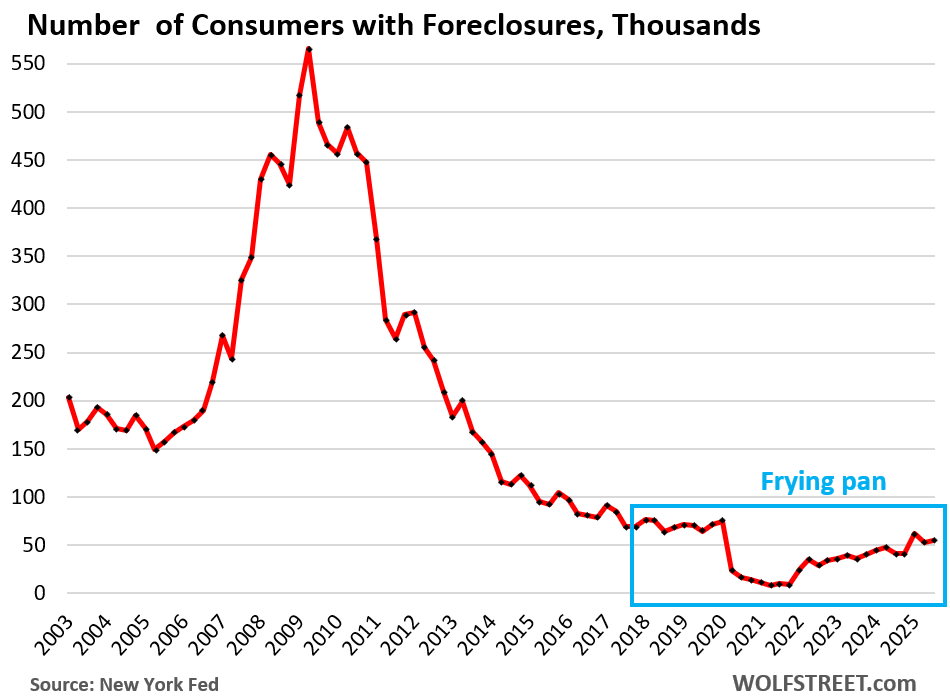
Core Insights - The article discusses the shifting of mortgage risks from banks to taxpayers and investors, highlighting the current state of mortgage balances and the implications for the housing market [1][16]. Mortgage Balances - Mortgage balances increased by $137 billion (+1.1%) in Q3 from Q2 and by $482 billion (+3.8%) year-over-year, reaching a total of $13.1 trillion [1]. - The growth in mortgage balances is influenced by several factors, including the financing of newly constructed homes and the cash-out portion of refinanced mortgages [2]. Home Equity Lines of Credit (HELOCs) - HELOC balances rose by 2.7% quarter-to-quarter and by 9.0% year-over-year, totaling $422 billion, with a 33% increase since the low point in Q1 2021 [5][6]. - Despite the increase, HELOC balances remain relatively low, with many lines of credit unused [6]. - Risks associated with HELOCs include the potential for foreclosure if homeowners default on the second lien while keeping the first-lien mortgage current [8][9]. Housing Debt Metrics - The housing-debt-to-disposable income ratio in Q3 increased to 58.6%, slightly above the record low in Q2 [14]. - The burden of housing debt is evaluated using the debt-to-income ratio, which includes both mortgage and HELOC debt [11][12]. Risk Distribution - Banks and credit unions are responsible for $2.7 trillion in mortgages, accounting for only 19.7% of the total mortgage and HELOC debt [16]. - The government is liable for $9.1 trillion of single-family mortgages that are securitized into mortgage-backed securities (MBS) [17]. - Investors hold $1.7 trillion of residential mortgages that are not government-backed, carrying the credit risk for these loans [18]. Delinquency and Foreclosure Rates - Serious delinquency rates for mortgages and HELOCs remain low at 0.8% [19]. - Foreclosures in Q3 rose to 54,760, significantly below the pre-crisis levels [23].