
Digital Asset Oversight

Search documents
X @The Block
The Block· 2025-11-19 23:13
With major crypto bills pending, lawmakers press CFTC Chair pick Selig on agency independence and digital asset oversight https://t.co/UDOtSxNpme ...
Australian Regulator Signals Broader Digital Asset Oversight Ahead of New Licensing Regime
Yahoo Finance· 2025-10-29 12:08
Core Viewpoint - Australia's markets regulator, ASIC, is enhancing its regulatory framework for digital assets, indicating that many digital assets qualify as financial products under existing laws [1][3]. Group 1: Regulatory Changes - ASIC is revising its Information Sheet 225 to expand the definition from "crypto assets" to "digital assets," providing 13 examples of when various tokens and products require financial services licenses [2]. - The regulator's guidance aligns with the Treasury's upcoming Digital Asset Platforms and Payment Service Providers bills, which will formalize licensing for exchanges, custodians, and certain stablecoin issuers [3][6]. Group 2: Specific Asset Classifications - ASIC has identified that fiat-backed stablecoins may be classified as non-cash payment facilities, while wrapped tokens could be considered derivatives, both necessitating Australian Financial Services (AFS) licensing [4]. - The commission emphasizes that Australian law applies to offshore and decentralized structures marketed to local users, ensuring that global platforms cannot evade regulatory oversight based on geography [4]. Group 3: Custodial Obligations - New custodial obligations require firms holding client assets to meet net tangible asset thresholds of up to 10 million Australian dollars (approximately US$6.5 million), unless their custody role is incidental [5]. - ASIC is providing a transitional "no-action" period for companies seeking the necessary licenses after the guidance is finalized, but it has indicated that enforcement expectations are increasing [5].
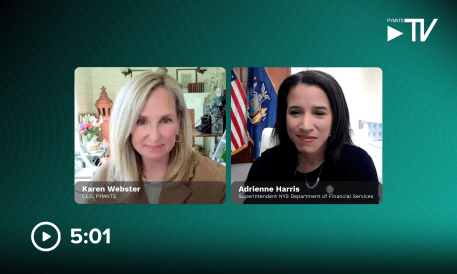
Adrienne Harris Reflects on 4 Years of Redefining Financial Regs
PYMNTS.com· 2025-10-20 08:00
Core Insights - The New York Department of Financial Services (DFS) is drafting rules for Buy Now, Pay Later (BNPL) that focus on disclosure, credit reporting, and harmonization with other regulators while ensuring appropriate guardrails [1][10] - Adrienne Harris, the outgoing superintendent, emphasizes that regulators can protect consumers and markets while being supportive of business [3][4] - The DFS has established itself as a national model for financial regulation, promoting innovation within defined boundaries [4][8] Regulatory Developments - The DFS's virtual currency team has expanded from a few members to 60, making it one of the largest regulatory groups for virtual currencies globally [9] - The agency's early adoption of the BitLicense framework has positioned New York as a leader in digital asset oversight, influencing the recent federal GENIUS Act [8][9] - Proposed BNPL rules will address fees, disclosures, and credit reporting, ensuring that regulations keep pace with evolving financial models [10] Leadership Transition - Kaitlyn Asrow will assume the role of acting superintendent, ensuring continuity in the DFS's leadership in digital finance [6] - Harris's tenure included significant challenges, such as the crypto winter and the collapses of several banks, leading to internal reforms within the DFS [11] Achievements and Legacy - Under Harris's leadership, the DFS has secured over $725 million in restitution for consumers, highlighting a commitment to consumer protection [11] - Harris's legacy includes redefining how regulation can support innovation sustainably and durably for all stakeholders [11]


U.S., U.K. Form Task Force to Align on Crypto and Capital Markets
Yahoo Finance· 2025-09-22 18:10
Core Insights - The U.S. and U.K. have launched a joint Transatlantic Taskforce to enhance cooperation on capital markets and digital assets [1][2] - The task force aims to develop oversight approaches for digital assets and explore opportunities in wholesale digital markets [2][4] - The initiative emphasizes the importance of aligning regulatory frameworks as technology transforms financial markets [3] Group 1: Taskforce Objectives - The task force will report within 180 days, providing recommendations in consultation with the private sector [2] - Short-term measures will focus on facilitating cross-border use cases, while long-term strategies will aim to advance digital market infrastructure [4] Group 2: Industry Implications - The collaboration is seen as a validation of the digital assets industry, promoting higher standards of transparency and accountability [5] - The initiative may set a global benchmark for other jurisdictions if they choose to follow this structured collaboration [5]