Drug Approval Process

Search documents
Scholar Rock (NasdaqGS:SRRK) 2026 Conference Transcript
2026-03-10 19:32
Summary of Scholar Rock Conference Call Company Overview - **Company**: Scholar Rock (NasdaqGS:SRRK) - **Focus**: Development of Apitegromab, a muscle-targeted therapy for Spinal Muscular Atrophy (SMA) Key Points Industry Context - The conference highlighted the challenges faced by biotech companies, particularly in drug development and regulatory compliance, with a specific focus on the manufacturing issues related to the Catalent Novo facility [6][7][8]. Apitegromab Development - **Phase 3 Trial**: Scholar Rock announced positive results from the phase 3 SAPPHIRE trial involving 188 patients, achieving statistically significant improvements in motor function for SMA patients [6]. - **Regulatory Timeline**: The company filed for approval in January 2025, received priority review, and had an action date set for September 22, 2025. However, a complete response letter was issued due to compliance issues at the manufacturing facility [7][14]. Manufacturing and Compliance Issues - The compliance issue was specifically related to the third-party fill-finish manufacturing facility in Bloomington, Indiana, which is now owned by Novo Nordisk [7][10]. - Following a Type A meeting with the FDA, there has been a positive progression in communication and remediation efforts at the facility, with expectations for a formal re-inspection soon [11][12][13]. Resubmission and Launch Plans - Scholar Rock reaffirmed its guidance for a BLA resubmission and U.S. launch in 2026, contingent on the successful re-inspection of the manufacturing facility [14][25]. - The company is also working on a second fill-finish facility to ensure redundancy in its supply chain, which is expected to support the 2026 launch [19][20]. Supply and Inventory Management - Scholar Rock has tens of thousands of vials of Apitegromab ready for the SMA community, which were manufactured before the compliance issues arose [22][23]. - The company is confident that the existing inventory will meet initial demand upon approval, with additional supply expected from the second facility [25]. Commercial Readiness - The commercial team has been actively preparing for the launch, including disease awareness campaigns and building relationships with treatment centers and payers [32][33]. - A patient assistance program, Scholar Rock Supports, has been established to help patients navigate the reimbursement process [35]. Global Market Opportunity - The company anticipates a significant global market for Apitegromab, with expectations of a balanced distribution of sales between the U.S., Europe, and other regions [43][46]. - There are approximately 35,000 patients globally who have received SMN-targeted therapies, indicating a robust market opportunity for Apitegromab [46]. Future Development Plans - Scholar Rock is exploring additional formulations and indications for Apitegromab, including subcutaneous delivery options and new therapies like SRK-439, a myostatin inhibitor [52][53]. Financial Position - The company announced a new loan of up to $550 million to support its operations and pipeline without diluting equity, maintaining a strong balance sheet with $368 million at year-end [57][58]. Conclusion - Scholar Rock is navigating significant regulatory and manufacturing challenges but remains optimistic about the approval and launch of Apitegromab in 2026. The company is also strategically positioning itself for future growth in the neuromuscular disease space.

Praxis Precision Medicines (NasdaqGS:PRAX) FY Conference Transcript
2026-03-02 17:52
Summary of Praxis Precision Medicines FY Conference Call Company Overview - **Company**: Praxis Precision Medicines (NasdaqGS:PRAX) - **Key Products**: ULYXIA (for essential tremor), relutrigine (for epilepsy) Core Industry Insights - **Market Size**: The addressable market for essential tremor is over 2 million patients at peak, significantly larger than previously anticipated [15][16] - **Regulatory Strategy**: The company opted for a standard review process for ULYXIA instead of a priority review to maintain a strong relationship with the FDA and maximize revenue potential before IRA negotiations begin [15][16] Key Points Discussed 1. **NDA Submission**: The NDA for ULYXIA has been submitted, and the company is not requesting priority review, anticipating a standard review process [7][15] 2. **FDA Relationship**: The company has maintained continuity in its interactions with the FDA, with no significant staff changes in the review team since the end of Phase 2 meetings [19][20] 3. **Titration Schedule**: The NDA submission included a standard titration schedule, with a proposal to allow clinicians to maintain a 20-milligram dose for an extra week if tolerability issues arise [30][34] 4. **Patient Tolerability**: Approximately 30% of patients may experience dizziness, which could lead to discontinuation of the drug; however, the company believes that maintaining the 20-milligram dose could resolve this issue for most patients [32][34] 5. **Pre-Launch Activities**: The company is focusing on disease awareness and prescriber identification to prepare for the ULYXIA launch, targeting over 200,000 patients interested in clinical trials [58][71] 6. **Sales Force Strategy**: The company plans to hire around 300 sales representatives to ensure adequate coverage and demand generation for ULYXIA, rather than starting with a smaller team and scaling up [126][127] 7. **Pricing Strategy**: The pricing for ULYXIA is expected to reflect its innovative nature, with a potential starting point in the mid-range of existing treatments for similar conditions [112][114] 8. **Relutrigine Development**: The company is also preparing for the launch of relutrigine, which is expected to receive priority review, with a PDUFA date likely in Q4 [135] Additional Important Insights - **Market Dynamics**: The company anticipates a large volume of patients seeking treatment for essential tremor, with about 1 million patients seen by neurologists annually for prescriptions [76][77] - **Community Engagement**: The company is focusing on building relationships with both specialized centers and community neurologists to ensure effective patient referrals and education [140][141] - **Future Data Catalysts**: Upcoming data from the POWER1 study for vormatrigine is expected to show significant efficacy, with a target of 30% placebo-adjusted seizure reduction [152][154] - **Ongoing Studies**: The phase 3 study for Elsunersen is progressing well, with an amendment to remove sham controls based on FDA recommendations [160][162] This summary encapsulates the key discussions and strategic insights from the Praxis Precision Medicines FY Conference Call, highlighting the company's focus on regulatory strategy, market preparation, and product development.

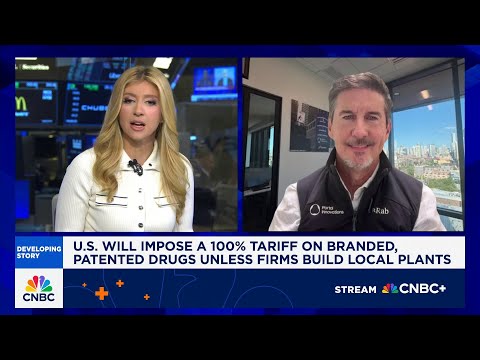
Portal Innovations’ John Flavin: Tariffs on pharma could raise costs and delay drug access
CNBC Television· 2025-09-26 16:21
Potential Impact of Tariffs - A 100% tariff on pharmaceutical companies is threatened if they don't build manufacturing plants in the US, potentially increasing the burden on US consumers and insurance companies [1][2] - Tariffs could increase the cost of bringing new drugs to market and negatively impact young startups relying on outsourced opportunities for cost-competitive clinical trials [3] - Short-term concerns exist regarding changing supply lines and the capacity for onshoring final manufacturing of active pharmaceutical ingredients, potentially causing delays in bringing products to US patients [5] Onshoring and Investment - Onshoring of manufacturing is viewed positively, with companies like Eli Lilly, Novartis, and Roche announcing investments of over $20 billion in new plants [4] - Building plants in the US may lead to favorable treatment regarding tariffs, particularly for patented technologies, while generic products may not be affected [6][7] - US manufacturing is beneficial for national security, especially after COVID-19 revealed the risks of outsourcing early-stage and raw ingredient supply lines [11] FDA and Regulatory Concerns - Concerns exist regarding the FDA's willingness to approve certain therapies, potentially impacting investment decisions [8] - Confusing factors, including threats to NIH funding and mixed messages around the FDA process, create uncertainty for investors [12][13] - Efforts to accelerate the drug approval process are viewed favorably by investors and patients [12] Innovation and Market Dynamics - US innovation in treating rare diseases using CRISPR and cell therapy is expected to continue transforming and addressing unmet patient needs [10] - Trade deals with countries like Japan and Korea may shield them from the tariffs [14]