
ECB Policy

Search documents
Dollar Climbs on Hot US PPI and Iran War Escalation
Yahoo Finance· 2026-03-18 14:35
The dollar index (DXY00) today is up by +0.30%. The dollar recovered from early losses today and turned higher after US Feb producer prices rose more than expected, a hawkish factor for Fed policy. Also, signs of escalation in the Iran war knocked stocks lower and boosted liquidity demand for the dollar after Iran said it will target energy infrastructure in Saudi Arabia, Qatar, and the UAE in retaliation for US and Israeli airstrikes on its South Pars gas field and its Asaluyeh oil industry facilities. ...
Dollar Mildly Higher as T-note Yield Rises
Yahoo Finance· 2026-03-11 15:21
The dollar index (DXY00) is up +0.17% on support from today's +4.7 bp rise in the 10-year T-note yield, which supported the dollar's interest rate differentials. Also, today's +4% rally in WTI crude oil prices is hawkish for Fed policy and supportive of the dollar. Today's US CPI report was in line with market expectations and roughly neutral for the dollar. The Feb CPI rose +0.3% m/m and +2.4% y/y, while the Feb core CPI rose +0.2% m/m and +2.5% y/y. Today's headline CPI report of +2.4% y/y was just 0 ...
Energy Shock From Iran War Puts ECB Policy on Edge
Yahoo Finance· 2026-03-05 18:51
Core Insights - The European Central Bank (ECB) is currently in a stable phase with interest rates on hold and inflation nearing its 2% target, but the ongoing conflict involving Iran poses new challenges [2] - ECB officials are concerned that prolonged energy price increases could alter inflation expectations, potentially leading to a shift in monetary policy [3][4] Group 1: Economic Impact of the Conflict - ECB Vice President Luis de Guindos indicated that a long-lasting conflict in the Middle East could elevate inflation expectations, prompting a policy shift [3] - The immediate concern revolves around energy prices, which have surged due to the conflict, potentially impacting headline inflation and economic stability [4] - Other ECB policymakers, including Finnish central bank governor Olli Rehn and Bundesbank President Joachim Nagel, emphasized that the duration of the conflict will significantly influence economic outcomes [5] Group 2: Policy Stance and Market Reactions - There is currently no consensus among ECB officials that higher interest rates are necessary, with some suggesting that the rise in oil prices alone does not warrant a policy tightening [6] - The ECB is adopting a meeting-by-meeting approach to assess whether the energy shock is temporary or will have lasting effects on inflation dynamics [6] - Market expectations are shifting, with Morgan Stanley no longer anticipating interest rate cuts from the ECB this year, reflecting concerns that energy prices may keep inflation elevated [7] Group 3: Challenges for Central Banks - Energy shocks present a complex challenge for central banks, as they can simultaneously drive inflation up while hindering economic growth by increasing costs for households and businesses [8]
Lagarde Says Inflation, ECB Policy in 'Good Place'
Bloomberg Television· 2026-02-05 15:35
Now, are we are we still in a good place. I would certainly argue that we are in a good place and inflation is in a good place. Now.Two words of explanation because some of you might be riveted to the January data points. And I would like just to remind you that a good place is a factor of whether we are. Convinced that we will reach our medium term target of 2%.And we cannot be. Hostage to one data points. I've said that many times we cannot be hostage to one reading of inflation, which is set to vary over ...

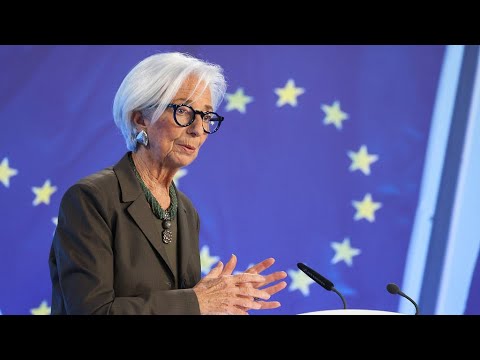
Lagarde Says Inflation, ECB Policy in 'Good Place'
Yahoo Finance· 2026-02-05 14:47
"We are in a good place and inflation is in a good place," European Central Bank President Christine Lagarde told reporters in Frankfurt. She made the comments after the central bank decided to hold interest rates. ...
Dollar Slips and Gold Rallies to a Record High as the US Government Shuts Down
Yahoo Finance· 2025-10-01 19:34
Core Insights - The dollar index fell by -0.06%, reaching a 1-week low, primarily due to the US government shutdown and weak labor market data [1] - The unexpected decline in the September ADP employment change by -32,000, the largest drop in 2.5 years, has increased the likelihood of a Fed rate cut to 100% for the upcoming FOMC meeting [2][3] - The ISM manufacturing index for September rose to a 7-month high of 49.1, which provided some recovery for the dollar after its initial losses [1][3] Labor Market - The September ADP employment change unexpectedly fell by -32,000, contrasting with expectations of a +51,000 increase, marking the largest decline in 2.5 years [2] - The August ADP employment figure was revised down from +54,000 to -3,000, indicating a weaker labor market than previously thought [2] Manufacturing Sector - The ISM manufacturing index increased by +0.4 to 49.1, surpassing expectations of 49.0, indicating a stronger manufacturing sector [3] - The ISM price paid sub-index fell by -1.8 to an 8-month low of 61.9, which was weaker than the expected 62.7 [3] Eurozone Insights - The euro rose by +0.02%, supported by dollar weakness and an upward revision of the Eurozone September S&P manufacturing PMI to 49.8 [4][5] - Eurozone September CPI increased by +2.2% year-on-year, aligning with expectations, while core CPI remained unchanged at +2.3% year-on-year [5] Central Bank Divergence - The market perceives the ECB as nearing the end of its rate-cut cycle, while the Fed is anticipated to cut rates approximately two more times by the end of the year [5][6] - Swaps indicate a 1% chance of a -25 basis point rate cut by the ECB at the October 30 policy meeting [6] Currency Movements - The USD/JPY fell by -0.55%, with the yen reaching a 2-week high against the dollar due to increased safe-haven demand following the US government shutdown [7] - Positive economic indicators from Japan, including an increase in the Q3 Tankan large manufacturing sentiment index and an upward revision of the September S&P manufacturing PMI, contributed to the yen's strength [7]