
EV Overseas Expansion

Search documents
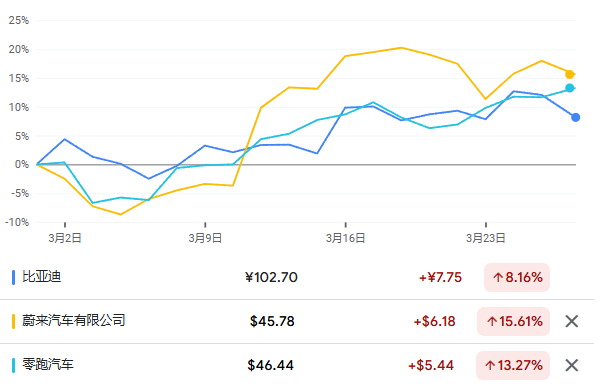
伊朗战争“避风港”:比亚迪3月大涨,电车股成恒科最佳之一
Hua Er Jie Jian Wen· 2026-03-27 00:48
Core Viewpoint - The surge in oil prices due to the Iran conflict has unexpectedly catalyzed the Chinese electric vehicle (EV) sector, with BYD's Hong Kong stock rising 8% in March, marking its best monthly performance in over a year. The overseas market has become a key driver for valuation amid a backdrop of weak domestic demand and ongoing price wars [1][4]. Group 1: Market Dynamics - The increase in oil prices is reshaping the investment logic for electric vehicles, with BYD's stock performance being significantly influenced by overseas market demand [1][4]. - Strong momentum in overseas markets is a crucial support for the current rebound, with BYD's overseas sales in the first two months of the year surging by 50% year-on-year, particularly in markets like the Philippines and Indonesia [3][4]. - The conflict in Iran has directly stimulated consumer interest in electric vehicles in emerging Asian markets, leading to reports of consumers queuing to purchase EVs [4]. Group 2: Company Performance and Strategy - BYD's overseas delivery volume reached 1.05 million units last year, with a target of selling 1.3 million units outside China this year. The company’s proprietary fast-charging technology could address key bottlenecks in charging speed and infrastructure [4]. - Analysts highlight that BYD's cost advantages from in-house battery production enable strong profitability in its export business, effectively capturing demand shifts driven by rising oil prices [4]. - There is a growing divergence in market sentiment regarding BYD, with short positions increasing from 0.7% to 3.2% of free-floating shares, indicating some investors' skepticism about the sustainability of the rebound [6]. Group 3: Future Outlook - Investors are focusing on the upcoming earnings report and full-year guidance to assess the sustainability of the export-driven recovery [3][6]. - Despite the strong performance, BYD's stock is still down over 30% from its historical high in May of last year, making the upcoming earnings release a critical point for determining whether the current rebound can evolve into a sustained trend [6].


中国电动汽车_本土市场降温迹象明显
2025-11-16 15:36
Summary of China Auto/EV Global Markets Research Industry Overview - The report focuses on the **China auto market**, particularly the **electric vehicle (EV)** segment, highlighting recent trends in wholesales and retails, as well as market dynamics affecting demand and competition. Key Points Market Performance - **Wholesales**: The China auto market delivered **3.0 million** wholesales unit shipments in October 2025, representing a **7.5% year-on-year (y-y)** increase and a **3.6% month-on-month (m-m)** increase [1][6] - **Retails**: Retail unit shipments were **2.2 million units**, showing a **0.9% y-y** decline and a **0.1% m-m** decline [1][6] - **EV Sales**: Monthly retail sales for passenger vehicle (PV) EVs reached **1.28 million units**, marking a **7.0% y-y** increase but a **1.4% m-m** decrease [1][6] Demand Trends - The report indicates that local demand in the China auto market has started to cool down, attributed to the **National Holiday week** and tightening policy trends initiated from **late September 2025** [1][6] - The **EV penetration rate** remains stable at **56.5%**, consistent with the previous month [1][6] Future Outlook - The demand situation for **Q1 2026** is expected to be challenging, particularly due to the upcoming **50% cut to EV purchase tax exemption** and the effects of the national trading-in/scrapping policy [1][8] - OEMs are anticipated to push for sales targets in the last two months of 2025, leading to solid deliveries despite a potentially lackluster orders situation [1][2] Competitive Landscape - Market share winners identified include **Geely**, **Leapmotor**, and **Huawei-related brands** in the mass market, while **Xiaomi** is noted in the premium segment [2] - New entrants like **NIO** and **XPENG** are expected to continue gaining traction with upcoming model launches [2][19] Export Performance - The China auto industry exported **571,000 units** of PVs in October 2025, reflecting a **22.7% y-y** increase and a **2.0% m-m** increase [3][31] - Cumulative exports for the first ten months of 2025 reached **4.7 million units**, a **15.7% y-y** increase, with EV exports showing a significant **87% y-y** growth [3][31] Individual Company Performance - **BYD**: Retail sales dropped to **296,000 units** in October 2025, a **31.4% y-y** decline, with a market share decrease to **23.1%** [15] - **Geely**: Achieved **164,000 unit** EV retail sales (+54.7% y-y) with an improved market share of **12.8%** [16] - **NIO**: Recorded **40,000 unit** retail sales (+90.5% y-y), with expectations for improved quarterly financials [18] - **XPENG**: Delivered **37,000 unit** retail sales (+82.2% y-y), with a strong pipeline for future models [19] Risks and Challenges - The report highlights potential risks including intensified market competition, slower-than-expected overseas expansion, and the impact of geopolitical uncertainties on global expansion efforts for Chinese OEMs [4][8] Conclusion - The China auto market is experiencing a cooling demand phase, with significant competition among OEMs. While some companies are gaining market share, the overall outlook remains cautious due to policy changes and market dynamics. The export performance of EVs is a positive sign amidst local market challenges [1][4][8]


