EV Revolution

Search documents
Ford Takes $19.5 Billion EV Hit. Is the EV Revolution Over?
The Motley Fool· 2025-12-27 01:04
Core Insights - The electric vehicle (EV) market is experiencing a significant downturn, with major automakers like Ford taking substantial write-offs and pivoting towards hybrid models instead of fully electric vehicles [3][9][11] - The initial optimism surrounding EVs may have been premature, as the technology and cost structures have not yet aligned for mass-market adoption [4][9][15] - Automakers are recalibrating their strategies to align with current market realities and consumer demand, indicating that the transition to EVs will be a longer process than previously anticipated [9][11][15] Industry Trends - Ford has announced a $19.5 billion write-off related to its EV division, signaling a shift in focus towards hybrids and a delay in profitability expectations for its EV segment until 2029 [9][11] - The expiration of the $7,500 federal consumer tax credit has further complicated the EV market, impacting sales and consumer confidence [11][9] - The current market for EVs is characterized by high costs and limited consumer adoption, particularly among cost-conscious buyers [9][15] Company Strategies - Ford and GM are adjusting their production lines to be more flexible, allowing for the manufacturing of hybrids alongside traditional vehicles, which is seen as a more profitable strategy in the short term [13][14] - Automakers are not abandoning EVs entirely but are recognizing the need to focus on hybrids and internal combustion engine vehicles to maintain profitability [14][15] - The market is witnessing a divergence between traditional automakers, which are leveraging their established manufacturing capabilities, and newer entrants like Rivian, which are struggling with profitability and cash flow [22][26] Market Dynamics - The EV market is still expected to grow, particularly in regions like China, but the pace of growth has slowed compared to earlier projections [15] - Investors are advised to approach the EV market with caution, as the hype surrounding certain companies may not be justified by their current financial performance [21][22] - The complexities of the automotive supply chain and the challenges faced by newer companies highlight the importance of scale and established infrastructure in achieving profitability [26][27]



4 Stocks Poised to Capitalize on the EV Revolution in 2026
ZACKS· 2025-12-22 17:26
Industry Overview - Electric vehicles (EVs) are becoming integral to global transportation, with advancements in battery technology and charging infrastructure making them more practical and affordable for everyday use [1] - Modern EV batteries have improved in longevity, charging speed, and production costs, narrowing the price gap with gas-powered vehicles and expanding EV appeal [1] - Fast-charging networks are expanding in major markets, addressing one of the significant concerns for potential buyers: charging time [1] Market Dynamics - Despite uneven adoption rates, the long-term shift toward electrification is firmly established, with global EV sales rising 21% year over year to 18.5 million vehicles in the first 11 months of 2025 [4] - The number of electric vehicles in use is expected to grow by 30% in 2026, reaching 116 million units worldwide, with plug-in hybrid vehicles forecasted to increase by 32% [4] - China is a key driver of this transition, with competitive pricing, strong government support, and innovation leading to a majority share of light-vehicle sales [5] - Global plug-in vehicle sales increased by 25% in 2024 to 17.8 million units, capturing nearly 20% of the light-vehicle market, projected to rise to 22.1 million in 2025 [6] Company Highlights - **Blue Bird Corporation (BLBD)**: A leader in low- and zero-emission school buses, with over 20,000 buses operating in the U.S. The company aims for $1.5 billion in revenues and $220 million in adjusted EBITDA for fiscal 2026, with a target of adjusted EBITDA margins above 16% on approximately $2 billion in revenues [7][8][10] - **Workhorse Group Inc. (WKHS)**: Focused on medium-duty electric commercial vehicles, with a production capacity of over 5,000 vehicles per year. The company has a solid sales pipeline and a growing backlog, with a projected year-over-year improvement of 90% and 56% for 2025 and 2026, respectively [11][12][13] - **QuantumScape Corp. (QS)**: Developing solid-state lithium batteries with significant advancements in manufacturing processes. The company recorded $12.8 million in customer billings for the first time and is moving closer to commercialization [14][16] - **ChargePoint Holdings, Inc. (CHPT)**: A leading player in EV charging, connecting drivers to over 1.3 million charging ports worldwide. The company reported a 6% year-over-year revenue increase to $105.7 million in fiscal Q3 2026, with subscription revenues up 15% [17][19]





Europe's EV Revolution Is on Track. How Auto Makers Plan to Win.
Barrons· 2025-09-18 16:00
Core Viewpoint - The European Union will implement a ban on the sale of new gasoline-powered internal-combustion passenger cars by 2035, promoting the transition to electric vehicles (EVs) [1] Industry Summary - The decision by the European Union presents a significant opportunity for automakers to pivot towards electric vehicle production [1]


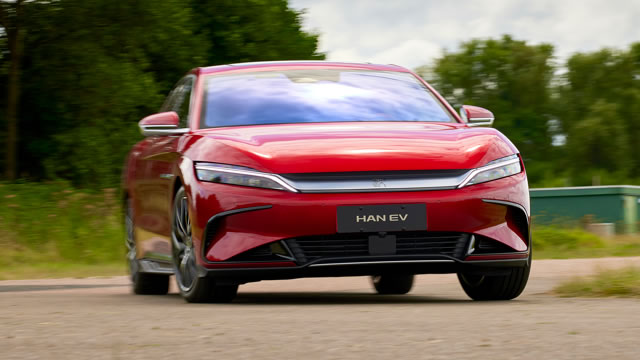
BYD Is Quietly Building a Global EV Empire -- Here's What Investors Should Know
The Motley Fool· 2025-08-25 09:14
Core Insights - BYD has transformed from a Chinese battery maker to a global electric vehicle (EV) leader, surpassing Tesla in global EV sales in 2024, indicating its ambitions beyond domestic markets [1][12]. Group 1: Supply Chain Control - BYD's vertical integration allows it to manufacture almost all components in-house, including batteries and semiconductors, providing a significant speed and cost advantage [4]. - The company produces its proprietary "Blade Battery," which is a lithium iron phosphate (LFP) battery, offering safety and longevity, thus avoiding supply shortages faced by competitors [5]. - BYD operates its own shipping fleet, reducing reliance on third-party carriers and ensuring timely delivery of vehicles [5]. Group 2: Localization Strategy - To succeed internationally, BYD is establishing manufacturing plants in various countries, including Thailand, Brazil, Hungary, Turkey, and Pakistan, to reduce tariffs and shipping costs [8]. - Local production allows BYD to adapt vehicles to regional preferences and positions the company as a local automaker rather than just a Chinese exporter [9]. Group 3: Multi-Brand Strategy - BYD segments its vehicle lineup to target different customer demographics, offering budget-friendly options in China while also catering to premium and luxury segments through brands like Denza and Yangwang [10]. - This multi-brand approach enhances BYD's flexibility in marketing and distribution, appealing to both emerging-market buyers and affluent customers in Europe [11]. Group 4: Investment Perspective - BYD's international expansion is a gradual process, with its strategies of supply chain control, localized manufacturing, and multi-brand positioning working together to create a competitive global EV company [12]. - The company's ability to scale production outside China and establish credibility in premium markets like Europe will be crucial for its long-term investment potential [13].

EVgo Vs. ChargePoint: Tariffs, Technicals, And The Road To Profitability
Benzinga· 2025-05-02 12:35
Core Viewpoint - The EV market is experiencing a slowdown, but EVgo Inc (EVGO) is positioned more favorably than ChargePoint Holdings Inc (CHPT) due to better utilization, partnerships, and a clearer path to sustainable returns [1][2]. Company Positioning - EVgo is an owner-operator of DC fast-charging stations and is gaining traction with original equipment manufacturers (OEMs), rideshare, and autonomous fleets, which provides strong customer momentum and an attractive asset base [5]. - ChargePoint is struggling, with its stock trading below key moving averages, indicating a bearish sentiment and limited recovery potential [6]. Market Dynamics - The muted demand for electric vehicles (EVs) is impacting discretionary hardware purchases, favoring owner-operators like EVgo over hardware-software players like ChargePoint [2]. - Potential tariffs on hardware sourced from Taiwan could increase costs for both EVgo and ChargePoint, raising concerns about profitability as EV penetration estimates have been revised down from 11% to 9% for 2025 [4]. Financial Indicators - EVgo's stock shows bullish signals, trading above the eight-day, 20-day, and 50-day simple moving averages (SMAs), although it remains below the 200-day average, which is a longer-term bearish indicator [5]. - ChargePoint's stock is in a neutral position, trading below the eight-day, 50-day, and 200-day SMAs, with most indicators remaining bearish despite a minor bullish signal from a 20-day crossover [6].