Estate Tax

Search documents
Estate Taxes Explained | 5 Questions with Fidelity | Fidelity Investments
Fidelity Investments· 2026-04-09 20:34
Trusts can be useful for many as they can be structured to provide beneficiaries with protection, manage money for minor beneficiaries, help avoid the probate process, and more. This episode of 5 Questions with Fidelity tells you what you need to know about the recent updates to federal estate tax laws that could potentially affect your estate plan. We’ll look at how you can take advantage of the latest gifting limits in your planning strategies, discuss some reasons to consider using trusts, and much more. ...


Avoid These Estate Tax Errors That Could Ruin Your Legacy Plans
Yahoo Finance· 2026-03-01 13:02
Core Insights - The article emphasizes the importance of effective estate planning to avoid significant tax burdens on heirs, particularly concerning estate taxes and gifting strategies. Group 1: Gifting Strategies - Individuals can give up to $19,000 per recipient tax-free in 2026, allowing married couples to gift $38,000 to each child or grandchild without affecting their lifetime estate tax exemption [2] - Gifting cash while alive is recommended, as gifting appreciated assets like stocks transfers the original cost basis to the recipient, leading to potential capital gains taxes upon sale [3] Group 2: Estate Tax Exemptions - The federal estate tax exemption is currently at a record high of $15 million per person, but experts predict potential increases in future tax changes [4] - Surviving spouses can transfer unused estate tax exemptions from deceased spouses by filing a 706 form, which can enhance their own exemption [5] Group 3: State and Local Tax Considerations - Some states impose estate taxes at lower thresholds than the federal exemption, and may also have inheritance taxes that complicate the tax landscape for heirs [6] Group 4: Legal and Regulatory Changes - Estate plans must be updated regularly to reflect changes in tax laws and exemptions, as outdated plans may result in higher taxes for heirs due to new regulations [7] - Beneficiary forms for certain accounts and assets take precedence over wills, highlighting the need for regular updates to these documents to ensure alignment with estate planning goals [8]
Will the bank get suspicious if I deposit $150,000 in cash into my checking account?
Yahoo Finance· 2026-02-27 22:49
Core Points - The legality of depositing a large cash inheritance, such as $150,000, into a bank account is questioned, particularly regarding tax implications and documentation requirements [1][3][4] Group 1: Legal and Regulatory Aspects - Depositing more than $10,000 will likely trigger a mandatory currency-transaction report to the Internal Revenue Service and the Financial Crimes Enforcement Network under the Bank Secrecy Act of 1970, aimed at detecting potential money laundering [3][4] - Deliberately breaking up deposits into smaller amounts to avoid triggering alerts is illegal and known as "structuring," which can be detected during audits [5] - Financial institutions may request probate documents, a letter from the executor, or a death certificate to confirm the cash's legal source, especially if it is not directly inherited [6] Group 2: Tax Considerations - Only a few states impose an inheritance tax, with the amount depending on the heir's relationship to the deceased, while there is no federal inheritance tax; however, a federal estate tax applies with an exemption threshold adjusted annually for inflation [7]
‘I need to get my financial ducks in a row’: I’m 80 with $1 million. How do I prevent my son from being hit with inheritance tax?
Yahoo Finance· 2026-02-22 16:30
Core Points - The article addresses concerns regarding estate planning and tax implications for an octogenarian's inheritance to her son, emphasizing the importance of understanding tax laws and exemptions [1][4]. Group 1: Inheritance and Tax Implications - Inherited investments receive a "step-up in basis," resetting their cost basis for tax purposes to fair market value at the time of death [3]. - The lifetime estate-tax and gift-tax exclusion for 2026 is approximately $15 million per individual, allowing significant wealth transfer without incurring federal estate tax [4][5]. - Inheritances are not considered taxable income, meaning the son will not owe income tax on the received assets, although potential capital gains and retirement account withdrawals may be taxed [6]. Group 2: State Regulations and Life Insurance - Some U.S. states impose inheritance taxes, but many exempt close relatives like children, making state laws crucial for estate planning [7]. - Life insurance death benefits are generally free of income tax for beneficiaries, and it is advised to name the son directly as the beneficiary to avoid complications [8].
A New IRS Rule Could Affect Your Plans for an Irrevocable Trust
Yahoo Finance· 2025-12-11 07:00
Core Viewpoint - The recent IRS rule change regarding the step-up in basis for assets held in irrevocable trusts significantly impacts estate planning strategies, particularly for those looking to minimize tax liabilities for heirs [5][6]. Group 1: Step-Up in Basis - The step-up in basis allows inherited assets to reset to their current fair market value, eliminating tax liabilities on unrealized capital gains [2]. - For example, if an asset purchased for $100,000 is sold for $250,000, the capital gains tax applies only to the profit above the original basis unless inherited, where the basis steps up to $250,000 [3]. Group 2: Irrevocable Trusts - Irrevocable trusts are used to protect assets, as the grantor relinquishes ownership rights, allowing the trust to own the assets for the beneficiaries' benefit [4]. - The new IRS ruling (Rev. Rul. 2023-2) stipulates that assets in an irrevocable trust must be included in the taxable estate of the grantor to qualify for the step-up in basis [5]. Group 3: Estate Tax Implications - The $13.61 million per-person estate tax exclusion in 2025 means that most estates in the U.S. will not incur estate taxes, benefiting heirs by allowing them to receive a step-up in basis [6]. - In 2021, only 42% of estates required to file estate tax returns actually paid any tax, indicating a low tax burden for most estates [7]. - However, the estate tax exemption limit is set to revert to $5 million in 2026, which could affect future estate planning strategies [7]. Group 4: Reasons for Using Irrevocable Trusts - Individuals often use irrevocable trusts to qualify for Medicaid assistance by removing assets from their ownership, allowing for tax-free transfer of properties to heirs [8].
X @Forbes
Forbes· 2025-10-24 11:45
Make a loved one's day.Gift up to $19,000 per recipient (2025 limit) to reduce your estate’s taxable value. Married couples can gift up to $38,000 per recipient. While you don't get an income tax deduction for these gifts, the recipient won't owe taxes, and the gift can help reduce the value of your estate without using up your lifetime gift and estate tax exemption. https://t.co/PnMwP2I23y ...
‘I’m in the home stretch’: I’m 80. Do I leave my kids a ‘Magnificent Seven’ dynasty trust or a brokerage account?
Yahoo Finance· 2025-10-23 12:02
Core Insights - The article discusses the complexities of estate planning for high-net-worth individuals, particularly regarding the decision between capital gains tax on dynasty trusts versus estate tax on personal accounts [2][4][6]. Group 1: Estate Planning Considerations - Dynasty trusts allow assets to be excluded from estate tax calculations, but beneficiaries face significant capital gains taxes upon sale [2][4]. - Transferring stocks back to a personal account can utilize the step-up rule, avoiding capital gains tax but incurring a 40% estate tax [2][4]. - The decision-making process involves various factors, including the size of the inheritance, asset appreciation, and potential changes in estate tax exemptions [4][6]. Group 2: Financial Implications - A hypothetical scenario suggests that if stocks are valued at $20 million, children may pay more in capital gains tax than in estate tax [6][7]. - The federal estate and gift-tax exemption for 2025 is projected to be $13.99 million per person, or $27.98 million for married couples [7].
Former World Bank President David Malpass: Markets all over need more dynamism
CNBC Television· 2025-10-22 12:03
Monetary Policy & Federal Reserve (The Fed) - The Fed needs reform, particularly regarding Quantitative Easing (QE), which is considered not stimulative and a cause of wealth inequality [1] - The Fed's large staff and control over markets are criticized, suggesting it's part of the "deep state" [1] - The Fed is skeptical of allowing others to participate in short-term markets, specifically stablecoins, and is slow to change [1] - A 50 basis point cut (0.5%) in the Fed Funds Rate is suggested for the next meeting, as the Fed is behind the curve [4] - Current short-term interest rates are at 415 basis points (4.15%) [3] Fiscal Policy & Taxation - The world needs more growth, which could be achieved through tax cuts in countries like Japan and the US [1] - High marginal tax rates (e.g., 45% in Japan) and VAT taxes are seen as detrimental to economic outlook [1] - Capital gains taxes in the US are too high, locking up unrealized gains and reducing market dynamism [1] - Lowering the capital gains rate to 10% for a limited time could create a government windfall [1] - Taxing wealth can lead to capital flight, as seen in Britain and Washington state [1] Economic Growth & Energy - More energy use is correlated with higher per capita income, advocating for more fossil fuels and less focus on renewable energy [1] - Increased energy production in the US is necessary for competition with China [1]
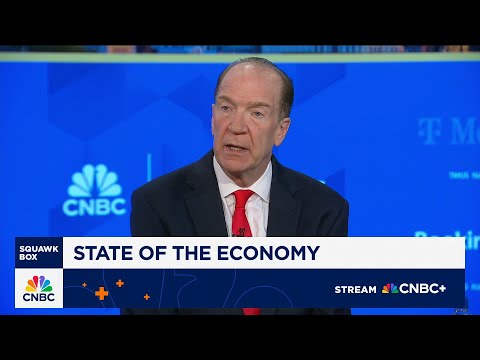
Former World Bank President David Malpass: Markets all over need more dynamism
Youtube· 2025-10-22 12:03
Economic Policy and Central Banks - The Fed needs to consider reforms, particularly regarding quantitative easing (QE), which has not been stimulative and has contributed to wealth inequality [1][2] - There is a call for the Fed to allow more market functionality and to be open to changes, especially concerning stable coins and short-term markets [1][2] - The current high capital gains tax in the US is seen as detrimental to market dynamism, and lowering it could lead to increased investment and growth [1][2][3] Taxation and Growth - Tax cuts are advocated for both the US and Japan to stimulate growth, with Japan's high marginal tax rate of 45% being a concern [1][2] - The idea of a temporary capital gains tax holiday is proposed, suggesting it could lead to a windfall for the government and potentially be extended if successful [2][3] - The impact of tax policies on market behavior is highlighted, with lower tax rates leading to increased equity values as they reflect growth opportunities [2][3] Interest Rates and National Debt - The current short-term interest rates set by the Fed at 4.15% are considered too high, especially in relation to long-term rates, indicating the Fed is behind the curve [3][4] - There is a concern that the national debt is too large, which could affect the demand for dollars, but recent trends show a preference for US assets as gold prices decline [3][4] - A suggestion for a 50 basis point cut in interest rates is made, arguing that the Fed should have started cutting earlier to align with market conditions [4][5]