Fact - checking

Search documents
AI差点骗过全世界,这个8.7万赞的帖子被揭穿后,我开始怀疑一切了
3 6 Ke· 2026-01-11 23:41
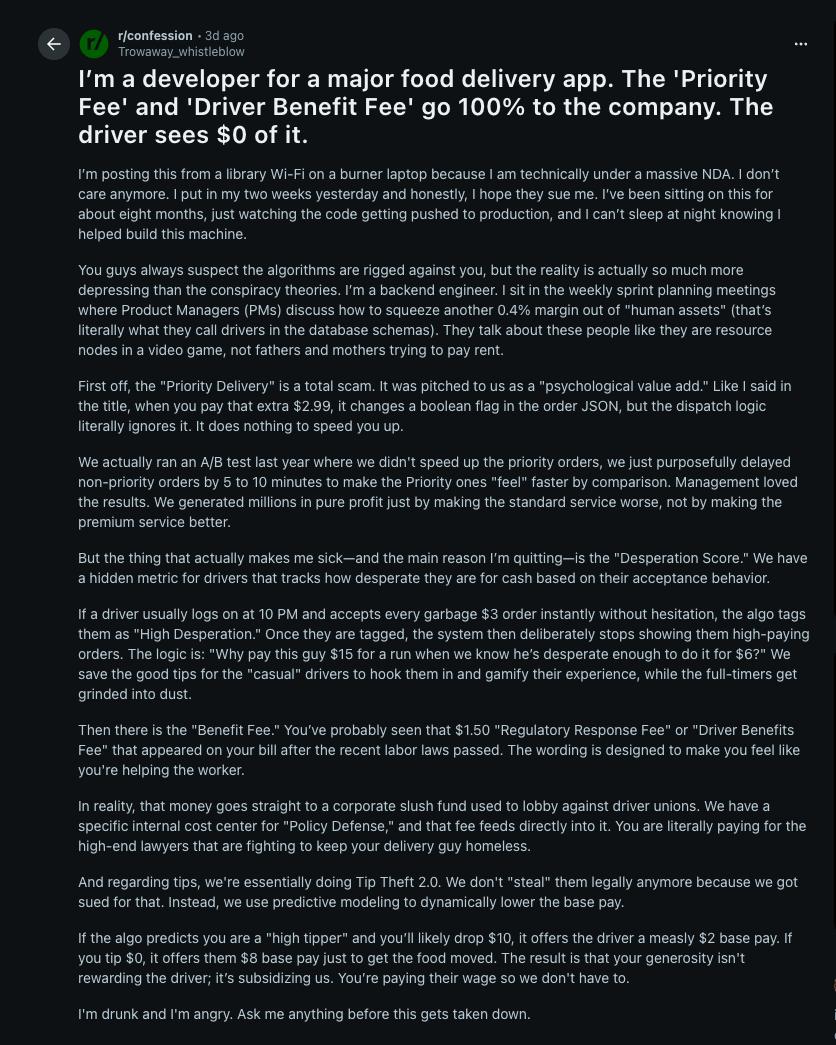
Core Insights - A new user named Trowaway_whistleblow claims to be a software engineer at a food delivery platform and is preparing to expose alleged company misconduct [1] - The story aligns with public perceptions of "evil capitalism" but is revealed to be an AI-generated hoax [2] Group 1: Allegations Against the Company - The whistleblower's post details how the platform manipulates algorithms to harm consumers and delivery workers, such as intentionally delaying regular orders to make paid priority orders appear faster [3] - The platform allegedly charges a "regulatory response fee" to lobby against driver unions, and calculates a "Desperation Score" for drivers based on their acceptance of low-paying orders [3] - The CEO of DoorDash, Tony Xu, publicly denied the allegations, stating that if anyone promotes such a culture, they would be fired [3] Group 2: Previous Legal Issues - DoorDash has previously faced lawsuits for stealing driver tips, resulting in a settlement of $16.75 million [4] - The exploitation of gig economy workers is not a new issue, as advocacy groups like Los Deliveristas Unidos have noted that such allegations resonate with the experiences of delivery workers [4] Group 3: Investigation and Verification Challenges - A journalist, Casey Newton, attempted to verify the whistleblower's identity but noticed inconsistencies, such as a spelling error in the whistleblower's communication [5] - The whistleblower provided a photo of an employee ID, which was later identified as AI-generated, raising concerns about the authenticity of the claims [11] - The rapid advancement of AI tools has made it easier for individuals to create convincing forgeries, complicating the verification process for journalists [14][15] Group 4: Broader Implications of AI in Information Verification - The rise of deepfake technology poses significant challenges for journalists, as it increases the difficulty of distinguishing between real and fabricated information [15][16] - The phenomenon of deepfakes contributes to a growing distrust in information sources, leading to societal uncertainty [16]

YouTube to allow creators banned for Covid-19, election misinformation to apply for reinstatement
CNBC· 2025-09-23 19:04
Core Points - YouTube will allow previously banned accounts to apply for reinstatement, reversing a policy that treated violations as permanent [1][2] - The reinstatement applies to channels removed for posting Covid-19 or election-related misinformation [1][2] - This change follows pressure from Republican lawmakers to alter Biden-era speech policies regarding misinformation [4] Group 1: Policy Changes - YouTube's Community Guidelines now permit a broader range of content related to Covid and election integrity [2] - The reinstatement program will be a limited pilot project for a subset of creators and channels terminated under retired policies [2] - YouTube ended its standalone Covid misinformation rules in December 2024 [5] Group 2: Political Context - The move comes amid increasing Republican pressure on tech companies to reverse policies on vaccine and political misinformation [4] - In March, Rep. Jim Jordan subpoenaed Alphabet CEO Sundar Pichai, accusing YouTube of participating in a censorship regime [4] - Senior Biden administration officials had previously pressured YouTube to remove certain Covid-related videos that did not violate its policies [5] Group 3: Content Moderation - YouTube will not empower third-party fact-checkers for content moderation, emphasizing free expression on the platform [6] - The platform has produced programs to label context on videos, although it has not used fact-checkers [6] - YouTube features information panels with links to independent fact checks under videos to provide additional context [7]

Oversight board voices concern about Meta nixing fact checks
TechXplore· 2025-04-23 06:33
Core Viewpoint - Meta's decision to end its US fact-checking program has raised significant concerns regarding the potential increase in misinformation and its implications for human rights [2][4]. Group 1: Policy Changes and Reactions - Meta announced a policy shift to replace third-party fact-checkers with a community-based moderation tool called "Community Notes," which has been criticized for its effectiveness [5][6]. - The Meta Oversight Board criticized the announcement as being made "hastily" and emphasized the need for a balance between free expression and safety from harm [3][4]. - Analysts suggest that the policy change may have been influenced by political pressures, particularly from then US President-elect Donald Trump [3]. Group 2: Recommendations and Concerns - The Oversight Board issued 17 recommendations for Meta, urging the company to evaluate the effectiveness of Community Notes compared to traditional fact-checking methods, especially in contexts where misinformation poses public safety risks [4]. - Experts have expressed skepticism about relying on crowd-sourced moderation, likening it to an abdication of social responsibility by Meta [6][8]. - The board's recommendations are not binding, meaning Meta is not obligated to implement them despite promising to honor rulings on appeals regarding content moderation [8].