File System

Search documents
What if you could get file-system speed with object-store simplicity?
DDN· 2025-12-01 21:29
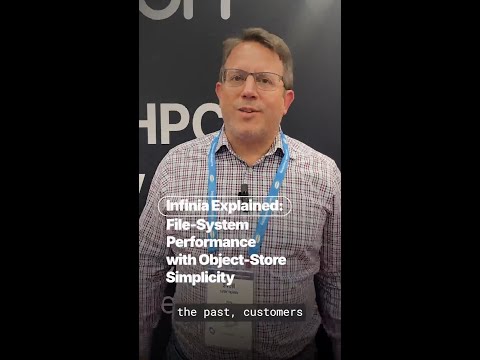
So in the past customers picked object store interfaces because of their simplicity and picked file systems interfaces primarily for their performance. What would you do if you have a technology that can give you the interactive performance of a file system but the simplicity of an object store. That is essentially what Infinia does. ...

What are Deep Agents?
LangChain· 2025-11-24 07:14
Hey, this is Lance. I want to talk a bit about the deep agents package that we recently released. Now, the length of tasks that an agent can take every seven months.And we see numerous examples of popular longrunning agents like Claude Code, Deep Research, Manis. The average Manis task, for example, can be up to 50 different tool calls. And so, it's increasingly clear that agents are needed to do what we might consider deeper work or more challenging tasks that take longer periods of time.Hence, this term d ...

How Agents Use Context Engineering
LangChain· 2025-11-12 16:36
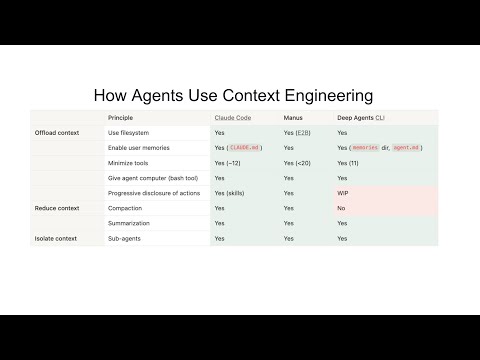
Context Engineering Principles for AI Agents - The industry recognizes the increasing task length AI agents can perform, with task length doubling approximately every seven months [2] - The industry faces challenges related to context rot, where performance degrades with longer context lengths, impacting cost and latency [3][4] - Context engineering, involving offloading, reducing, and isolating context, is crucial for managing context rot in AI agents [8][9][10] Context Offloading - Giving agents access to a file system is beneficial for saving and recalling information during long-running tasks and across different agent invocations [11][15][18] - Offloading actions from tools to scripts in a file system expands the agent's action space while minimizing the number of tools and instructions [19][22] - Progressive disclosure of actions, such as with Claude skills, saves tokens by selectively loading skill information only when needed [26][30] Context Reduction - Compaction, summarization, and filtering are techniques used to reduce context size and prevent excessively large tool results from being passed to the language model [32][33][39] - Manis compacts old tool results by saving them to a file and referencing the file in the message history [34] - Deep agents package applies summarization after a threshold of 170,000 tokens [38] Context Isolation - Context isolation, using separate context windows or sub-agents for individual tasks, helps manage context and improve performance [10][39][40] - Sub-agents can have shared context with the parent agent, such as access to the same file system [42] Tool Usage - Agent harnesses often employ a minimal number of general, atomic tools to save tokens and minimize decision-making complexity [44] - Cloud code uses around a dozen tools, Manis uses less than 20, and the deep agent CLI uses 11 [24][25][44]
What are Deep Agents?
LangChain· 2025-07-31 18:29
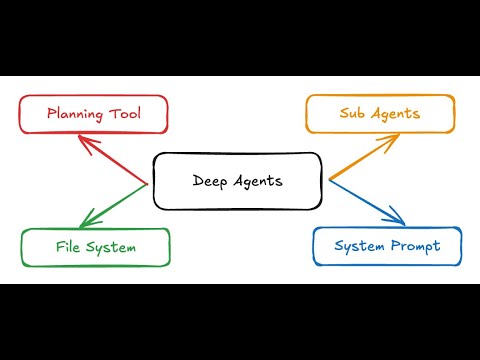
Deep Agent Characteristics - Deep agents utilize a planning tool to manage long-term tasks, enabling cohesive action over extended periods [3][5][9] - Sub-agents are employed to focus on specific areas, preserving context and allowing for specialized expertise, which can improve overall results [3][10][11][12][13][15] - A file system is used to offload context, preventing performance degradation of the LLM by storing and accessing information as needed [3][16][17][18] - Detailed system prompts, often hundreds or thousands of lines long, are crucial for guiding the agent's behavior and tool usage [3][21][22][23] Deep Agent Implementation - Deep agents operate using the same tool-calling loop as simpler agents, but are distinguished by their prompts and tools [3][4][5] - Planning tools can be simple, such as a "to-do write" tool that generates and modifies task lists within the model's context [7][8] - Sub-agents can have specialized expertise and different permissions, allowing for focused work and better results [13][14] - File systems allow agents to manage context by referencing files instead of directly including large observations in the LLM context [17][18] Deep Agent Benefits - Deep agents are capable of handling longer time horizon and more complex tasks compared to naive LLM implementations [4][5] - Sub-agents facilitate context preservation, preventing the main agent's context from being polluted by sub-tasks and vice versa [11][12] - Reusable sub-agents can be created and used across different agents, promoting efficiency and modularity [14]