Floating Rate Funds

Search documents
首批浮动费率基金业绩分化悬殊:华商致远回报A涨59%领跑,广发价值稳进A跌8%垫底,安信、银华旗下产品落后
Xin Lang Cai Jing· 2025-12-17 07:59
Core Insights - The first batch of floating fee rate funds has shown significant performance differentiation, highlighting the varying capabilities of fund managers in terms of positioning, sector allocation, and market judgment [1][9] Performance Overview - As of December 16, 2025, out of 26 funds, 19 achieved positive returns while 7 reported negative returns. The top performer, Huashang Zhiyuan Return A, delivered a remarkable return of 58.90%, followed by Xin'ao Advantage Industry A at 36.86% and E Fund Growth Progress A at 34.98% [2][10] - Other notable performers include Jiashi Growth Win A and Invesco Great Wall Growth, both exceeding 23% returns. Conversely, funds like Guangfa Value Steady A and Yinhua Growth Smart A reported negative returns of -8.32% and -3.35%, respectively [2][10] - The overall distribution of fund returns is characterized by a "middle large, both ends small" pattern, with most funds yielding between -0.1% and 7% [2][10] Fund Size and Performance Relationship - Notably, high-performing funds are not exclusively large. Huashang Zhiyuan Return A, with a size of 2.838 billion yuan, is the largest, while Jiashi Growth Win A, with a size of 406 million yuan, achieved a return of 32.88%, demonstrating the agility of smaller funds in volatile markets [2][10] Investment Strategies - Top-performing funds tend to focus on high-growth sectors. For instance, Huashang Zhiyuan Return A has concentrated holdings in AI computing-related stocks, with significant contributions from stocks like Zhongji Xuchuang and Shijia Photon, which saw increases of 45.39% and 40.17% over the past three months [3][11] - Xin'ao Advantage Industry A has a high concentration in semiconductor storage, with key stocks like Demingli and Jiangbolong rising by 55.43% and 119.02%, respectively. However, this strategy also led to volatility, as some holdings experienced declines of 13% to 21% [5][13] - E Fund Growth Progress A adopts a more balanced approach, diversifying across sectors such as optical communication and consumer electronics, successfully capturing gains from leading stocks [6][15] Underperforming Funds - Underperforming funds often remain focused on traditional industries or deviate from market trends. Guangfa Value Steady A has a significant allocation to liquor stocks, which have generally declined over 10% in the past three months, contrasting sharply with the strong performance of technology sectors [7][16] - Yinhua Growth Smart A is heavily invested in the real estate sector and certain pharmaceutical stocks, with some holdings experiencing declines as steep as 44.58%, indicating a lack of timely adjustments to market shifts [8][17] Conclusion - The short-term performance of the first batch of floating fee rate funds reflects a collision of different investment strategies and market styles in 2025. Funds aligned with the technology growth narrative performed strongly, while those focused on traditional value or balanced strategies lagged behind [9][17]


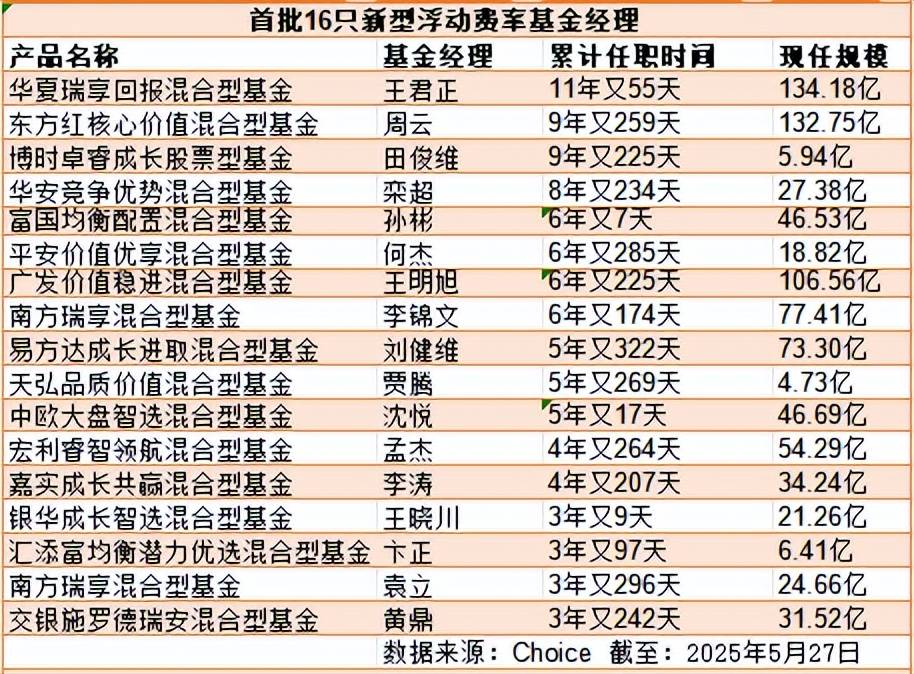
首发16只浮动费率基金经理画像:中生代为主体,10位任职5-10年
Sou Hu Cai Jing· 2025-05-28 12:15
Core Viewpoint - The first batch of 16 new floating rate funds has been launched, with significant expectations from the management for these innovative products [2][5]. Group 1: Fund Manager Selection - The fund managers for these new funds are primarily mid-career professionals, with 10 out of 17 having 5-10 years of experience [2][3]. - There is a notable absence of previously popular star managers or those heavily invested in trending stocks, indicating a focus on experienced managers [2][3]. Group 2: Fund Manager Performance - Among the 17 fund managers, 5 have achieved an annualized return exceeding 10%, while only 1 has a negative performance [5][6]. - The overall performance of these fund managers has outperformed the annualized return of the CSI 300 index, with specific returns of 13.33% for Wang Mingxu from GF Fund and 13.04% for Wang Junzheng from Huaxia Fund [6][7]. Group 3: Fund Management Scale - The current management scale of these fund managers varies, with 3 managing over 10 billion yuan, while 4 manage less than 1 billion yuan [4][6]. - The majority of fund managers have a management scale between 2 billion and 10 billion yuan, indicating a balanced distribution [4]. Group 4: Investment Style - The fund managers exhibit diverse investment styles, with 10 favoring value investing and 7 specializing in growth stocks [9][11]. - Different fund companies offer various styles, allowing investors to choose funds that align with their investment preferences [12].