Fund flows

Search documents
策略观点 - 中东战争进一步打压投资者情绪并驱动资金轮动-GOAL Positioning_ Middle East war weighs further on investor sentiment and drives rotations
2026-03-26 13:20
Summary of Key Points from the Conference Call Industry Overview - The ongoing Middle East war is negatively impacting investor sentiment and driving asset rotations across various sectors, particularly in loans and global financial equities, which have experienced significant outflows in recent weeks [4][15]. Core Insights and Arguments - **Investor Sentiment**: The sentiment and positioning indicator has decreased to neutral levels, currently at the 48th percentile, indicating a decline in risk appetite due to concerns about the growth/inflation mix stemming from geopolitical tensions [4][6]. - **Equity and Credit Markets**: Active managers' exposure to US equities has sharply decreased, while hedge fund net leverage has declined, suggesting a broader de-risking trend among investors [4][7]. Despite this, flows into equities have not turned negative, as some investors continue to "buy the dip" in regions like Europe and Japan [4]. - **Sector Performance**: Energy equities have seen inflows reaching multi-year highs, driven by rising crude prices. Other sectors such as Industrials, Utilities, and Infrastructure are also experiencing positive inflows [4][13]. - **Safe Haven Assets**: Investors are rotating into safe havens, with inflation-linked bonds seeing positive inflows due to anticipated inflation impacts from energy prices. In contrast, Gold ETFs have faced large outflows as gold prices are affected by rate shocks [4][16]. - **Market Volatility**: Credit and equity volatility remains high, with risky asset skew above the 80th percentile, indicating ongoing uncertainty in the market [4][6]. Additional Important Insights - **Hedge Fund Positioning**: The reset in call positioning has been sharp across equity indices, with a notable increase in S&P 500 skew at both single stock and index levels [4][11]. - **UK Bonds**: UK long-dated Gilts have experienced one of the largest outflows on record, attributed to rising breakevens and a hawkish stance from the Bank of England [4][9]. - **Investor Surveys**: Surveys indicate a decline in optimism among investors, with the RAI (Risk Appetite Indicator) close to zero, reflecting a cautious outlook [4][6][140]. This summary encapsulates the critical insights and trends discussed in the conference call, highlighting the impact of geopolitical events on market dynamics and investor behavior.
2025年底之际的完整资⾦流向、技术⾯与持仓市场总结-The_Complete_Flows,_Technicals_&_Positioning_Market_Summary_As_We
2025-12-10 02:49
Market Summary Key Points Industry Overview - The summary discusses the overall market performance as of December 2025, highlighting trends in various sectors and investor sentiment. Core Insights and Arguments - December has historically been a mixed month for the S&P 500, ranking as the second worst month of the year in terms of performance, only better than September [1][2] - The S&P 500 index is currently just 20 points away from its record close, with a shift in market consensus regarding interest rate cuts from unlikely to a 100% probability within three weeks [11][12] - Hedge funds have shown increased gross leverage, rising 1.5% to 286.6%, indicating a bullish sentiment in the market [13] - Global equities have seen net buying for the seventh consecutive week, with long buys outpacing short sales at a ratio of 1.3 to 1 [14] - Major sectors experiencing net buying include Financials, Health Care, and Communication Services, while Consumer Discretionary, Staples, and Utilities saw the most net selling [15] Important but Overlooked Content - A notable rotation occurred from defensive sectors (Utilities down 4.83%, REITs down 2.58%, Health Care down 1.69%) to cyclical sectors, with cyclical stocks outperforming defensives by 5.01% [7][8] - The sentiment among retail investors has turned bullish, with the AAII sentiment survey showing a significant increase in bullish sentiment to 44.3% [37] - The CNN Fear & Greed Index has risen to 40/100, indicating a shift towards fear, the highest level since late October [42][43] - Corporates are actively engaging in buyback programs, with a significant increase in trading volumes compared to previous years, particularly in Q4 as companies aim to meet year-end buyback goals [35] Summary of Fund Flows - Global equity funds experienced subdued net flows of +$8 billion, down from +$18 billion the previous week, indicating a slowdown in investment activity [21][22] - Inflows into technology funds have turned negative, contrasting with strong inflows into South Korea and Taiwan [22] Conclusion - The market is currently experiencing a complex interplay of investor sentiment, sector rotation, and corporate actions, with significant implications for future performance as 2025 comes to a close.
基金经理观察_资金流动悖论
2025-08-31 16:21
Summary of J.P. Morgan Fund Manager Radar - The Flow Paradox Industry Overview - The report focuses on the Australian equity market, highlighting the paradox of rising equity prices despite ongoing earnings per share (EPS) downgrades and cautious management guidance [6][6]. Key Points Market Dynamics - **Market Ascent Driven by Flows**: The Australian equity market continues to rise due to strong inflows from passive, active, and buyback activities, which are overwhelming the negative impact of fundamental factors [6][6]. - **EPS Downgrades**: Despite the market's rise, the earnings backdrop is described as mid-single digit at best, indicating a disconnect between market performance and underlying fundamentals [6][6]. Fund Flows - **Robust Inflows**: Australia is leading globally in terms of net inflows, with three months of positive active inflows in the year-to-date (YTD), contrasting with only one positive month in the previous two years [6][6][19]. - **Corporate Buybacks**: Approximately one-third of companies in Australia are engaging in buyback programs, with major players like CBA, CSL, and TLS collectively buying back around AUD 3 billion [6][6]. Sector Positioning - **Sector Movements**: In July, sector movements were muted, typical for the month leading into the full-year results season. Financials saw the largest inflow, while Materials and Communications experienced funding reductions [6][6]. - **Love Index**: ORI, BSL, and SGH emerged as the most loved stocks, while JBH, JHX, and ORG dropped out of the loved category [38][43]. Performance Metrics - **Relative Performance**: The report includes a table of stock performance relative to the ASX200, with notable positive movers like ORI (7.3% in July) and negative movers like MQG (-7.3% in July) [1][1]. - **Sector Allocation**: As of July 2025, the largest overweight positions were in Tech, Communications, and Healthcare, while Financials and REITs remained underweight [7][7]. Additional Insights - **Short Interest Trends**: The report notes significant changes in days-to-cover for various stocks, indicating long buying and short covering activities, particularly for stocks like STO and RMD [44][44]. - **Market Sentiment**: The Love Index reflects market sentiment, with upward momentum for several stocks, indicating a shift in investor preferences [38][38]. Conclusion - The Australian equity market is experiencing a paradoxical rise driven by strong fund inflows and corporate buybacks, despite a backdrop of EPS downgrades and cautious outlooks. The sector positioning and Love Index provide insights into investor sentiment and potential future movements in the market.
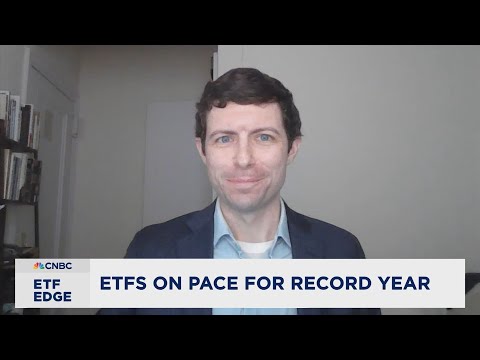
Why 2025 is on pace to be another record year for ETF inflows
CNBC Television· 2025-08-12 02:26
ETF Market Trends - ETFs are on pace for a record year, with over $700 billion flowing in YTD, including $120 billion in July alone [1] - The industry is projected to reach $12 trillion to $13 trillion in inflows, surpassing last year's $11 trillion record [2] - Equity ETFs have received $360 billion, while fixed income ETFs have seen $230 billion in inflows [2] - The fourth quarter is historically the strongest for ETF inflows, suggesting potential acceleration [2] - ETFs now offer exposure to various strategies, including active management, crypto, hedge fund strategies, and option strategies [2] AI and IPOs - AI is considered a significant innovation area, attracting substantial investment [5] - Companies are integrating AI into their solutions across the tech stack [6] - Companies are refining their AI narrative in preparation for IPOs, addressing investor inquiries about AI integration and potential disruption [7][8]