Green Apron service model

Search documents
As we continue to make progress, the stock will take care of itself, says Starbucks CEO Brain Niccol
Youtube· 2025-10-15 23:48
Core Insights - Starbucks is undergoing a significant turnaround under CEO Brian Nickel, focusing on enhancing customer experience and operational efficiency, despite ongoing stock struggles [1][24] - The China business is projected to exceed $10 million in value, including potential partnerships and future royalties [1] - The introduction of the Green Apron service model aims to improve customer service by increasing staff presence and focusing on personal connections [1][12] Business Performance - Starbucks has closed 1% of its stores, primarily those underperforming financially or failing to provide a satisfactory customer experience [3][5] - The company has experienced transaction and comparable sales growth in China, indicating a recovery in that market [12][14] - The operational focus has shifted from efficiency to enhancing customer service and store experience, addressing previous missteps that led to declining sales [8][10] Employee Engagement - Starbucks aims to provide the best retail jobs, with a turnover rate below 50%, which is significantly lower than industry averages [20][21] - The company has invested over $500 million into stores and employee development, including programs for personal growth and education [21][22] - Partner engagement scores are at all-time highs, reflecting positive employee sentiment and commitment to the company's vision [21] Future Outlook - The company is optimistic about its turnaround strategy, believing that improved customer and partner experiences will lead to better financial performance and stock recovery [24][23] - Starbucks is committed to enhancing the customer experience across all locations, including licensed stores, to ensure consistency in service quality [15][16]

As we continue to make progress, the stock will take care of itself, says Starbucks CEO Brain Niccol
CNBC Television· 2025-10-15 23:48
Business Performance & Strategy - Starbucks expects its China business to be worth over $10 million, including upfront investment and future royalties [1] - The company closed 1% of its stores, focusing on underperforming locations or those not suitable for a coffee house experience [3][4] - Starbucks aims to improve the experience in licensed stores, including those in airports and Targets [15][16] - Starbucks' turnover is now lower than 50%, indicating positive changes in employee satisfaction [20] Operational Improvements - Starbucks is implementing a "Green Apron service model" to improve customer service by deploying more partners in stores and focusing on customer connection [1][2] - The company is uplifting stores to return them to a coffee house atmosphere, emphasizing the "third place" concept [1] - Starbucks is using "smart Q" technology to sequence orders for drive-thru, counter, and mobile order pickup [1] - The company is reinvesting over $500 million into stores and partners [21] Challenges & Recovery - Starbucks had previously focused too much on efficiency, leading to reduced labor and a decline in the coffee house experience [8][9] - Pricing and labor issues contributed to a deterioration in business performance, which the company is now correcting [9][10]

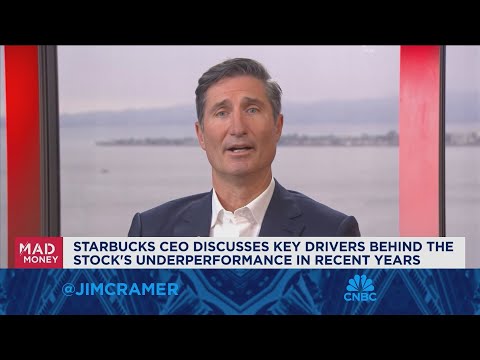
Starbucks CEO Brian Niccol: We want to build back a better Starbucks
CNBC Television· 2025-07-30 13:46
Green Apron Service Model - The Green Apron service model aims to improve customer service and partner engagement, leading to increased business and brand esteem [2][3][4][15] - The model focuses on optimizing staffing levels during peak hours, including dedicated drive-thru personnel and "play callers" for mobile orders [5][6] - Technology like the "smart queue" is being implemented to ensure cafe orders are delivered in under 4 minutes and drive-thru orders are also under 4 minutes [7] China Market - The company has learned to compete more effectively in the Chinese market with innovation, culturally relevant marketing, and smart pricing strategies [9][10] - Despite competition, the company sees an opportunity for tens of thousands more stores in China, with comps up 2% driven by 6 points of transaction growth in the most recent quarter [12][13] - The company aims to continue growing the coffee category in China, balancing mobile order, drive-thru, and cafe experiences [14] Financial Goals - The company aims to return to a total company operating margin of roughly 17% [15][16] - The strategy involves investing in growth opportunities and improving the cost structure to build a better Starbucks financially, for customers, and for partners [17][18]