Healthcare Reform

Search documents
UNH vs. MOH: Which Insurer Can Better Navigate Current Volatility?
ZACKS· 2026-01-20 15:46
Core Insights - UnitedHealth Group Incorporated (UNH) and Molina Healthcare, Inc. (MOH) operate in a highly regulated U.S. health insurance market, but their business models and exposure to policy risks differ significantly [1][2] - Investors are reassessing which insurers can better handle regulatory changes and cost pressures amid renewed volatility in healthcare stocks [1][3] Group 1: UnitedHealth Overview - UnitedHealth has unmatched scale and diversification across insurance and healthcare services, providing earnings stability that few peers can replicate [4] - The company reported steady revenue growth in its last quarter, driven by higher domestic commercial membership and expansion at Optum Rx, despite facing margin pressure from increased utilization [5] - UnitedHealth consistently generates strong operating cash flow and maintains disciplined capital deployment, allowing it to absorb short-term reimbursement changes without significantly disrupting long-term earnings [6] - The company faces challenges from heightened regulatory scrutiny and potential compliance costs under the proposed Great Healthcare Plan, but its scale and operational depth position it well to absorb impacts [7] Group 2: Molina Healthcare Overview - Molina Healthcare has a strong focus on Medicaid-managed care, benefiting from steady enrollment growth and relationships with state governments, but its narrow focus increases vulnerability to reimbursement changes [8][9] - The latest quarterly results showed stable revenue growth driven by rising premiums and membership gains, but Molina's EBITDA margin of 3.7% is lower than UnitedHealth's 7.3% [10] - Molina's earnings profile is more sensitive to utilization spikes and regulatory shifts, with a worsening medical care ratio (MCR) from 88.1% in 2023 to 89.1% in 2024 [11][12] Group 3: Valuation and Performance Comparison - UnitedHealth's forward price-to-earnings (P/E) ratio of 18.64X reflects its earnings durability, compared to Molina's 13.92X [13] - UnitedHealth's consensus estimate for 2025 EPS is $16.30, indicating a 41.1% year-over-year decline, while Molina's is $13.95, a 38.4% decrease [15][16] - Over the past six months, UnitedHealth shares gained 17.3%, outperforming Molina's 8.4% growth, indicating investor preference for stability [17] Conclusion - UnitedHealth is positioned as the more resilient choice in a volatile healthcare environment due to its scale, diversified model, stronger profitability, and healthier balance sheet [20] - Molina's narrower business mix makes it more vulnerable to policy shifts and utilization swings, leading to less earnings visibility [20][21]



Trump Unveils 'Great Healthcare Plan,' Takes Aim At PBM 'Kickbacks' - CVS Health (NYSE:CVS)
Benzinga· 2026-01-16 07:30
Core Insights - The article discusses President Trump's unveiling of "The Great Healthcare Plan," which aims to reform the medical pricing structure by targeting kickbacks from pharmacy benefit managers (PBMs) [1][2]. Group 1: Healthcare Plan Overview - The plan seeks to reduce drug prices and insurance premiums by eliminating kickbacks paid by PBMs to large brokerage middlemen, which are seen as predatory fees that inflate costs for patients [2]. - The White House claims that these kickbacks "deceptively raise the cost of health insurance" and intends to redirect subsidies from large insurance companies to eligible Americans directly [2][3]. Group 2: Expert Validation - Independent analysis supports the administration's view on the PBM issue, with experts describing the PBM model as a "pay for play" system that prioritizes rebates over patient efficacy [4]. - Experts suggest that drug manufacturers would price their products significantly lower—up to five times less—if PBMs were removed from the pricing equation [5]. Group 3: Transparency and Accountability - The plan includes a "Plain-English Insurance" standard, requiring insurers to provide clear rate and coverage comparisons without complex jargon, addressing concerns about undefined terms that facilitate claim denials [6]. - The administration's push for "unprecedented accountability" indicates a potential confrontation with the healthcare lobby [6]. Group 4: Investment Opportunities - A list of top PBM operators and pharmaceutical ETFs is provided for investors considering opportunities in light of the ongoing healthcare reform discussions [7]. - Performance data for various stocks and ETFs is included, showing year-to-date and one-year performance metrics for companies like CVS Health Corp., Cigna Group, and UnitedHealth Group, as well as several pharmaceutical ETFs [8][9].

Mark Cuban on the $38 trillion national debt and the absurdity of U.S. healthcare: we wouldn’t pay for potato chips like this
Yahoo Finance· 2026-01-06 16:48
Core Insights - Cost Plus Drugs can significantly reduce the price of certain generic medications from thousands of dollars to double-digit amounts, particularly benefiting uninsured patients or those with high deductibles [1] - The company operates by selling medications at manufacturing cost plus a flat 15% markup, eliminating traditional pharmacy benefit managers (PBMs) and providing transparency in pricing [2] - Mark Cuban advocates for dismantling opaque middlemen in healthcare to improve market efficiency and reduce fiscal strain on the national budget [4] Company Overview - Cost Plus Drugs sells medications directly to consumers, bypassing PBMs, which have been criticized for their role in inflating drug prices [5] - The company publishes acquisition costs and pricing formulas, allowing customers to understand how prices are determined [2] Industry Context - The national debt of the United States has surpassed $38 trillion, with annual interest payments around $1 trillion, raising concerns about fiscal sustainability [3] - The FTC has investigated PBMs for excessive markups, with a report indicating that they marked up drugs by $7.3 billion beyond acquisition costs [5] - Health insurance costs are a major concern for voters, with a significant portion prioritizing lower healthcare costs in upcoming elections [9] Proposed Solutions - Cuban's proposal includes imposing fines on insurers that over-bill or deny care, aiming to promote transparency and efficiency in healthcare pricing [4] - He suggests that if brand medications were sold at net pricing, it could save patients tens of billions annually [6] Challenges and Criticism - Experts caution that while Cost Plus Drugs exemplifies a model for reducing prices, it may not address the broader structural issues contributing to the national debt [10] - The criticism of PBMs has led to ongoing legal challenges, highlighting the contentious nature of the healthcare pricing landscape [7]
海南省卫生健康委党委书记、主任李文秀:以健康为中心 加快建成高水平国际健康岛
Hai Nan Ri Bao· 2025-12-30 01:38
Core Viewpoint - The Hainan Provincial Health Commission is focused on enhancing health standards in line with national policies, aiming to establish a high-level international health island by 2030, with significant improvements in life expectancy and health service accessibility [1][3]. Group 1: Health Improvements - Hainan's average life expectancy increased from 79 years in 2020 to 80.5 years in 2024, with a target of around 81 years by 2025, positioning it among the top provinces in China [1]. - Maternal mortality rate, infant mortality rate, and under-five mortality rate have significantly decreased, with figures dropping to 7.31 per 100,000, 2.95‰, and 3.98‰ respectively [1]. Group 2: Medical Resource Distribution - The province has implemented a plan for the gradual distribution of quality medical resources, with 689 medical professionals sent to assist 16 cities and counties, achieving full coverage in support [2]. - Six medical groups in Haikou, Sanya, and Danzhou have stationed 292 medical staff in 75 grassroots clinics, enhancing local healthcare services [2]. Group 3: Future Goals and Strategies - By 2030, Hainan aims for an average life expectancy exceeding 82 years and a health literacy rate of 40% among residents, while controlling maternal and child mortality rates within specified limits [3]. - The province plans to establish a health priority development system tailored to the characteristics of the Hainan Free Trade Port, including health impact assessments and health-focused legislation [3]. Group 4: Public Health Infrastructure - A public health risk prevention system for major infectious diseases is being developed, alongside a medical emergency response system to address public health events [4]. - The province is optimizing the layout of medical institutions and implementing a strong foundation project for healthcare, focusing on key diseases and specialties to reduce the need for out-of-province medical services [4]. Group 5: International Collaboration and Medical Tourism - Hainan is set to create a high-level international specialized medical cluster, promoting health consumption and medical tourism, with a focus on health management and high-end medical services [5]. - The province aims to attract top-tier public hospitals and establish a new collaborative model for medical services that connects local and international healthcare systems [5].
更暖,更新,笃定前行
Xin Lang Cai Jing· 2025-12-30 00:29
Group 1 - The year 2025 is characterized by rapid changes, particularly in the field of artificial intelligence, which is reshaping various sectors including education and healthcare [1] - Breakthroughs in generative AI are accelerating educational processes, shifting the focus from knowledge transmission to capability cultivation, thereby enhancing students' creativity and problem-solving skills [1] - The integration of general AI models and vertical medical AI is ushering in a new era of intelligent healthcare, exemplified by the "Yueyi Huizhen" intelligent clinical decision support system in Guangdong [1] Group 2 - Educational reforms are promoting balanced development and addressing issues like "key classes" and homework optimization, reflecting a commitment to nurturing students' well-being [1] - The healthcare reform aims to alleviate anxiety for ordinary people regarding medical care, childbirth, and retirement, providing a sense of security through incremental policy changes [2] - The introduction of new AI-related academic programs in universities and the establishment of technology transfer centers signify a push towards innovation and alignment with national strategic needs [2] Group 3 - The transformation in education and healthcare emphasizes placing "people" at the center, moving away from anxiety-driven pursuits towards deeper engagement [3] - The anticipation for higher quality development in the coming year reflects a commitment to adapt and thrive in a rapidly changing environment [3]
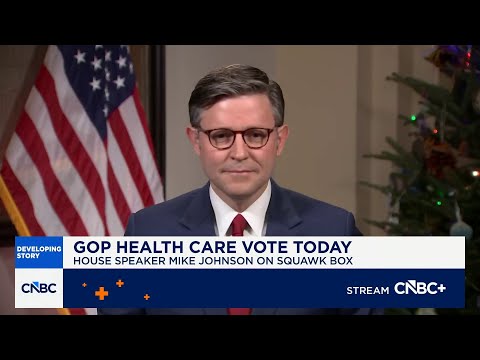
House Speaker Mike Johnson on upcoming GOP health care vote
CNBC Television· 2025-12-17 13:46
Healthcare Policy Debate - The debate centers on extending COVID-era enhanced subsidies (premium tax credits), with Republicans expressing concerns about subsidizing insurance companies and masking the rising costs of healthcare [2][3] - Democrats are portrayed as falsely claiming the subsidy affects everyone, when it impacts 7% of Americans, and even with extension, would only reduce premiums for this group by 5.7% [4] - Republicans aim to address healthcare costs for 100% of Americans, not just the 7% affected by the subsidies, through measures like the Lower Premiums for All Americans Act [6] Republican Healthcare Plan - The Lower Premiums for All Americans Act includes cost-sharing reduction programs, projected to reduce premiums across the board by at least 11% and save taxpayers billions of dollars [8] - The plan incorporates health association health plans to provide more flexibility to small businesses and insured individuals [8] - The Republican plan also includes PBM (Pharmacy Benefit Manager) transparency and choice accounts to give consumers more choices and lower costs, while increasing access to care [9][10] Political Positioning - Republicans claim Democrats created the healthcare problem with the Affordable Care Act (Obamacare) and are now trying to blame Republicans for healthcare costs [10][17] - Republicans position themselves as the party with ideas to fix healthcare, promising to reform the system and address the root causes of rising premiums [10][15] - The speaker acknowledges internal disagreements within the Republican party regarding healthcare policy, particularly concerning the impact on specific districts [5][6]
Fed REVEALS decision on rates as Trump hits the road on economy tour | Recap
Youtube· 2025-12-13 13:01
分组1 - The Biden administration's Department of Justice allegedly attempted to bribe Democratic representative Henry Quayar, who claims there was no evidence of a quid pro quo [1] - Quayar has been vocal about the issues related to the open border under Biden's leadership, which he believes has led to increased crime and safety concerns in his district [1] - The political landscape in Quayar's district is shifting, with Republicans aiming to gain ground, especially after Trump's recent pardon announcement [1] 分组2 - Senate Majority Leader John Thun criticized the Democrats' healthcare plan, suggesting it prioritizes political issues over genuine healthcare reform, as Obamacare subsidies are set to expire [2] - The House is expected to introduce a healthcare plan that may include income limits and anti-fraud measures, as Republicans seek to address healthcare affordability [2] - The conversation around extending Obamacare subsidies is complicated, with concerns about the impact on premiums and the need for a new open enrollment period [2] 分组3 - The SBA Fraud Enforcement Extension Act aims to extend the statute of limitations for COVID loan fraud investigations by an additional five years, addressing an estimated $200 billion in fraud [3] - There is a call for stronger federal safeguards to prevent fraud in state-administered federal programs, highlighting the need for accountability in the use of federal funds [3] - The focus on fraud, waste, and abuse is a priority for Republicans, who are advocating for better tracking and management of federal funds [3] 分组4 - The Federal Reserve is under scrutiny for perceived partisanship, with calls for it to return to a nonpartisan focus on monetary policy and bank regulation [4][5] - Concerns have been raised about the Fed's handling of interest rates and its communication strategies, particularly in relation to political events [4][5] - The Fed's effectiveness in forecasting economic conditions and managing inflation is being questioned, with suggestions for a reevaluation of its research priorities and personnel [4][5] 分组5 - The conversation around AI and job displacement is ongoing, with industry leaders suggesting that while AI may create efficiencies, it will not lead to massive job losses in the immediate future [38][39] - Companies are investing heavily in AI technologies, with expectations of significant returns on investment as efficiencies improve across various sectors [38][39] - The importance of critical thinking and skill development is emphasized as a way for workers to adapt to changes brought about by AI [38][39]

Warren Buffett Bought UnitedHealth Stock. Should You Do the Same?
The Motley Fool· 2025-08-20 08:05
Core Insights - Berkshire Hathaway has acquired 5 million shares of UnitedHealth Group, which has positively impacted the stock price despite a challenging year for the company [1][5][6] - UnitedHealth's stock is down 40% year-to-date, but Berkshire's investment may attract other investors [2][10] - The investment aligns with Warren Buffett's strategy of seeking predictable, long-term investments, especially during market sell-offs [4][12] Company Performance - UnitedHealth has faced significant challenges, including a leadership change and scrutiny from the Department of Justice regarding its billing practices [7][8] - The company has reported earnings below analyst expectations due to rising expenses [7][10] - Despite these issues, UnitedHealth maintains a profit margin of over 5% and currently offers a dividend yield of around 3%, which is atypical for the stock [9][12] Investment Considerations - Berkshire's investment may signal confidence in UnitedHealth, but the company still faces uncertainty and may not see a quick turnaround [6][10] - The stock is trading at a low price-to-earnings ratio of 13, indicating potential value for long-term investors [9][12] - Investors are advised to conduct their own analysis rather than solely following Buffett's investment decisions [11][13]

UnitedHealth's Dividend Yield Has Never Been This High. Should You Buy the Stock?
The Motley Fool· 2025-08-15 08:25
Core Viewpoint - UnitedHealth Group's stock has significantly declined this year, leading to an increase in its dividend yield, which may present an opportunity for dividend investors [1][2][4]. Group 1: Stock Performance and Yield - UnitedHealth's stock yield has risen to approximately 3.5%, nearly three times the S&P 500 average of 1.2%, which is atypical for the company [2]. - Historically, UnitedHealth's yield has been below 2%, making the current yield more attractive for potential investors [2]. - The stock has lost about 50% of its value this year due to concerns over growth prospects amid healthcare reform and rising costs [4]. Group 2: Financial Performance - In the most recent quarter ending June 30, UnitedHealth's sales increased by 13% year over year to $111.6 billion, slightly exceeding analyst expectations of $111.5 billion [6]. - However, adjusted earnings per share were reported at $4.08, falling short of Wall Street's projections of $4.48 [6]. Group 3: Management Changes and Market Sentiment - The company underwent a CEO change this year, with Andrew Witty resigning and Stephen Hemsley returning as CEO, which may influence investor sentiment positively or negatively [7]. - UnitedHealth's stock is currently trading at a steep discount, with a price-to-earnings ratio of less than 11, compared to the S&P 500 average of around 25 [8]. - Despite the challenges, the market may have overreacted to negative press, suggesting that the stock could be a good buy for long-term investors willing to be patient [10].