Hero User

Search documents
AI时代的SaaS,出路在哪里?
Hu Xiu· 2025-07-31 06:51
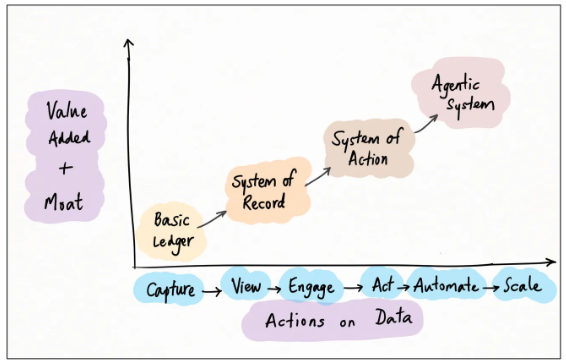
Core Concept - The software industry is undergoing a significant paradigm shift from "System of Record" to "System of Action," where software not only manages business processes but actively executes them [1][3][29]. Group 1: Transition from System of Record to System of Action - The concept of "System of Action" represents the next evolution of "System of Record," enabling humans, AI-assisted humans, and fully autonomous AI agents to take action on data and trigger downstream workflows [3][5]. - Traditional software focused on recording and managing tasks, while "System of Action" allows for proactive decision-making and execution based on data [3][5][29]. - The rise of generative AI is facilitating this shift, allowing software to directly execute complex tasks that previously required human judgment [5][6]. Group 2: Emergence of Hero Users and Power Shift - The emergence of "Hero Users," defined as influential users with the power to make purchasing decisions, is reshaping software procurement from a top-down to a bottom-up approach [7][8]. - Hero Users prioritize tools that enhance their efficiency, leading to a decentralization of purchasing power within organizations [7][8]. - Companies that can effectively engage Hero Users gain a competitive advantage in becoming the "System of Action" [9]. Group 3: Case Study of Veterinary Practice Management Software - The traditional veterinary practice management system (PMS) has been a strong control point, but the introduction of AI transcription tools is disrupting this market by addressing user pain points [10][11]. - AI tools that simplify documentation for veterinarians have gained rapid adoption due to their user-friendly experience, highlighting the importance of user experience over technical complexity [11][14]. - Existing software companies often hesitate to adapt quickly, allowing agile AI startups to capture market share by meeting immediate user needs [13][14]. Group 4: Strategies for Native AI Companies - Native AI companies should focus on markets with slow-moving incumbents, as these present significant opportunities for disruption [19][20]. - Understanding the work of Hero Users and automating administrative tasks can create substantial value [21][22]. - Providing a magical user experience, even if the underlying technology is not groundbreaking, is crucial for success [22][23]. Group 5: Economic Restructuring of Software Models - The transition to "System of Action" will redefine software economics, moving from subscription-based models to outcome-based pricing [29][30]. - Companies that can directly create business value will shift their relationships with clients from vendor-buyer to partnership [30][31]. - Investment and valuation metrics will also evolve, focusing more on the actual business value created for clients rather than traditional revenue metrics [31][32]. Group 6: Future of AI Agent Workflows - The evolution of workflows will progress from human action to human + AI agent collaboration, eventually leading to fully autonomous AI agents [33][35]. - This shift will necessitate changes in organizational structures, emphasizing strategic roles over traditional hierarchical models [36][54]. - The concept of work will be redefined, with human roles focusing on creativity and strategic decision-making as AI handles routine tasks [37]. Group 7: Industry Verticalization Opportunities - The concept of "System of Action" offers insights into industry verticalization, emphasizing the need for AI agents to understand specific industry practices and regulations [42][43]. - Specialized AI companies that deeply understand industry pain points will have a competitive edge over generalist tech firms [44][46]. Group 8: Regulatory and Ethical Challenges - The rise of AI agents executing business decisions raises complex issues regarding accountability, decision transparency, and data privacy [47][48]. - Companies that proactively establish industry standards and best practices will have opportunities to shape the regulatory landscape [49][50]. Group 9: Talent and Organizational Change - The emergence of "System of Action" will drive the need for new talent that can bridge business processes and AI collaboration [52][56]. - Organizations will need to foster a culture of openness and experimentation to adapt to the integration of AI agents [55][56]. Group 10: Insights for Entrepreneurs and Investors - Entrepreneurs should target industries with strong Hero Users but outdated technology, focusing on solving real user pain points [57][58]. - Investors need to evaluate companies based on their understanding of target industries and their connection with Hero Users [60][61].